The Brattle Theater celebrates the movie’s anniversary with special screenings on July 21-23.
By Bob Tremblay/For Boston Movie News
Fifty years ago, a film about criminals won seven Oscars, including Best Picture. A hit with the public, it earned $160 million at the box office. That film was “The Sting.” Another film about criminals also debuted that year, but it didn’t win any Oscars. In fact, it didn’t receive any Oscar nominations. It also didn’t sell many tickets as it failed to recoup its estimated $3 million budget in box-office returns. That film was “The Friends of Eddie Coyle.”
After its inauspicious debut, “Friends” became a hard film to find, either for home viewing or in the theater for a variety of reasons. The good news is that FOF (Friends of “Friends’) get a chance to see it on the big screen again as the Brattle Theatre in Cambridge is showing the movie July 21-23. Yes, “Friends” should be a treat for first-timers, too, especially if they have hankering for noir and Massachusetts locations.
While “The Departed,” “Mystic River,” “Gone Baby Gone” and “Good Will Hunting” may have higher profiles, they don’t have the Bay State bona fides of “Friends.”
Anyone who grew up in Boston or in such Massachusetts communities as Quincy, Sharon, Milton, Weymouth, Dedham, Malden and Cambridge will have a field day spotting familiar sites. Some just may look a little different. Natick, Fall River, Brookline, and the South End get mentioned, also. Prominent locations include Boston’s Government Center and the Wollaston section of Quincy where Eddie resides with his wife and children in a house on Fayette Street.
The old Boston Garden gets showcased, too, as Eddie attends a Bruins game against the Chicago Blackhawks. Yes, that’s Tony Esposito, brother of Phil, in goal for the Blackhawks. Eddie even gives a shout-out to a Bruins player of note, complete with the Boston accent: Number Faw, Bobby Aw.” That’s Bobby Orr to you out-of-staters.
But wait, there’s more. The now-departed Kentucky Tavern, at the corner of Newbury Street and Mass. Avenue provided the location for the film’s bar scenes, while the Dedham Plaza displays a huge sign for Barbo’s Furniture. Come on, readers, sing along with me, “Barbo’s, Barbo’s, the furniture you will live with happily ever after.” Then there’s the sign pictured during a scene at the Sharon train station that reads “Sharon – A better place to live because it’s naturally beautiful.”
Just don’t expect a lot of beauty in the locales. The film has no interest in serving as a tourist ad for the Bay State. While “The Sting: is glossy, “Friends” is gritty. Based on the 1970 debut novel by George V. Higgins, who prosecuted criminals as a U.S. attorney, the film knows its subject matter and wears its seaminess well. Directed by Peter Yates from a script by Paul Monash, “Friends” provides a bird’s-eye view of people committing crimes, people who want to commit crimes, and people who want to stop people from committing crimes. It all takes place in a working-class environment where drab is the most prominent color.
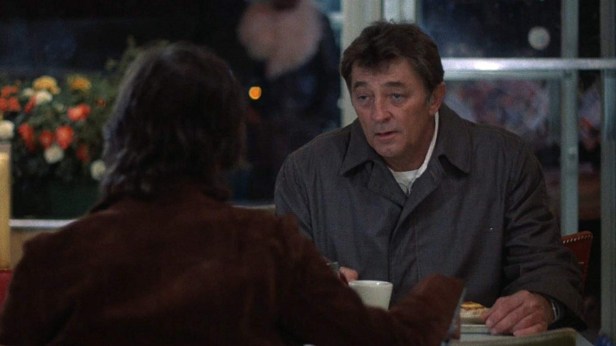
Robert Mitchum, so menacing in “Cape Fear” and “The Night of the Hunter,” plays against type here as the title character, a down-on-his-luck crook facing jail time for his part in a stolen goods scheme. Wearing a hangdog expression like an old suit, he tries to avoid incarceration by providing information to a federal agent. But Eddie’s not the only one feeding tips to the feds, and it won’t be long before you discover that the film’s title is seriously ironic as Eddie has no friends.
The film also benefits from a stellar supporting cast, including Alex Rocco, as bank robber Jimmy Scalise (he’ll later play Moe Greene in “The Godfather”), Peter Boyle as a barkeep, Richard Jordan as the federal agent, and Steven Keats as gun dealer Jackie Brown. Any relation to this film’s Jackie Brown and the title character of Quentin Tarantino’s film is not coincidental. That movie is based on “Rum Punch,” a book by Elmore Leonard who was a Higgins fan and named his protagonist after the character in “Friends,” simply changing sexes. This film’s Jackie gets to deliver one of its signature lines: “This life’s hard, man, but it’s harder if you’re stupid.”
Behind the scenes, the film has more anecdotes than Boston potholes. Are any true? Who cares? One has George Kimball, a sportswriter for the Boston Herald at the time, claiming that Mitchum, in researching the role, wanted to meet mobster Whitey Bulger but was warned against doing so by Higgins. Another has Rocco, who grew up in Somerville, introducing Mitchum to Howie Winter of the Winter Hill Gang. Or was he introduced to Winter Hill hitman Johnny Martorano, lovingly nicknamed “the Basin Street Butcher”? Mitchum, himself, was no stranger to being on the wrong side of the law as he was arrested for possession of marijuana in 1948.
That didn’t hurt his career and this film didn’t either. He received well-deserved praise for his portrayal of Eddie Coyle. The character may not have had any friends in the film, but he has plenty of them now.
A tip of the chapeau to Paul Sherman, whose fabulous book, “Big Screen Boston,” provided information for this article.
See ‘The Friends of Eddie Coyle’
When: July 21-July 23
Where: The Brattle , 40 Brattle St., Cambridge
Info: 617-876-6837 or brattlefilm.org
Bob Tremblay is the former film critic for The MetroWest Daily News and a member of the Boston Society of Film Critics.
 Boston Movie News