Oscar-winning director Martin Scorsese tells the real-life tale of the 1920s killings of the Osage people, who had become some of the richest people in the world when oil was discovered on their land.
By Al Alexander/Boston Movie News
From the first to the last shot 206 minutes later, Martin Scorsese’s epic “Killers of the Flower Moon” exhibits immense love and care in effectively doing justice to America’s indigenous people. It’s as gripping and poignant as any film since Edison developed the medium. And the inventiveness in how it’s presented is off the charts. So, why did I walk out only mildly impressed?
It’s certainly not the fault of Robert De Niro and Leonardo DiCaprio, both outstanding as members of a heartless 1920s Oklahoma crime family bent on restoring order to a section of the country where Native Americans control all the wealth and white men are their obedient servants. Nor is it a failing on the part of Lily Gladstone, superb in the role of the “mark,” a proud, savvy Osage woman who makes the mistake of falling in love with a weak-minded rube displaying fealty to a racist, conniving uncle.
As for Scorsese, he’s as iconic as ever, his technical skills at a zenith in sparing none of the ugliness of one of America’s most ignominious moments in history. He knows how to artfully blame and shame a nation complicit in a genocide rivaling the Holocaust in its wantonness and cruelty. You simply cannot walk away without being forever impacted. His work is that powerful.

So, again, why was I left underwhelmed? Well, in a quick check of the credits, one individual stands out as a prime suspect: Eric Roth. He’s the author of some of the most brain-numbing scripts in the past three decades: “Forrest Gump,” “The Curious Case of Benjamin Button,” “The Horse Whisperer,” “The Good Shepherd,” and “Extremely Loud and Incredibly Close.” And while “Flower Moon” is a substantial improvement over those insipid screenplays, his adaptation of David Grann’s best-selling “Killers of the Flower Moon: The Osage Murders and the Birth of the FBI” is left wanting in terms of depth.
As a result, you sit—and sit and sit—immersed in the spectacle yet only mildly engaged by the machinations of ignorant, racist white people in felonious pursuit of fortunes they judge to be unfairly bestowed on a long-suffering people. We feel the outrage, but that’s it. Part of the problem is that Roth, with a partial assist from Scorsese, approaches the fact-based tale from the perspective of the criminals, all of whom are repulsive, including DiCaprio’s Ernest Burkhart, an ex-doughboy after the dough possessed by his soon-to-be wife, Mollie (Gladstone, “Certain Women”), an Osage woman so in love she errantly suspends her distrust of white devils.
I know it’s Scorsese’s MO to focus on the bad guys, but here they are so devoid of humanity that you’re too repelled to care. We prefer to be in the heads of the Osage, experiencing their heartbreak, disgust, and powerlessness to prevent unchecked crimes seemingly occurring daily with law enforcement turning a blind eye. We get slivers of their ordeal, such as the tribal council discussing how to combat the murders, but not nearly enough.
Instead, the focus is on the thugs, led by De Niro’s “King” Bill Hale, a nasty piece of work oozing unctuousness in presenting himself as a supposed “friend of the Indians.” As he regularly boasts, he brought civilization to what was a vast wasteland until an ocean of oil was struck beneath it. Now, it’s a boomtown, with more millionaires per capita than anywhere else in the world. But in King Bill’s racist eyes, that wealth does not rightfully belong to the “red man.” It’s upsetting the natural order, and King Bill is determined to remedy this with his elaborate scheme to get his gullible nephew, Ernest, to marry into one such family before proceeding to kill off enough of their prey’s relatives so the clan’s entire fortune funnels down to one woman. That “woman” is Mollie. The hitch in the plan is that Ernest genuinely loves her.
I wanted to understand Mollie more than Ernest, whom DiCaprio portrays as so utterly clueless that his character borders on comical. Don’t get me wrong, DiCaprio is fabulous at uncovering a scintilla of warmth in what is otherwise a soulless cipher. I rank it among his best work, but his persona is so devoid that you’re baffled as to why Scorsese and Roth make him the primary focus.
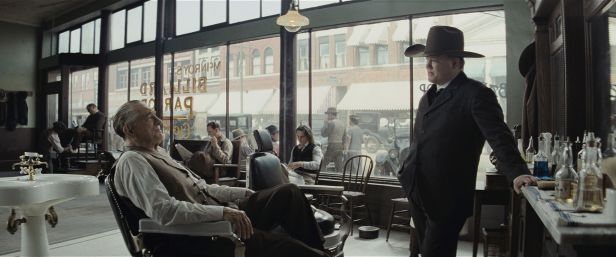
The people we want to get to know are Mollie and King Bill. As it stands, they are largely stock characters for DiCaprio to play off with his dumb-hick schtick. Did they not recognize that the film’s emotional center is Mollie? We crave her perspective as she endures unimaginable tragedy, sitting helplessly as her family is systematically killed under “mysterious circumstances.” This is obviously destroying her, along with an under-treated case of diabetes. But the film treats her plight as secondary to Ernest’s moral epiphany.
And what about King Bill? What is the root of his deep-seated hatred of Native Americans? Why is greed his only motivation? He’s a crime boss in the vein of Tony Soprano, ordering hits, threatening witnesses, and using cold, calculated psychology to manipulate his minions into committing murder after murder. What was it that extinguished his soul? This is the psyche we want to decipher.
Ditto for Tom White (Jesse Plemons), a special agent under the direction of J. Edgar Hoover, sent to Oklahoma with a dozen other feds to end the murders while setting the foundation for what eventually would become the FBI. It’s amazing how much richer the film becomes once White arrives on the scene nearly two hours in. He and his laid-back strategy for getting King Bill’s disciples to flip is fascinating. Yet, we never really learn much about him or what his blueprint is to catch the culprits.
Despite the missteps, “Flower Moon” remains a stunner, from Rodrigo Prieto’s cinematography to production design by Jack Fisk, to the costumes by Jacqueline West, to the evocative score by the late Robbie Robertson. Everything about it is big, sprawling, and emotionally resonant. Above all, it’s significant, particularly when many seek to whitewash our long history of oppressing people of color. Naturally, “Flower Moon” won’t rectify that injustice, but it’s a right step. And it’s not to be missed. Just temper your expectations and watch open-minded. You’ll be richly rewarded.
‘Killers of the Flower Moon’
Rated: R for some grisly images, language and violence
Cast: Robert De Niro, Leonardo DiCaprio, Lily Gladstone, Jesse Plemons, John Lithgow and Brendan Fraser
Director: Martin Scorsese
Writers: Eric Roth and Martin Scorsese
Runtime: 3 hours, 26 minutes
Where to see: In theaters Oct. 20
Grade: B
 Boston Movie News
Comments are closed.