A double shot of curious characters—and sweet treats—from Timothée Chalamet and Emma Stone
By Dana Barbuto/Boston Movie News
Two restless dreamers, both with a sweet tooth—chocolate for him, Portuguese tarts for her. Those are the dots loosely connecting two curious characters from the musical prequel “Wonka” (in theaters everywhere) and the twisted fantasy “Poor Things,” expanding to suburban cinemas this weekend.
“Wonka” is the origin story of chocolatier Willy Wonka, played with dewy-eyed charm by Timothée Chalamet (“Little Women”). The character was introduced in Roald Dahl’s 1964 children’s book, “Charlie and the Chocolate Factory,” and rendered iconic by Gene Wilder in 1971’s “Willy Wonka & the Chocolate Factory.” The latest installment, directed by “Paddington’s” Paul King, is loaded with heart, humor, and a jacked supporting cast featuring Oscar-winner Olivia Colman (“The Favourite”) as Mrs. Scrubitt, the evil boarding house proprietress (Olivia Colman) and an orange-faced, green-haired Hugh Grant as a 20-inch-tall Oompa Loompa.
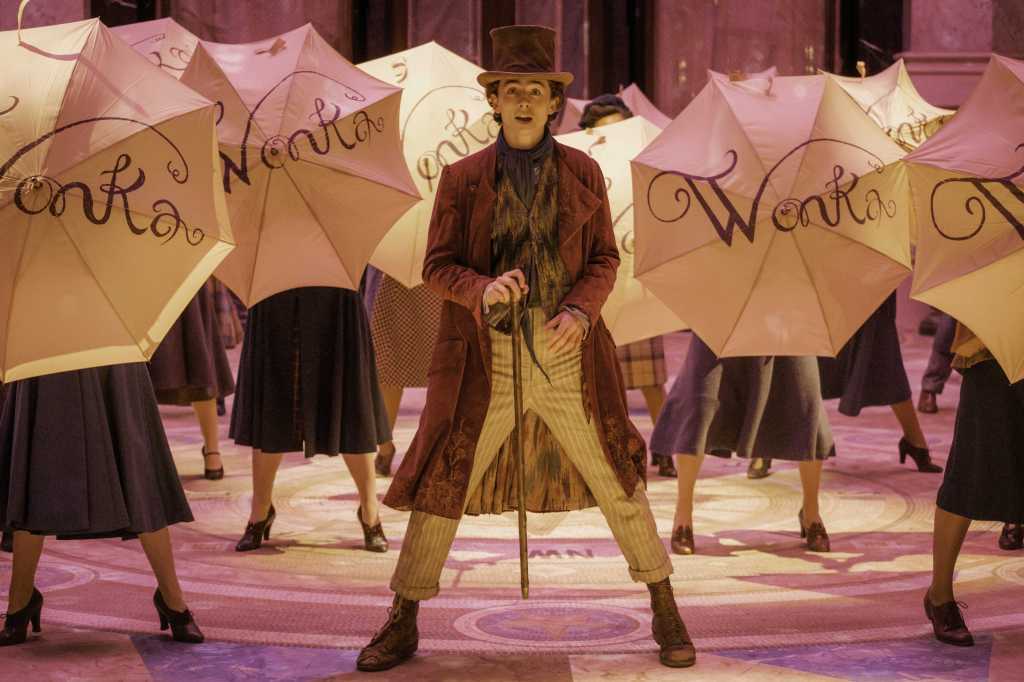
Carrying a “hat full of dreams”—and a magical tote bag that would make Newt Scamander jealous—Willy arrives in town to open a chocolate shop. Immediately, he clashes with the local Chocolate Cartel. By the end of the opening musical number, he’s fresh out of “Silver Sovereigns,” winding up at Scrubitt’s joint, where she hoodwinks him into indentured servitude. Willy schemes back with a handful of new friends and a unique confection called “hover chocolates,” a candy that makes you float. Driving Willy the most, however, is a promise he made to his dying mom (Sally Hawkins).
Rounding out the cast are Keegan Michael-Key as a chocaholic cop who keeps packing on the pounds; Roland Atkinson as a dodgy priest; and Calah Lane as Noodle, Willy’s orphan sidekick. “Downton Abbey’s” Jim Carter is a good-natured (does he ever play baddies?) accountant, Abacus Crunch, and Tom Davis shows up as Scrubitt’s henchman, Bleacher.
Altogether, “Wonka” proves a warmly fuzzy watch. Chalamet is no song-and-dance man, but he has great hair and infuses Willy with more sweetness than sourness, appearing to be having genuine fun and sharing an easy chemistry with his pint-sized co-star. Chalamet tends to play more serious parts: young cannibal in love, legendary British king, meth addict. “Wonka” allows him to show off another side of his talent, scoring the golden ticket and a Golden Globe nomination. (PG for some violence, mild language, and thematic elements. Showing in theaters. Grade: B)
Speaking of sweet treats, Emma Stone is more than just eye candy in Yorgos Lanthimos’ “Poor Things.” Stone’s latest collaboration with the edgy Greek auteur—she first worked with him in 2018’s “The Favourite”— has her playing a Franken-girl “reanimated” with a child’s brain by her mad scientist “father,” the seriously disfigured Godwin Baxter (Willem Dafoe). Stone rips through the part with reckless abandon, taking Bella from a lock-legged toddler to an empowered 30-year-old woman. When we first meet Bella, she’s feral and petulant, acting like a 2-year-old speaking in two-word sentences such as “Bella eat” or “Bella cut.” But this mental toddler is trapped in a blossoming woman’s body, so when Bella is suddenly pleasuring herself with an apple at the dinner table, you know you’re in for one outrageous ride. There’s a lot of perverse sex, nudity, and grotesque situations. The faint of heart need not apply. The curious and adventurous? Step right up.
In adapting Alasdair Gray’s novel, Tony McNamara’s script moves the story quickly, and it’s not long before Bella yearns to see the world. Off she runs with Duncan Wedderburn, a rakish attorney (Mark Ruffalo) emanating the “scent of 100 women,” on a grand European adventure full of “furious jumping” (what Bella calls sex) and Portuguese tarts, stuffing her face until she pukes. She is not afraid to spit out the food she dislikes or say what’s on her mind, including her desire to punch a loud baby, one of the film’s more hilarious lines. Bella lives in the moment. She has no limitations—until she does. Globetrotting from London to Lisbon and Alexandria to Paris, Bella matures, gradually becoming interested in politics, social issues, and sexual agency. Slowly, she discovers her purpose and plots to break free from the male-dictated Victorian-era social mores binding her. Ramy Youssef, Jerrod Carmichael, and Christopher Abbott also add to the imaginative proceedings.
Indeed, “Poor Things” is a warped feminist tale that doesn’t always land well. Is it male fantasy or female empowerment? Or both? Bella’s worldly education, set in a steampunk-ish glow and often viewed through the director’s signature fish-lens style, includes a stint in a French brothel, where she finds enlightenment bumping uglies with various repulsive men. And she never gets an STD? The sex doesn’t bother Bella. Her concern is more significant, marked by a lack of personal autonomy. Why do men get to choose the women they sleep with and not vice versa? Stone is deeply committed to the role and is practically a lock in the Best Actress Oscar race. When the movie lands on a streaming service near you, I worry some viewers will fast-forward to the sex scenes and miss out on a wonderfully bizarre journey of self-discovery. Don’t do it. (R for strong and pervasive sexual content, graphic nudity, disturbing material, gore, and language; Showing in theaters; Grade: B+)
 Boston Movie News
Comments are closed.