The Oscar-nominated ‘Io Capitano’ depicts the brutal migrant journey from Senegal to Italy, highlighting the harrowing experiences and resilience of its characters.
By Bob Tremblay/Boston Movie News
The trials and tribulations of the immigrant experience come to the forefront in riveting fashion in “Io Capitano,” Italy’s representative in the foreign film category for an Academy Award. The Oscar presentations take place on Sunday.
The plot is simple: Two teenage cousins from Senegal head for Europe, where they plan to find success as musicians. What they didn’t plan on are the brutal hardships they’ll experience on their way there. The film is unrelenting in its stark portrayal of the horrors migrants can endure on their journeys to find a better life or escape a worse fate in their homeland.
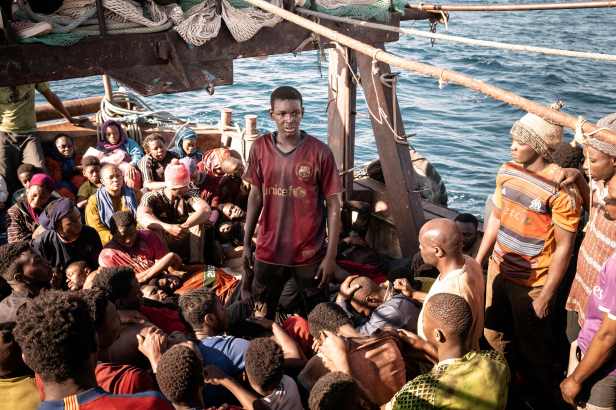
In “Io Capitano,” Seydou (Seydou Sarr) and Moussa (Moustapha Fall) start their trip full of optimism. Before leaving, Seydou tries to convince his mother that he’ll be fine. He doesn’t succeed. She warns him of the perils he’ll face. Seydou should have listened to his mother. The cousins’ naivete doesn’t last long.
The trip from Senegal to Libya, from where Seydou and Moussa expect to take a boat to Italy, would take about three days by car. Let’s just say they don’t enjoy that convenience. Much of the journey is by foot over the Sahara Desert. Not all the migrants on the trip have the stamina to make it. Seydou sees skeletal remains in the sand. But that’s not the worst hardship the migrants will endure. Imprisonment and torture turn the trip into a trek from hell.
As for the film’s title, roughly translated as “I’m the captain,” the final leg of the journey has Seydou put in charge of the boat taking the surviving migrants from Libya to Italy. Seydou has never been on a boat before, let alone operated one. The boat also looks like one that a large wave would capsize in an instant. In the best conditions, the trip takes from 10 to 12 hours.
Garrone films “Io Capitano” with an unsparing eye. With its stark realism, the movie could almost pass for a documentary. The screenwriters actually interviewed people who weathered this storm, and one can feel the authenticity.
The tale isn’t a total downer. Humanity does find its way into the film as Seydou gets befriended by a fellow migrant, and they find work as laborers. We also see the benefits of a loyal friendship.
The movie’s spark comes from Sarr’s amazing performance. If this were an American film or a film given more publicity, he’d be a candidate for a Best Actor Oscar. He’s already won the Marcello Mastroianni Award for Best Young Actor at the Venice Film Festival. The migrant experience lives in his eyes.
Cinematographer Paolo Carnera also gives the film a boost, especially the haunting desert scenes.
Interestingly, even though “Io Capitano” is an Italian movie, virtually no Italian is spoken in the film. Most of the dialogue is in Wolof or French, both of which are spoken in Senegal. For the geographically challenged, Senegal is on the west coast of Africa, bordering the Atlantic Ocean. Libya is located in northern Africa, bordering the Mediterranean Sea. The two countries are separated by more than 2,000 miles if you take a direct route.
“Io Capitano” faces an uphill battle in the Oscar race against the heavily favored “The Zone of Interest.” Both films put a face on mankind’s more unseemly side. “Io Capitano” brilliantly captures one man’s valiant struggle.
‘Io Capitano’
Rating: The film is not rated, but if it were, it would likely be rated R for the violence the characters endure
Cast: Seydou Sarr and Moustapha Fall
Director: Matteo Garrone
Writer: Matteo Garrone, Massimo Gaudioso, Massimo Ceccherini and Andrea Tagliaferri
Running time: 121 minutes
Where to watch: In theaters now
Grade: A
Bob Tremblay is the former film critic for the MetroWest Daily News in Framingham, Mass., and a member of the Boston Society of Film Critics.
 Boston Movie News