Director Ken Loach‘s drama follows a pub owner struggling to keep his pub afloat is a once-thriving mining village that becomes divided after the arrival of Syrian refugees.
By James Verniere/Boston Movie News
The village pub at the heart of Englishman Ken Loach’s valedictory film “The Old Oak,” which is set in the North of England in 2016 and gives the film its name, is nothing less than a metaphor for modern-day Britain. The Old Oak has seen much better days. It’s falling apart. The sign out front sags at the K. The back room, where weddings were once celebrated, is no longer fit for public use. Its plumbing and cooking facilities are “knackered.” The village and its workers were once part of the UK’s thriving coal mining industry (Loach once made documentaries about the mining strikes of 1984-85). But the pits have been long closed, and the villagers are struggling. Some of them are even hungry. Racial hatred has infected the pub’s front room, where the weary landlord and working-class King Lear Tommy Joe Ballantyne (firefighter-turned-great-actor Dave Turner) presides. A bus arrives carrying immigrants from Syria. A big lug (Neil Lieper) grabs a camera belonging to a young Syrian woman named Yara (a powerful turn from drama teacher and actor Ebla Mari), the eldest daughter of Fatima (Amna Al Ali), whose husband has been imprisoned by the brutal Assad regime, which has used chlorine gas on its own people (many of the actors playing Syrians are genuine refugees).
Yara’s camera is her eye upon a world under upheaval. It is damaged in the scuffle. Later, Yara goes to the Old Oak to find out who the man is. TJ takes her to the back room, where he has old cameras that he offers to barter at a local shop in exchange for getting her camera fixed. She gazes at the photos on the walls of the 1980s coal strikes, some of them depicting women providing food to the striking workers and their families. Yara suggests that TJ start the same sort of thing in his back room in an effort to bring all the villagers together and feed the hungry, both immigrant and native.
But there is a canker in the heart of the village in the form of several older men, regular customers of the Old Oak, and friends of TJ, who despise the Syrian newcomers. TJ lives alone above the pub. His wife has divorced him. His adult son will not speak to him. His only friend is a little black dog named Marra. The word “marra” was a miner’s expression used to describe a trusted friend. TJ likes to take Marra to the nearby seashore, where, depressed, he once dreamed of taking “a long swim.”
Written by Loach regular Paul Laverty (“The Wind That Shakes the Barley”), “The Old Oak” is a worthy farewell from an 87-year-old filmmaker who has made British working-class struggle the mainstay of his work. His monumental 1969 coming-of-age film “Kes,” another Loach drama with a coal-mining background, was voted the seventh-best British film of the 20th century by the BFI. Like the working-class dialect in “Kes,” “The Old Oak” is replete with Old English-type expressions (“nowt” in place of “nothing;” “howay” for “c’mon;” “bairn” for “child”). You’ll catch on.
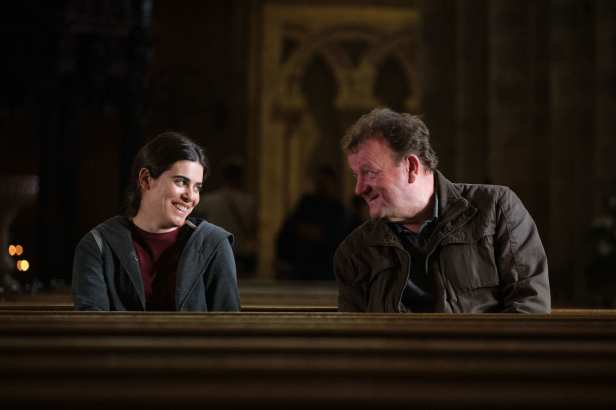
The old men in the pub “wind each other up” when they talk about the refugees. The more they drink, the more wound up they get. Their language gets increasingly misogynistic and violent. Yara tries to help a local girl named Linda (Ruby Bratton), who becomes ill. Yara takes the girl home and asks her brother Max (Alex White) to help. But the children’s furious, racist mother throws Yara out of their old row house. Some villagers mistakenly label the Syrians “Pakis.” “I’m no racist,” says one young woman in spite of evidence to the contrary. The most virulent racist in town is a pub regular named Vic (Chris McGlade). But TJ’s former classmate Charlie (Trevor Fox) is even more malignant. TJ takes Yara to Norman-era Durham Cathedral, where she is transported by the sound of the choir practicing. She bemoans the loss of the Temple of Bel in Palmyra, Syria, which was destroyed by the Islamic State. She bitterly tells TJ that she and her family were “thrown to the wolves.”
The natural beauty of the world gives TJ succor, which is why he spends so much time at the beach. The film ends with a parade similar to one seen in photos of the coal strike period, complete with a banner commemorating the British Battalion in the Spanish Civil War. The end credits thank “Syrians who shared their stories but wish to remain anonymous.” The Old Oak is a fitting farewell from a filmmaker whose art has been synonymous with compassion and social justice.
‘The Old Oak’
Rating: Not rated; contains profanity, violence, and emotional anguish.
Cast: Dave Turner, Ebla Mari, Trevor Fox, Chris McGlade
Director: Ken Loach
Writer: Paul Laverty
Running time: 1 hour 53 minutes
Where to Watch: Coolidge Corner Theatre
Grade: A-
 Boston Movie News
Comments are closed.