Prime Video documentary captures the inspiring journey of Brian Wallach and Sandra Abrevaya as they fight to find a cure for ALS. Featured interviews include Priscilla Chan, pediatrician, Quincy High graduate, and wife of Facebook founder Mark Zuckerberg.
By Sarah G. Vincent/Boston Movie News
“For Love & Life: No Ordinary Campaign” is a documentary about Brian Wallach and Sandra Abrevaya, the founders of I AM ALS, a nonprofit dedicated to raising awareness and funding for research on amyotrophic lateral sclerosis (ALS), also known as Lou Gehrig’s disease. This fatal neurodegenerative disease progressively weakens muscles until the affected individual cannot breathe. Directed by Christopher Burke in his first feature-length film, the documentary delves into the highs and lows of the ongoing battle to cure ALS and includes commentary on the viral Ice Bucket Challenge. Burke, a friend of the couple and Wallach’s fellow Yale alum, typically works in television. The film won the Audience Choice Award for Best Documentary at the Chicago International Film Festival in October 2022, but it took years to find a distributor.
Wallach, who lost his father while in college and later worked as a lawyer on President Barack Obama’s campaign, met Sandra Abrevaya, who was then a communications director and later founded several nonprofits. Wallach subsequently worked at the prestigious law firm Skadden, Arps, Slate, Meagher, and Flom LLP before becoming a federal criminal prosecutor in Chicago. In 2017, shortly after the birth of their second daughter, Wallach was diagnosed with ALS and given only six months to live. Unfazed, he dedicated himself to learning everything about ALS. He embarked on a fact-finding tour to understand ongoing efforts against the disease and figured out how he could contribute to finding a cure by connecting ALS patients and their families with medical and political stakeholders. He built a virtual community for ALS patients, helping them avoid isolation and despair.
I AM ALS successfully requested federal funding for medical research, collaborated with other organizations to get Congress to approve the ALS Disability Insurance Access Act, and proposed the Accelerating Access to Critical Therapies for ALS Act. It is a story about achieving impossible, bipartisan support at the height of an era noted for its polarizing politics, which practically translates into people living longer than two years after diagnosis.
If it was not for the innate pathos of Wallach and Abrevaya’s story and their noble fight against a terrifying disease, “For Love & Life: No Ordinary Campaign” would feel like a slick packaged advocacy infomercial. While the couple remains the focus, the film also highlights others affected by ALS, often presented through photographic montages and testimonials from their families. This approach unintentionally affirms the subconscious American belief that sickness is a personal shortcoming and relies hard on respectability politics to prove that these people are worthy of sympathy and support. It suggests that if ALS can strike such photogenic, successful people, it could happen to anyone.
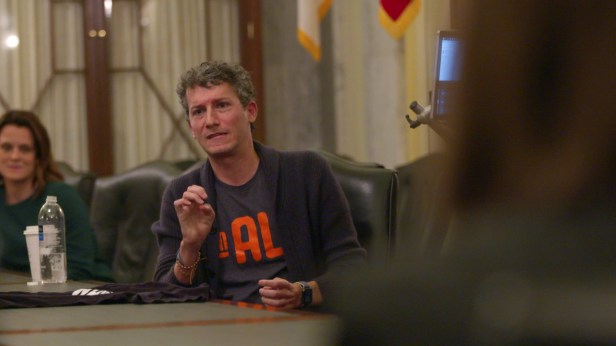
To be fair, the documentary’s primary function is likely part of the broader campaign to garner support against ALS, so its lack of countercultural messaging is understandable, given the stakes. However, it’s worth noting that all featured ALS patients are portrayed as active, positive, likable individuals, which might place undue pressure on those who cannot maintain such optimism. The message should be that all human life is valuable, regardless of whether it is helpful or likable.
“For Love & Life: No Ordinary Campaign” includes original footage from 2019, which is when the nonprofit started, through December 2021, showcases a lot of family home videos and archival news reports to depict the couple’s lives and the nonprofit’s Congressional efforts to push through legislation. Without any explicit reference, Burke casts Wallach and Abrevaya as if they are the protagonists of a contemporary, real-life Frank Capra film. Even the politicians are good guys, and there is not a hint of the acrimony in the political climate of that ongoing era, probably out of fear of alienating future supporters. It is a smart move, but documentaries have always created the illusion of reality, and this optimistic political landscape feels like an alternate utopia if potential viewers accurately remember life at that time. Does anyone remember the January 6, 2021, attack on the U.S. Capitol?
To further legitimize the cause, which feels universally easy to support, Burke punctuates the human-interest angle with talking heads, which include Obama, whom some viewers may still consider a polarizing figure and may not be as appealing as Burke and the couple think. Most talking heads are medical experts, including local Dr. Merit Cudkowicz, Director of Sean M Haley & AMG Center for ALS at Massachusetts General Hospital, or have turned out their deep pockets for the cause like Harvard alum and the named founders of the Chan Zuckerberg Initiative, but note that Priscilla Chan has a medical background as a pediatrician and is a former local, who was born in Braintree and grew up in Quincy. Other than the medical experts, these talking heads may feel like the fat that needed to be trimmed from the documentary, but it is another cynical but effective way to ensure future support—by giving credit. Don’t hate the player; hate the game.
Despite its high-definition, upbeat presentation, the documentary effectively conveys the power and fragility of human life. Viewers cannot help but be moved by Wallach’s declining health and Abrevaya’s palpable grief. Staying on message becomes increasingly impossible as his body and voice wither. Wallach and Abrevaya put up a brave front for most of “For Love & Life: No Ordinary Campaign” by joking around and being constantly on the move, but Wallach stops returning the volley when he dictates a line for a future Congressional testimony, admitting that he accepts his death as inevitable. Not looking at her husband and focusing on the laptop screen, Abrevaya almost crumbles in grief and struggles to continue working. It is the most raw and truthful moment, underscoring the harsh reality that no amount of effort or talent can ultimately stave off death. Even though most viewers do not personally know them, they will also feel their hearts tighten at the impending loss.
While a patient-centric movement to stop a nightmarish disease is a fantastic accomplishment, watching a film about it can feel a little pat and glossy, which may turn off viewers weary of toxic positivity. It only verbally alludes to the holes in healthcare that leave families acting as medical caregivers, with the home turning into a hospice. However, there are scenes with Abrevaya performing seemingly invasive medical duties. This documentary still has value as a human testament of facing hardship with grace, determination, and growing grief and as a tool to learn more about this real-life horror story that is not as rare as imagined and affects 1 in 300 people. The bell tolls for everyone, even if ALS is not ringing it, so this documentary illustrates one way to live.
‘For Love & Life: No Ordinary Campaign’
Cast: Brian Wallach, Sandra Abrevaya, Barack Obama
Director: Christopher Burke
Running time: 83 minutes
Where to watch: Prime Video
Grade: B
 Boston Movie News