Writer-director Chris Nash’s latest film brings a new dimension to the slasher genre.
By Sarah G. Vincent/Boston Movie News
“In a Violent Nature” is a slasher film that centers on the killer responsible for murdering a group of people, dubbed the White Pine Slaughter, which occurred 60 years ago. A group of young people disturb the unmarked grave of Johnny (Ry Barrett), a hulking, cadaverous man who rises from the ground to find them. He moves forward at a constant pace through the woods and begins to pick them off one by one. Will they find a way to stop him, or will he just keep killing?
Surprisingly, Johnny is a sympathetic protagonist with poignant motivation. He is trying to retrieve a stolen memento, the last vestige of his old life. Director and writer Chris Nash adheres to the genre’s demand for gruesome kills while conveying flashes of insight into Johnny’s intent. Though a mythical feature in urban legend and the culprit in a true crime mystery, Johnny is flesh and blood, albeit impervious to the needs of mortal men. He has hopes and dreams like any person, gets angry, and is a bit of a cultural critic in the way that he dispatches his victims according to their favored activity.
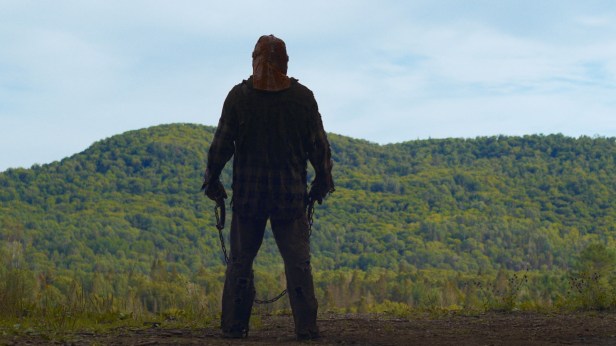
While “In a Violent Nature” may be the audience’s first time witnessing Johnny’s rampage on-screen, it is just another sequel for him. His deliberate pace and movement may reflect his awareness of his condemnation to an earthbound eternity doomed to walk alone with no one he loves. Johnny can move quickly, but he mostly plods forward with a silent determination focused on specific targets with actions that display sardonic wit and intelligence, which contradicts rumors of his rudimentary intelligence. Surrounded by the natural majesty of a field of flowers with a tree-lined horizon and a stunning sunset, he is emotionally unmoved, though he can feel it. Splendor does not impress.
Nash obscures his face by blurring his image or shooting him from behind. The occasional buzz of flies denotes the putridness of his flesh. Nash reveals his face for a moment to indicate how he behaved when he was alive a long time ago, but that moment is fleeting, and when Johnny wakes from his respite of reverie, he picks up the pace and gets back to business. As the movie unfolds, he becomes more brutal out of frustration. He is a monster to others, but he has lived there longer than most have been alive. His life is an entertaining diversion for others to be told as a late-night scary story. His sense of intrusion and outrage is palpable. The audience has more in common with the callow campers than this melancholic killer.
Those recreationists are mostly forgettable young people, except they seem to have a miserable time together long before Johnny shows up. Troy (Liam Leone) appears to be the jerk of the group whose actions unwittingly unleash a new cycle of terror. His girlfriend, Kris (Andrea Pavlovic), has a quick wit that makes him lash out at the other guys in the group, including the mournful Colt (Cameron Love), hipster storyteller Ehren (Sam Roulston), and the perspicacious Evan (Alexander Oliver). PC, hippie chick Aurora (Charlotte Creaghan), and pot stirrer Brodie (Lea Rose Sebastianis) flirt but have not sealed the deal. Their noisy gathering attracts his attention, and they may not have survived the woods even if Johnny was still sleeping under piles of decaying leaves.
They are not the first sounds that attract Johnny. That initial lure belongs to a ranger (Reece Presley) admonishing an angry man who lives in the woods, Chuck (Timothy Paul McCarthy), to be more careful. Johhny seems to want to eliminate the ranger initially but settles for the latter, which feels a little bit like justice, an easy kill of an arrogant, defiant, unempathetic, careless man who thought he was the biggest bad in the region. All of Johnny’s victims suffer the same sin. They know of the disturbing tales, ignore warnings and their knowledge, yet behave as if they are immortal when that title only belongs to Johnny.
Johnny’s plodding walk symbolizes the inevitable passage of time, innocence, and love. He is the personification of death. The key to survival is acknowledging this reality. When the final survivor emerges, that character almost takes on Johnny’s characteristics by constantly moving forward and becoming overwhelmed with the diegetic sounds of nature, which include the haunting, incessant blows that Johnny inflicted on his most recent victim. While neither sound nor graphic violence overwhelms Johnny, the final person’s reaction is normal, making them a foil for the lumbering ax-wielder. The final scene raises an implicit debate about Johnny’s nature. Is he like an animal who cannot be reasoned with and only kills? The last shot answers in the negative.
“In a Violent Nature” may remind some of Ryûsuke Hamaguchi’s latest masterpiece, “Evil Does Not Exist,” in the way that the camera drinks in nature with multiple long shots and extended tracking shots. It also shares the theme of how man’s interference with nature unleashes violence unexpectedly because of the death of an innocent. The original sin that created Johnny is deforestation or logging. While his kills are not about preservation, the callousness Johnny faced when he was alive can be framed as a continuum of an ongoing contempt for all life and an impulse antithetical to quotidian existence. The opening shot is of an askew frame with the forest as the unintentional subject, which cannot be contained, much like Johnny. Man cannot tame nature forever.
Like the recent “Sasquatch Sunset,” “In a Violent Nature” uses the road as a dividing line between mythical figures and civilization. Like the humanoid cryptids turned cinematic comedy figures, regardless of obstacles, Johnny moves forward through nature but avoids the road even though it would be a more convenient and smoother path for pursuing his targets. While the Bigfoot tribe shows their outrage in primitive ways and fears the encroachment, preferring to stick to nature, Johnny turns the tables by using the alleged tools of civilization against those who benefit. Live by the dragging hook, die by the dragging hook.
If the concept of an art house slasher horror scares you, you can still turn off your brain and savor the kills. “In a Violent Nature” never flinches. Johnny likes to mess with people’s heads in creative ways. He has a sharp eye for landing blows from a distance and excellent reflexes. He pays homage to one victim’s love of yoga with his homicidal technique and does a mean impression of Gallagher without the mallet or watermelon. He prolongs the agony of those with whom he has an ax to grind (tip your waiters), and Nash shows every measured moment as the blade approaches the victim’s head slowly. After death, he uses a body as a tool to break into places. Why should he risk getting stabbed with glass shards? It is a practical choice and a message to others that he is coming.
When “In a Violent Nature” ends, it is hard to believe it is over. Nash instills such a relentless vibe that when Johnny is not on screen, you may miss him and keep expecting him to peek around the corner. When he first rises, he sighs, resigned to his fate. Is he finally at rest or just peering with the dense trees acting as camouflage? Let’s leave him alone and appreciate this, hopefully as a standalone homage.
‘In a Violent Nature”
Rating: Unrated
Cast: Ry Barrett, Andrea Pavlovic, Cameron Love
Director: Chris Nash
Writer: Chris Nash
Running time: 94 minutes
Where to watch: In theaters May 31
Grade: B+
 Boston Movie News