Nico Tortorella and Juan Pablo Di Pace explore the emotional highs and lows of fatherhood.
By Sarah G. Vincent/Boston Movie News
“The Mattachine Family” follows Thomas (Nico Tortorella), a Missouri native, Los Angeles transplant, and married photographer, as he recovers from the heartbreak of a court returning his foster son, Arthur (Matthew Jacob Ocampo), to his mother. His actor husband, Oscar (Juan Pablo Di Pace), is in Michigan shooting a television series after a long dry spell with no work. With the support of his friends and unwanted, alone time that makes Thomas act independently from his husband, Thomas starts to figure out what he wants. Will he ever be happy again?
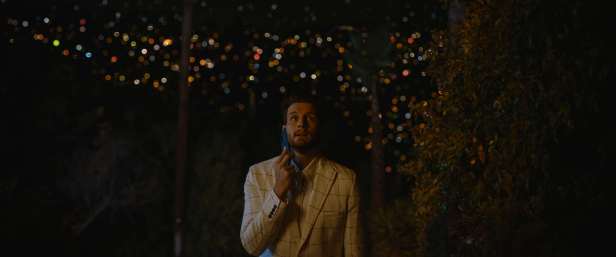
Tortorella is magnetic as Thomas. Without resorting to the usual broad theatrics, he experiences a full range of emotions, sometimes within the same scene. Tortorella is such a natural that it is easy to forget that Thomas is fictional. Whether he struggles from holding back tears to just putting his head on his hand, his performance feels organic and lived in as if it were indulgent, warm comfort food or a favorite sweater.
The bedrock of “The Mattachine Family” is Thomas’ friendship dynamics, and the chemistry feels authentic. Best hugs ever! Leah (Emily Hampshire), a friend from college, is having fertility problems and is married to wholesome Sonia (Cloie Wyatt Taylor), who loves baking pies and fails at convincing Leah to stay dairy-free. Jamie (Jake Choi) is a bit of a player who yearns for love, like Oscar and Thomas’ marriage. This ensemble has fantastic chemistry as if they love and care about each other and feel like three-dimensional characters that could have their own movie. They do not solely exist to live for the protagonist. The overall group dynamic is realistic and fun.
It is also lovely to have a married couple, especially a same-sex one, that are still hot for each other and cannot be mistaken for excellent friends or roommates. Oscar, a former foster child, usually takes the lead. He wanted kids, and Thomas gave in. He recovers quicker than Thomas from the heartbreak because he has a broader perspective about others’ wants and needs—a mother and child should be reunited even if they loved Arthur and were great children.
Unfortunately, that empathy does not translate into action when Thomas asserts his wants and needs instead of defaulting and letting Oscar steer the ship. Oscar wants to move to Michigan for his career, but it is only the first point of contention that drives a wedge between the two, which has never been a problem before. As their relationship transforms them, they trade places regarding what they want out of their lives.
Their differing socioeconomic childhood experiences have an indelible effect on their default programming. An emblematic scene of one of their early dates is set in a gallery showing Robert Mapplethorpe’s photos. Their burgeoning experiences with their sexuality were very different. Thomas revels in the beauty of these black-and-white photographs. Still, Oscar winces at the explicit nature and considers it responsible for the lengthy homophobic motivated chill that stifled his career. Oscar sees Mapplethorpe’s photographs as the negative, stereotypical, promiscuous, and pornographic image that Americans had of gay men and him after his nonconsensual outing when he was a child actor. Thomas sees Mapplethorpe’s portfolio as a symbol of freedom to be himself as an artist and a gay man. Mapplethorpe becomes a Rorschach test for the two.
Thomas often narrates “The Mattachine Family,” which toggles between time periods, kind of like a cinematic quality, gay chosen family “This Is Us.” Sections are punctuated with photograph montages like a film negative to depict his poignant recollections. If you are an overthinker, you will notice that Thomas could not possibly take some of the featured photographs, but allow yourself to get swept away with the lyrical reflections on his life, his husband, and his friends. He contrasts his early expectations of how he would live as a gay man versus what he wants out of life now that his options have expanded. Los Angeles is seen as a utopia populated predominantly with gay people and heterosexual people as the minority. There is no explicit onscreen homophobia or violence, just joy.
Most of their trials and tribulations involve the logistics of whether to have kids, which would not work in a movie with heterosexual couples because it is the expected default, and the logistics are easier. Having a baby is a bit more challenging for a same-sex couple. The human right to reproduce was not always accessible to same-sex couples and still is not depending on the location. The title is probably unfamiliar to the average person. It is a historical reference to the Mattachine Society, the first American national gay rights organization with municipal-level chapters. French secret society masked groups that criticized the ruling class inspired cofounder Harry Hay’s name choice. It was founded in Los Angeles but was not limited to local issues like preceding groups and focused on international gay liberation. The organization led to the development of other groups, which included lesbians. The organization is verging on extinction and serves more of a cultural and historical role than one of contemporary activism because it was seen as too conservative despite its early communist roots. The Mattachine Steps, also known as the Cove Avenue stairway, an outdoor staircase in Silver Lake dedicated to the group and Hay in 2012, is featured in the film. The title reflects that these characters have achieved the dream of their spiritual and political ancestors to live the whole human experience as reproductive agents. This movie is not just about navigating that obstacle.
Even if the idea of watching a movie about gorgeous, wealthy people waking up to their biological alarm clock sounds like a nightmare, “The Mattachine Family” could still be for you. At its core, the movie is about a protagonist going through a grief journey and getting back in touch with himself instead of listening to others. People mourn the loss of a loved one when they cannot be together, and death does not always cause that separation. Ambiguous loss is a universal human experience that everyone will have in contexts that do not involve children or romantic partners. There are many ways to love and lose without anyone being the bad guy; not enough movies address that issue.
If the film does not work for you, it may be because you checked out of “The Mattachine Family” early in the proceedings before it finds its rhythm. There are times when Thomas seems mean to Laura (Annie Funke), a clumsy social worker who is unintentionally rubbing salt in Thomas’ wounds, but Tortorella is aiming for melancholy, and the story does not have the opportunity to settle in. It begins gaining its footing after a poster of Ricky Marin suddenly appears to lighten the mood. Heather Matarazzo, best known for her film debut in “Welcome to the Dollhouse” (1995), is one of the most famous people in the cast along with Hampshire. Matarazzo plays a mom influencer and former lawyer, Annie, who hires Thomas to take photos of her son. Their scenes together are meant to orient the viewers and Thomas toward focusing on what he wants instead of just getting caught up in the everyday hurly-burly. Instead, it unfolds as an encounter where Thomas fumbles a connection, and she reacts in horror, but they move forward together anyway. Both actors are hamming it up in that scene, and the subtle message gets lost in the exaggerated and outsized antics. Then it feels like a meet-cute between Thomas and Ted (Carl Clemons-Hopkins), her co-parent and friend, but it is not. This film avoids pat tropes and tackles the dynamic of how relationships work. They can last a few minutes at a party or forever. There are a lot of casual scenes in which everyone has baby fever and is eager to share how they were able to make their dreams come true: surrogacy, IVF, adoption, etc. Think of the Baader-Meinhof Phenomenon or Frequency Illusion in action.
“The Mattachine Family” is the kind of film that could easily irritate some viewers. Everyone is attractive, deft at witty banter, able to afford their gorgeous homes while working jobs that ordinarily pay very little, and have all the time in the world to socialize and engage in their favorite activities. If viewers allow the movie to settle into its rhythm, it will probably charm everyone by the end. It works because the characters often acknowledge their privilege and success. Each character exhibits authentic emotion. They may be fortunate, but they are still real people, albeit leaning heavily towards the pleasant, photogenic side.
If you don’t mind a little schmaltz and lack of realism, check out filmmaking married duo director Andy Vallentine and writer Danny Vallentine’s autofiction film. It is an excellent palate cleanser in the form of an entertaining, glossy movie, wearing optimism, possibility, and love on its sleeve as if it were a badge of honor. The best revenge is living well.
‘The Mattachine Society’
Cast: Nico Tortorella, Juan Pablo Di Pace, Emily Hampshire
Director: Andy Vallentine
Writer: Danny Vallentine
Running time: 1 hour 39 minutes
Where to watch: Apple TV, Google Play Movies, Prime Video, Vudu, YouTube
Grade: B+
Sarah G. Vincent is a freelance film writer who writes for Cambridge Day, In Between Drafts, and sarahgvincentviews.com, her blog. She is a regular contributor on WGBH News’ Morning Edition and has made guest appearances on NECN/NBC 10. She is a Tomato-approved critic and a member of the Boston Society of Film Critics. She is originally from NYC and was introduced to repertory cinema while working at the Harvard Film Archives.
 Boston Movie News