Director Frauke Finsterwalder crafts a tale of loyalty and power in this dynamic biopic about Empress Elisabeth of Austria and Countess Irma Sztáray, played by Oscar-nominee Sandra Hüller.
Sarah G. Vincent/Boston Movie News
“Sisi & I” answers, “Do you need two movies about a 19th-century Austrian Empress and Hungarian Queen in the last two years?” Absolutely! The first shall be last, and the last shall be first. This film was announced before director and writer Marie Kreutzer’s “Corsage” (2022), a fictionalized biographical account starring Vicky Krieps, who played the lead role in “The Dead Don’t Hurt” (2023). Kreutzer’s self-professed feminist film about Empress Elisabeth of Austria, known to those close to her as Sisi, got released first and then became infamous for the director’s alleged awareness of allegations against one actor, who pled guilty to possessing child porn, and another unnamed alleged sexual harasser. Though “Corsage” got pulled from theaters and a public broadcaster refused to air any films with the prior actor, Austria still submitted “Corsage” in the 95th Academy Awards’ International Feature Film category.
Fortunately, director and co-writer Frauke Finsterwalder’s sophomore film appears to be free of scandal and covers completely different ground from the more comprehensive, period-accurate “Corsage,” which covered the empress’ life after her 40th birthday. In contrast, this film predominantly unfolds from 1894 through 1898 in Corfu, Greece, before a detour to Algiers, two locations where Kreutzer’s film does not tread, before returning to the continent. Technically, “Sisi & I” focuses more on the Bavarian-born empress’ last lady-in-waiting, Hungarian Countess Irma Sztáray, than regent consort Elisabeth, nicknamed Sisi. This film is a deliberately constructed myth about the dynamic between the two women, not an adaptation of the subordinate Hungarian noblewoman’s memoirs. It is shocking that Sandra Hüller, the toast of 2023 with such memorable performances in “Anatomy of a Fall” (2023) and “The Zone of Interest” (2023), could have a new film streaming and in a select number of theaters in only a few major markets yet this movie is barely making a ripple.
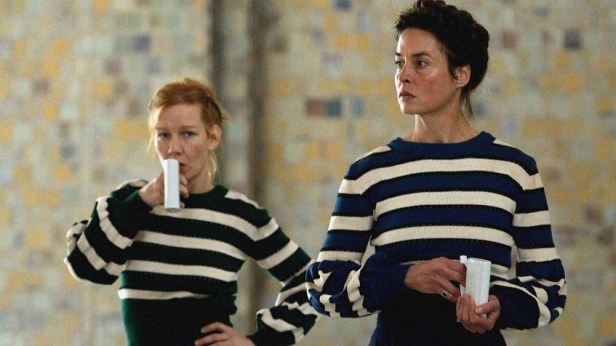
Hüller plays the single 42-year-old who must choose between marriage, the convent, or getting this job. “Sisi & I” comes out swinging before the credits roll. The unspoken but depicted motivating threat is continuing life under the iron fist of her domineering, abusive mother, Maria Countess of Sztáray (Sibylle Canonica). From the opening, it is clear that Irma has no control over her body or fate and is used to accepting rules. However, she never masks her emotional reaction to all the indignities and violations of her person. Unsurprisingly, Hüller nails the role by alternating between clutching her metaphorical pearls as a fish out of water in the Bohemian style of the Corfu court of Sisi (Susanne Wolff), an all-women and gay men retinue, and delighting in the relative freedom and mischievousness of her new position.
Power, Friendship, and Autonomy
Life with Sisi is sumptuous and loose but also shares some of the traits of a cult, which an abused person would not recognize the red flags after a life of blind obedience. Finsterwalder and her cowriter, novelist, and journalist Christian Kracht, who is also her husband and collaborator since her first fictional film, aimed to show the power inequities of Irma and Sisi’s friendship but probably did not intend to make Irma’s orientation appear straight out of a cult textbook: destroy personal belongings, sleep deprivation, drugging, withholding food, never being able to question the leader. It resembles a 19th-century, rustic, chic, more joyous version of “The Devil Wears Prada” (2006).
This Sisi is capricious in the vein of the careless upper classes of F. Scott Fitzgerald’s “The Great Gatsby,” but more sympathetic and relatable. She indulges her whims, and her ladies vie for her attention, a place in the sun. Sisi is uncertain whether Irma’s loyalty lies more with her as a trusted friend or a spy for her husband, Emperor Franz Joseph of Austria (Markus Schleinzer). There is something childlike about how everyone revolves around the popular girl and gaining her favor—like a timeless sleepover. Eventually, Irma becomes her favorite, and their dynamic is like a gender-bending, time-traveling Harold and Kumar-type friendship, with Irma, clearly crushing on her empress. Though Irma and Sisi explicitly express their revulsion of men’s bodies, a thick sapphic subtext bubbles to the surface but never lasts for more than a few beats.
Even a favorite can be put back on the shelf for more irreverent diversions, such as her brother-in-law/cousin, the outrageous, flaming Archduke Ludwig Viktor of Austria (Georg Friedrich), or an arrogant horse-loving British Captain Smythe (Tom Rhys Harries). Irma becomes sulky and throws tantrums when Sisi gets too far out of line and reverts to her off-screen teacher’s pet provincial, small-minded conservative tattler to rein in her superior when they are on the outs. There is even a tamer “Saltburn” (2023) consumption moment and a seething sense of vexation. The underlying tension is whether their friendship will survive the tension of Sisi’s disinterest and abandonment and Irma’s tattling tendencies. Irma is not the only one who knows how to act out.
A Mediation on Marriage
This heterosexual filmmaking couple paints a bleaker image of marriage and heterosexual relationships as slavery than “Corsage,” which depicts the empress as an untouched woman begging for physical affection. Complaints of historical inaccuracy point to the depiction of the royal couple’s marriage, but Finsterwalder and Kracht are disinterested in historical accuracy and use the famous figure as a provocative way to meditate about how the institution diminishes women. The hale and hearty Sisi becomes a fragile flower who likens herself to a doomed Sleeping Beauty relative to her proximity to her official duties in Austria. There are also superstitious prophecies of her foretold death. It is not without good cause—she goes from an autonomous woman to a person that people seek to tame into obedience. Unlike “Corsage,” which represents the empress’ physical ailments as an act, this Sisi is not performing and wilts under the eye of her subjects and the rule of her husband and mother. As “Sisi & I” unfolds, Sisi’s dispiritedness dominates, and bulimia becomes a way to reclaim her body from others’ commands, not a desperate act to preserve her beauty. Wolff’s performance evokes the classical grace of actors like Ingrid Bergman meets Katharine Hepburn with a dash of the goddess beauty of Monica Bellucci.
Unlike “Corsage,” Finsterwalder’s film has not been beset with comparisons to Sofia Coppola’s “Marie Antoinette” (2006), though it has more anachronisms from the soundtrack to the costumes by Helga Lohninger. Even if it did, the couple is not as vocal as Kreutzer in rejecting the comparison. These contemporary affectations appear when Sisi is most free, but the adherence to proper period appearance occurs at court. It is a perfect way to remind moviegoers that these are not bloodless historical figures but people they can relate to. It also makes the movie a feast for the eyes and a delightful vicarious way to enjoy the aristocratic, well-off exploits of untamed women.
There are some pacing problems, especially as Sisi descends into depression or engages in conventional bourgeoisie pursuits like romance. Ultimately, “Sisi & I” is a coming-of-age story for Irma as she fiercely retains the lessons of autonomy that she learned from Sisi and does not return to her cowed earlier self. It also does not gloss over the trickled-down toxicity of hierarchy, which poisons and distorts their friendship into an unequal relationship that does not permit dissent within it. It is disturbing that alternate histories about the empress never seem to imagine a utopian escape from self-harm or death, but this film is not the first work of fiction about the empress, and it won’t be the last. Maybe a future movie will be able to envision another fate.
‘Sisi & I’
Rating: Not rated
Cast: Sandra Hüller, Susanne Wolff, Georg Friedrich
Director: Frauke Finsterwalder
Writer: Frauke Finsterwalder, Christian Kracht
Running time: 132 minutes
Where to watch: Fandango At Home
Grade: B+
 Boston Movie News