Agnieszka Holland’s film chronicles the brutality faced by refugees and the small acts of kindness that offer a glimmer of hope.
By James Verniere/Boston Movie News
A grimly realistic, aptly black-and-white depiction of what is endured by a group of refugees fleeing Syria, Africa, and Afghanistan by way of the Belarus border to Poland, “Green Border,” from iconic Polish filmmaker Agnieszka Holland (“Europe, Europa,” TV’s “The Wire”), is a tough look at a difficult issue. The title may be a reference to the enormous, ancient green forest on both sides of the borderline. But there is nothing bucolic about the experience. While Poland welcomed over 2 million Ukrainians in the first two weeks of the Russian invasion, the Polish border guards in the film are openly encouraged by their superiors to keep non-Europeans, aka “darkies,” out.
This means people of color. These people are often young families with grandparents, even pets, seeking freedom and a better life in such places as Sweden, and they end up stranded in a freezing forest without shelter, food, or water. Since 2014, about 30,000 people have died trying to “cross over” by sea, land, and air. “Green Border” is a terrifying descent into a real-life circle of hell.
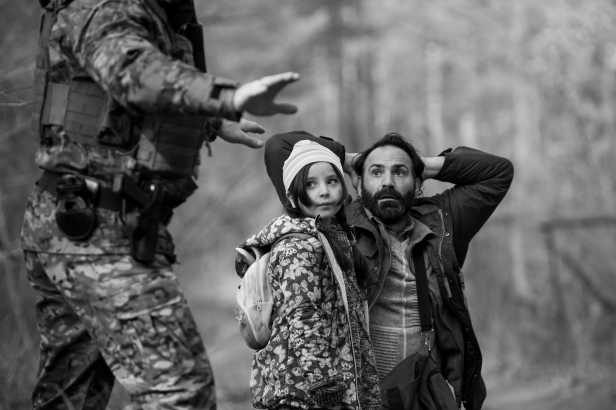
We begin with a family from war-torn Syria: mother Amina (Dalia Naous) and father Bashir (Jalal Altawil). They are accompanied by the grandfather and their three children: a young daughter Ghalia (Talia Ajjan), a preteen son, Nur (Taim Ajjan), and a breastfeeding infant.
First, they are robbed of precious cash by Belarusian border guards just to get to the border. Then, after they cross over, brutish Polish guards send them back across the razor wire in a brutal political chess game. In one case, the guards toss a struggling, pregnant African woman over the wire. A woman named Leila (Behi Djanati Atai) offers to take Nur over the border and reunite with his family later. But Leila and Nur fall into a swamp in the dark and are being horrifically dragged to their deaths in its murky depths. A Polish woman named Marta (Monika Frajczyk), a psychologist and widow sympathetic to the plight of the refugees, hears Leila’s cries in the night and tries to find her.
Holland, who co-wrote the screenplay with Gabriela Lazarkiewicz and Maciej Pisuk, shifts our focus to Polish sympathizers led by a no-nonsense, tough cookie named Julia (Maja Ostaszewska) and a deeply conflicted Polish border guard named Jan (Tomasz Wlosok) with a pregnant wife. Marta opens her home up to activists, striving to help get people to safety using legal and not-so-legal methods.
She spends an evening in jail after an interrogation and strip search. These women are our heroes.
“Green Border,” winner of the Special Jury Prize at the 2023 Venice Film Festival, is a portrait of real-life barbarism and cruelty. But it is tempered, even redeemed by its sudden bursts of kindness and compassion. Politicians push to dehumanize refugees, referring to them as “weapons.” The language and the technique are familiar. The guard finds a desperate interloper living in his unfinished home in the woods. Marta’s broken-down car in the “exclusion zone” is badly vandalized and marked with spray paint, most likely by the border patrol. But someone will show mercy to strangers, shining a light of hope in the darkness. A wealthy Polish family opens its doors to three young African men who perform the rap song “Died a Thousand Times” like they mean it.
‘Green Border’
Rating: Not rated, scenes of violence, inhumanity, profanity.
Cast: Jalal Altawil, Dalia Naous, Tomasz Wlosok, Maya Ostaszewka
Director: Agnieszka Holland
Writer: Holland, Gabriela Lazarkiewicz, Maciej Pisuk
Running Time: 2 hours, 32 minutes
Where to Watch: Coolidge Corner Theater
Grade: B+
 Boston Movie News