Chelsea McMullan’s documentary leaps beyond the stage to explore the trials and triumphs behind ‘Swan Lake.’
By Sarah G. Vincent/Boston Movie News
As an expression, swan song refers to a final performance before retirement, and the documentary “Swan Song” adheres to and transcends that meaning. The National Ballet of Canada’s artistic director, Karen Kain, “the Princess Diana of Canada,” who also danced for the company and is considered a legend, decided that she would retire after trying her hand at directing and staging Russian composer Pyotr Ilyich Tchaikovsky’s ballet “Swan Lake.” Kain’s final act takes longer than expected when the pandemic hits and postpones production for 18 months. Director Chelsea McMullan starts her film during the summer of 2020 and then chronicles the eight weeks of rehearsal before opening night, from April 15 through June 10, 2022. It is not solely a tribute to Kain’s final act. It also profiles many people who contribute to the production’s success and is an excellent primer on the behind-the-scenes ingredients that make an international-caliber production.
With no narrator, “Swan Song” alternates between a fly-on-the-wall approach to observing the action and using interviews with the onscreen participants to offer insight. As riveting as any fictional feature, McMullan’s documentary opens backstage on opening night, giving viewers a glimpse of the distinct, colorful personalities of choreographer Robert Binet and various corps members, which means the body of the ballet. Then McMullan rewinds to how they got there, beginning with Kain discussing her storied career in her lavish, impeccably designed home. The setting is complete with an Andy Warhol portrait of Kain and multiple framed magazine covers of her adorning the walls. McMullan provides more context for Kain’s career with a montage of archival footage from Studio 54 and various performances at the zenith of her career. Instead of crafting a lone examination of the most famous member of the company, McMullan takes a top-down approach by descending the organizational chart as the film unfolds. Next is the internationally acclaimed Russian Lithuanian principal ballerina, Jurgita Dronina, who at the time was dancing for the 10th time in the dual role of Odette/Odile, one of the most emotionally demanding parts ever choreographed. For those unfamiliar with ballet, Dronina’s role is like Hugh Jackman playing Wolverine, but instead of Wolverine, it’s as if Jackman were starring in his favorite musical—a dream come true for him. “Swan Song” profiles many members of the corps, especially Texas transplant Shaelynn Estrada, a Mexican American queer woman with ambitions to one day become a lead dancer.
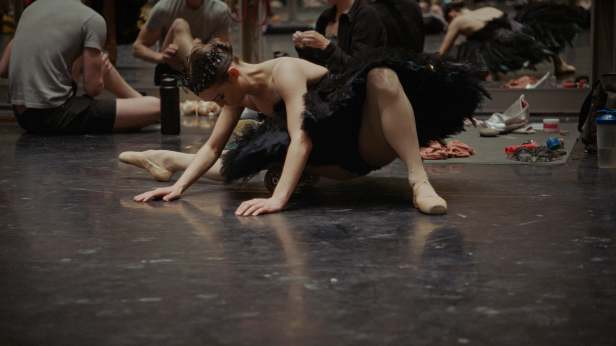
McMullan does not just focus her action at the theater but gives moviegoers glimpses of the lives of these ballerinas with montages of their accommodations to show, not just tell, their rank in the ballet. The camera reveals broad socioeconomic differences, but no one is depicted living in squalor like Degas’ ballerinas. Eventually, she reveals what each ballerina had to overcome for her art—the male ballerinas do not get any speaking roles. Even Kain confesses her dark night of the soul early in her career. Dronina’s vulnerability is gradually revealed, and because of her vast experience, she does not hide her confusion or potential for pain to become disabling. Dronina confesses, “I’m the most lost swan here.” For perspective, the corps dances the equivalent of a 5K during every performance. Success does not insulate anyone from physical or psychological injuries.
Unlike documentaries such as “Ballet 422” (2014), which offer no context and immerse viewers in the subject matter without guidance, “Swan Song” provides an accessible introduction to ballet. It is informative without being pedantic, making it perfect for those unfamiliar or uninterested in ballet. In addition to personal portraits of all the participants, the confessionals explicitly explain each interviewee’s role, the decision-makers, the expectations for how “Swan Lake” should look, how this production differs from the standard, their goals, and their shortcomings. The film features a few talking heads, such as dance scholar Seika Boye and dance critic Paula Citron, but they are engaging and do not disrupt the film’s flow.
It is easy to forget that during the pandemic, protests of the extrajudicial execution of George Floyd dominated conversation so as an artist, Kain would naturally want to contribute in some way to the contemporary discourse. Classical ballerinas used to sport a literal white face by painting their faces and bodies white and wearing pink-colored tights to create the illusion of uniform skin color and form one long line. Kain decided to ditch the tights, which causes a stir in the corps. The majority prefer to adhere to tradition and feel exposed. While Kain’s decision seems initially to be a gesture of inclusion, it also supports her interpretation of the ballet.
For those unfamiliar with “Swan Lake” or only know about it from watching Darren Aronofsky’s “Black Swan” (2010), it is about how a prince tries to save Odette, whom he discovers is one of many women whom the sorcerer Rothbart kidnapped and turned into swans during the day. To break the spell, the prince must love Odette forever, so Rothbart gets his daughter, Odette’s doppelganger, Odile, the black swan, to trick him into falling for her. The end changes depending on the production. Unlike most ballets that emphasize homogeneity, Kain wanted that sameness to be a symbol of Rothbart’s sexual deviant oppression, so the dancers’ physical individuality becomes a symbol of resistance. Their skin and scars rehumanize them instead of objectifying them into Rothbart’s idea of ideal womanhood. There is some subtle commentary that could be inferred if Rothbart is paralleled with the way that ballet treats its dancers.
While “Swan Song” gravitates towards a democratic impulse and Kain and Binet are concerned for the dancers, there is still a hierarchy, which carries an inherent tension of inequity, loss of autonomy, and heightened conflict. Do not expect reality television hijinks. While McMullan does not pull any punches, these are still consummate professionals who find ways to express their displeasure and save the theatrics for the stage. In the opening, the dancers read Binet’s letter of gratitude, and indeed, Binet appears in every scene to be gentle, concerned, and solicitous, but the dancers grumble about the felt impact and effect of his orders regardless of tone. When Binet talks about choices in how the ballet will be depicted, he emphasizes that the decision resides with Kain, not the dancers, which is an appropriate industry standard but may not be aligned with the underlying values of the era unless one considers that most of the dancers do not like change. A film about ballet reveals the underlying problem of democracy and freedom: the majority may be regressive because it is more comfortable, and achieving greatness and equity requires sacrifice that will not always feel connected with the agreed-upon goal. It unexpectedly represents complex concepts without giving in to dry, philosophical, droning detours.
For those who want to enjoy the pageantry and gorgeous spectacle, McMullan offers plenty of dishy moments at the beginning then when the company moves rehearsal to the Four Seasons Center for the Performing Arts, the theater featuring the production. From the patrons arriving on opening night to the swooning over Gabriela Tylesova’s set and costume designs, “Swan Song” offers the option of turning off your brain and just staring with your mouth agape at all the sumptuous offerings.
One flaw of any dance documentary, unless it focuses solely on the performance, is that the clips will never be enough to fully satisfy. The film devotes so much time discussing the challenges and obstacles that need to be overcome that it does not feel sufficient to simply hear about the triumph. There is a Canadian four-part docuseries with the same title that has an 184-munute runtime, which is 84 minutes longer than the feature and aired during the fall of 2023 in Canada. Anyone who watches “Swan Song” will probably be eager for more and want to follow up by looking for its availability on this side of the border.
Executive producer Neve Campbell of the “Scream” franchise and a former student of the company bet on a winner. Though it is Campbell’s first time producing and not appearing on camera, she is one of the few people who could quit her day job because McMullan’s film won the first ever Rogers Award for Best Canadian Documentary from the Toronto Film Critics Association Awards. It is a must-see film for anyone with even a slight interest in dance or teamwork.
‘Swan Song’
Rating: Not Rated
Director: Chelsea McMullan
Writers: Victoria Abolarinde (story editor), Chelsea McMullan and Sean O’Neill
Running time: 1 hour 43 minutes
Where to watch: Apple TV, Fandango at Home, Prime Video, YouTube
Grade: A-
 Boston Movie News