Sue Kim’s documentary on Apple TV+ is a tribute to South Korea’s ocean heroines as they struggle to preserve their heritage while combating environmental threats
By Sarah G. Vincent/Boston Movie News
In Korean, haenyeo means sea women, specifically referring to the women from the Jeju and Geoje islands off the coast of South Korea. They gather food from the ocean and dive without the benefit of oxygen tanks, which prevents over-harvesting. While the first haenyeo were recorded in the 17th century, the average person may not have heard of them until Min Jin Lee’s novel “Pachinko,” published in 2017 and adapted as an Apple TV+ television series. Thanks to production company A24, distributor Apple TV+, and producer Malala Yousafzai, first-time feature director Sue Kim, a Korean American director, gets a chance to shine a spotlight on the haenyeo to tell their own story and ring the alarm on the dangers threatening their way of life.
If you are looking for a comprehensive historical account of the haenyeo, you will not find it here. “The Last of the Sea Women” is a film that begins as a blend of human interest and nature documentary. Over time, it evolves into a narrative with a clear agenda, addressing not only climate change and everyday pollution but also the controversial release of treated wastewater from Japan’s Fukushima Daiichi Nuclear Power Plant into the Pacific Ocean, an action that commenced on August 23, 2023, following the plant’s nuclear accident on March 11, 2011. By focusing on ordinary women capable of legendary feats instead of talking heads droning on about the danger, the filmmakers found a clever way to get a broader potential audience who may not be interested in watching a documentary with an activist agenda. Those exclusively looking for more personal accounts about the women may be disappointed.
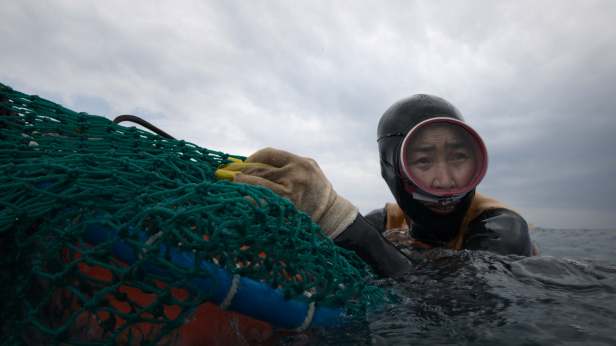
“The Last of the Sea Women” is primarily empowering and uplifting, accomplished by omitting certain salient facts. Because the narrative is framed as a personal account, the film does not provide background about Japan’s problematic past with Korea as a colonizer who tried to wipe out Korean culture, which explains why Korean people are later described as “indigenous.” Regardless of whether the International Atomic Energy Agency approves of the Japanese’s actions in the 21st century, the release of wastewater is just another offense in a laundry list of wrongs committed against the Korean people, especially women, which includes World War II when Japanese soldiers trafficked “comfort women,” i.e., sexually tortured and enslaved Korean women. Perhaps the filmmakers did not want to alienate Japanese allies or seem as if they were already predisposed to bias against the Japanese, but it is important to note that this latest action is just a continuation of centuries of harm that the Japanese perpetrated against its neighboring countries.
“The Last of the Sea Women” is an observational documentary that follows the haenyeo on their workday and after hours, which means a lot of sublime shots of their subterranean exploits and their camaraderie on the sea’s surface and on land: singing, shamanistic rituals, joking around, hauling the latest catch, riding in a boat or the back of a pickup, putting on their wetsuits and participating in an annual 16-year-old parade celebrating their accomplishments.
“The Last of the Sea Women” is a rare documentary that only has a few males appearing on screen for a limited amount of time, including one of the younger diver’s husband and sons, Geoje Fishing Chief, Haeng Pyo Lee, who supervises the younger divers, Ban Hideyuki, an Anti-Nuclear Activist from the Citizens’ Nuclear Information Center in Japan, Shaun Burnie, Greenpeace Nuclear Specialist, Jeong Do Kim, a Jeju Environmental Activist, Hansupul Haenyeo School officer Joo Hyun Kim, who admits that the haenyeo are more physically suited for the job, which is the perfect segue to how women cannot win under the double bind of patriarchy. Men stopped engaging in this type of work because it is so difficult, but then felt embarrassed when the women provide for their family because among many issues, their appearance changes—their skin gets darker in the sun and water. Colorism is an international problem.
In 2016, UNESCO added haenyeo to its Intangible Cultural Heritage List, and in 2017, South Korea designated them within their heritage preservation system as South Korean Intangible Cultural Property, which finally alleviated the stigma of women possessing indomitable physical prowess and providing for their families. This attention made the haenyeo the ideal recruits to fight Japan. An unnamed presenter at a town hall explained, “All the leaders in the fishing cooperative are men, and they say they are against the issue, but there’s been no action taken. I believe that the haenyeos’ spirit is our eternal strength.” Intertwining the haenyeos with environmental activism gives a human face to the cause and makes it seem less controversial. Environmentalism is not just for leftie anti-capitalists, but grandma.
There are few talking heads in “The Last of the Sea Women.” Haenyo Tradition Preservation Committee Historian Soon-E Kim provides the context of the logistical challenges to divers working in such an inhospitable environment and the dwindling numbers. Greenpeace Energy Campaigner Mari Chang moderates the town hall to explain the dangers of Japan’s discharge of radioactive water to the haenyeo. By calling on 18,000 gods, Jeju Island Shaman Soon Shil Seo performs an annual ceremony to protect the haenyeo and the ocean’s health. It is rare for shamanistic rituals to be depicted in films as light, joyous affairs and forces for unambiguous good when they are usually the portentous turning points in horror movies like “The Wailing” (2016) and “Exhuma” (2024). Regardless of genre, Korean shamans are still cast as spiritual warriors fighting against the Japanese invasion. Archival footage shows haenyeos in the 20th century, which reveals how much their customs changed in such a short amount of time. Western women are framed as allies. International Association of Democratic Lawyers’ Permanent Representative Micol Savia offers a tour of Room 20, the site of the Human Rights Council’s tri-annual meetings.
“The Last of the Sea Women” is primarily anecdotal with first-hand accounts. Some of the haenyeo get to share fragments of their life story in “The Last of the Sea Women.” Most haenyeo are elderly and range in age from their 60s to 80s. Soon Deok Jang, 72, a diver and tour guide, becomes the official spokeswoman on the international stage with the assistance of Hyewon Nam, her English interpreter. Im Seang Ko, 70, is one of the many women who feels relieved of the profession’s stigma after UNESCO’s recognition. Joo Hwa Kang, 63, is a teacher at the Hansupul Haenyeo School who highlights the peril of the work and the lack of a social welfare safety net when disabled. Yeong Yeong Ae Jeong, 67, echoes Danny Glover’s weary tone from the “Lethal Weapon” franchise as she describes the physical toll of the harvesting, which allows for only brief breaks to breastfeed, and the devastating impact it has on their ability to earn a living. Geum Ok Lee, 90, does not miss a beat by joining protests against the Japanese polluting the Pacific Ocean.
No generation gap here! “The Last of the Sea Women” also highlights younger sea women. Sohee Jin, 30, the youngest haenyeo, and Jeongmin Woo, 37, who still has a young family, are social media savvy and promote the profession to attract more newcomers. While an increased media presence may draw more potential recruits into the fold, the hard physical labor and inherent danger of fishing underwater will keep away the uncommitted. Ultimately, the main attraction is timeless: a way for women to financially support their families when the men in the family cannot and have a flexible job that allows them to continue caring for their family. Only the negligent homicide of ocean life can make the heanyeos extinct.
‘The Last of the Sea Women’
Rating: Not Rated
Director: Sue Kim
Running time: 1 hour 27 minutes
Where to watch: Apple TV+
Grade: B
 Boston Movie News