Mark Cousins’ documentary offers an inventive, psychological exploration of Hitchcock’s filmmaking style.
By James Verniere/Boston Movie News
From cinephile filmmaker Mark Cousins (“The Storms of Jeremy Thomas,” “The Eyes of Orson Welles”) comes “My Name Is Alfred Hitchcock,” an unconventional, fictionalized-non-fiction film, which is “narrated” by an actor playing the late “master of suspense,” an expression I don’t think you hear in the film. BBC TV star Alistair McGowan impersonates Hitchcock off-screen, delivering offbeat observations about his life and work. Most notably, the film breaks from the usual biographical account of its subject, a man who has inspired a slew of memoirs, including acclaimed books by Patrick McGilligan, Stephen Rebello, Francois Truffaut, and Donald Spoto. Instead, “My Name Is Alfred Hitchcock” offers an analysis of the psychology of his filmmaking style.
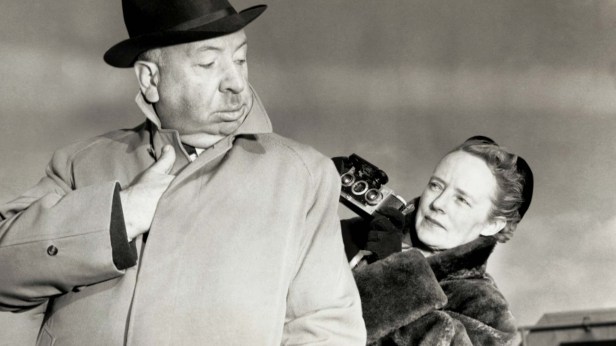
In Cousins’ film, Hitchcock himself points out what this “daredevil” filmmaker was trying to do to the audience that had never been done before, including attempting to “prod you a little” and explore “the dark side of desire.” I’d say Hitchcock, the maker of “Psycho” (1960), one of the greatest, most shocking, and memorable films ever made, was trying to “prod” you a lot about the darkness of desire. Among other things, Cousins, or I should say, Hitchcock, delivers a short treatise on how he opens doors in his films (there is a real knack to it) and why there are so many such shots in his work. Just between us, he’s no John Ford in this regard. Hitchcock tells us that he and his wife, Alma Reville, an experienced writer and editor, and his closest collaborator, make each other laugh.
Hitchcock’s masterpieces include “The 39 Steps” (1935), “The Lady Vanishes” (1938), “Rebecca” (1940), “Shadow of a Doubt” (1943), “Saboteur” (1942), “Spellbound” (1945), “Notorious” (1946), the experimental misfire “Rope” (1948) and “Strangers on a Train” (1951), based on the first novel by Texas-born Patricia Highsmith. The 1950s were a fruitful time for English immigrants to Hollywood. Hitchcock directs three films starring Grace Kelly, “Dial M for Murder” 1954), “Rear Window” (1954), and “To Catch a Thief” (1955). In 1956, he remade his 1934 thriller “The Man Who Knew Too Much” with James Stewart and Doris Day, followed by the great “Vertigo” (1958), in which desire runs darkly wild, and “North By Northwest” (1959) with its famous, glowering Mount Rushmore.
These films have scenes, twists, POV shots, characters, and postcard scenery, all designed to make the audience feel like voyeurs and even participants. In a sense, the audience holds the knife that kills Marion Crane. Many of the films feature insane serial killers, a fascination Hitchcock also indulged in his late effort “Frenzy (1972) and one that he shared with German fellow expat Fritz Lang (“Metropolis”), whose grotesque, groundbreaking 1931 expressionist thriller “M,” features a tormented and brilliant Peter Lorre as a Grieg-whistling Berlin pedophile-serial killer.
Instead of showing the face of narrator McGowan, Cousins shows us tiles depicting Hitchcock films in the Underground near his London childhood neighborhood, where his Roman Catholic father ran a produce and poultry shop. We also repeatedly see close-ups of photos of the master, one with shining eyes, and the enormous Anthony Donaldson sculpture of Hitchcock’s Buddha-like head at his old North London haunt, Gainsborough Pictures. Cousins shows us the scene inside a wood mill in “Foreign Correspondent” (1940), and the narrator tells us that the mill’s moving wheels, gears, and rods are “the workings of my mind.” “Movies are like postcards,” faux Hitchcock remarks, and we cut to the “fantasy Gothic Scotland” his designers built for a sequence in “The 39 Steps” and another such setting in “Spellbound” with its famous Salvador Dali dream sequence.
“My Name Is Alfred Hitchcock” contains clips of Hitchcock’s silent films, including “The Manxman” (1929) and the seminal Ivor Novello vehicle “The Lodger: A Story of the London Fog” (1927) about a mad killer preying on London blondes. I wish Cousins had explored Hitchcock’s relationship with Bernard Herrmann, who composed the scores of seven of his films, including “Vertigo,” “North By Northwest” and “Psycho.” Cousins also pays no attention to Hitchcock’s 1950s and ’60s television shows, which poked fun at his appearance and voice and made him an unlikely hero to American children, myself included. Throughout his career, Hitchcock worked with the most talented and attractive actors in the business: Sylvia Sydney, Madeleine Carroll, Carole Lombard, Joan Fontaine, Ingrid Bergman, the aforementioned Kelly, Kim Novak, Janet Leigh, and Tippi Hedren. Among the handsome men were Novello, Robert Donat, Michael Redgrave, Joel McRea, Gregory Peck, James Stewart, and, of course, Cary Grant. “My Name Is Alfred Hitchcock” reminds us that all of Hitchcock’s films offer a glimpse inside Hitchcock’s dark, twisted, but also funny, big head. Step inside if you dare.
‘My Name is Alfred Hitchcock’
Rating: Not rated
Cast: Alistair McGowan, Alfred Hitchcock, Sylvia Sidney, Tippi Hedren
Director/Writer: Mark Cousins
Running time: 2 hours
Where to Watch: Landmark Kendall Square
Grade: B+
 Boston Movie News