Right on cue for Halloween, Kino Lorber unveils a new 4K restoration of the cult classic horror film ‘Night of the Eagle’ aka ‘Burn Witch, Burn’
By James Verniere/Boston Movie News
Just in time for Halloween, Kino Lorber has released an HD Master from a 4K scan of the original negative of the 1962 cult favorite “Burn Witch, Burn,” now better known by its original UK title “Night of the Eagle.” Like many British genre productions of the postwar period—”The Quatermass Xperiment” (1955), “The Abominable Snowman” (1957), “Curse of the Demon” (1957), featuring Brian Donlevy, Forrest Tucker and Dana Andrews, respectively—“Night of the Eagle” costars American actor Janet Blair as an ordinary-seeming, faculty wife, who is in fact a practicing, modern-day witch, protecting herself and her husband from other evil witches. Blair appeared opposite Cary Grant in “Once Upon a Time” in 1944 and was well into her television career when she made this Anglo Amalgamated film at the legendary Elstree Studios in Hertfordshire, England, where “Star Wars” (1977), “The Shining” (1980) and the “Indiana Jones” films were subsequently made.
Directed by Sidney Hayers of the great, remarkably lurid, mad-scientist entry “Circus of Horrors” (1960), featuring a resplendent Anton Diffring as an insane plastic surgeon, another Anglo Amalgamated release, “Night of the Eagle” has quite the pedigree. Shot in luminous black-and-white by Reginald H. Wyer of Hammer’s “Spaceways” (1953) and Anglo Amalgamated’s early “Carry On” films, ”Night of the Eagle” boasts an adaptation by writing partners Richard Matheson and Charles Beaumont of TV’s “The Twilight Zone” as well as crime writer George Baxt (TV’s “Ivanhoe”). The film is based on the 1943 novel “Conjure Wife” by Fritz Leiber, one of the progenitors of the sword-and-sorcery school. The novel has inspired three films thus far, including the Lon Chaney Jr. “inner sanctum mystery,” “Weird Woman” (1944), and the semi-comic “Witches’ Brew” (1980) with Teri Garr.
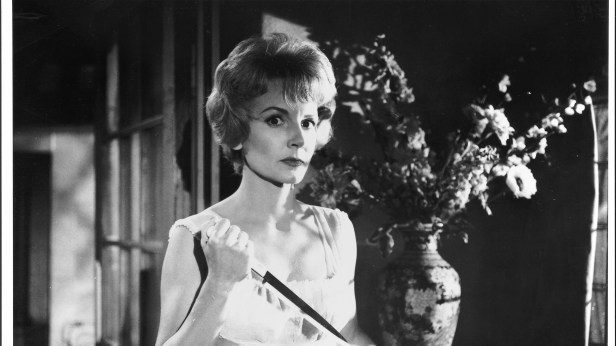
The setting of “Night of the Eagle” is the small, leafy Hempnell Medical College in rural England (exteriors were shot in Cornwall), where we spy a menacing eagle gargoyle in the first shot. Blair’s Tansy Taylor is the devoted wife of psychology professor Norman Taylor (a buff, trim, and often bare-chested Peter Wyngarde of Jack Clayton’s 1961 “The Innocents” in a role burgeoning Hammer star Peter Cushing turned down). The action begins with Norman teaching a class and ironically writing “I do not believe” on his chalkboard during a lecture about superstition. Among his students are Margaret Abbott (Judith Stott), who obviously worships Norman, and the deeply troubled Fred Jennings (Bill Mitchell), who obviously despises his teacher and is jealous of Margaret’s attachment. (Another student is a rare and random Black man. Five years later, the great Sidney Poitier would star in the London-shot, Columbia British Production, box-office hit “To Sir with Love.”)
It’s Friday night, and Norman and Tansy are hosting “bridge night” in their comfy, wood-paneled home near the campus (they also have a cottage at the beach), where they keep a long-haired, photogenic, black Persian cat. It is clear that university secretary Flora Carr (Australian Margaret Johnston), whose husband Lindsay (Colin Gordon, “The Pink Panther”) is about to be passed over for the department “chair” in favor of Norman, and fellow faculty wife Evelyn Sawtelle (an underutilized Kathleen Byron of “Black Narcissus”) are plotting something devious, if not diabolical.
Flora utters, “We don’t accept them,” about the Taylors. Johnston, who studied at the Royal Academy of Dramatic Art and whose Flora is partial to bestial fur and fuzzy collars, is this film’s ace in the hole. Her performance as the limping, hatred-driven, thoroughly evil rival witch gives “Night of the Eagle” a boost that must be acknowledged. Described by an angry Tansy as a “middle-aged Medusa,” Flora has an expression that will chill the blood in your veins, if not turn you to stone, and Johnston defaults to this evil grimace when she believes no one is looking. DP Wyer slyly sets up lights to illuminate Johnston’s face scarily from below, and the actor delights in moving deftly from one to another. It’s a fright show worthy of Margaret Hamilton.
After their guests leave, Tansy seems unwell and searches for something. She finally finds a furry amulet of some sort and burns it up in a shower of sparks. When Tansy looks into her bedroom tabletop mirror, she (and we) see two reflections looking back at her. She speaks of a trip to Jamaica, where she participated in a rite conducted by a voodoo practitioner to save Norman’s life. Nevertheless, unbeliever Norman, who always has a lit cigarette in his hand, forces his wife to collect all her amulets, talismans, and graveyard dust and throw them into their blazing fireplace. The proud and “logical” Norman simply refuses to believe that his career and success result from his wife’s witchcraft, not his hard work, class, and education (and slender waist). The male ego is also thrown into the fire in “Night of the Eagle,” along with the amulets. It is not until Norman admits that his wife’s magic is real and has protected and helped him that he can strive to save them.
Once those protections are removed, things fall apart quickly. A tape recording arrives in the mail with no return address. The cursed recording is a foreshadowing of the “Ringu” franchise with its death-dealing videotape. Norman is accused of rape by Margaret. Jennings threatens Norman with a gun.
Director Hayers shoots many scenes with his lens behind one of the school’s stone eagles, making it seem like the frozen predators stand watch, waiting to pounce (later, photographic effects bringing the eagles to life are admittedly crude). The tape appears to summon a squealing creature to the Taylor’s door. The third act evokes Orpheus and Eurydice. A spellbound Tansy leaves suddenly for the couple’s seaside cottage. Meanwhile, back on campus, Flora confronts Norman. She makes a paper house out of Tarot cards, sets it alight, and then plays the evil tape over the school’s outdoor loudspeakers.
With its skeptical expert who debunks claims of the supernatural, Jacques Tourneur’s “Curse of the Demon” aka “Night of the Demon” (1957), which is based on a 1911 story by M.R. James, is a clear harbinger of “Night of the Eagle” (they even sound alike). In addition to the “Ringu” series, “Night of the Eagle” also looks forward to New York City-born author Ira Levin’s 1967 novel “Rosemary’s Baby” and Roman Polanski’s classic 1968 film adaptation with Mia Farrow’s innocent, unwary newlywed surrounded by scheming witches and warlocks. “Night of the Eagle” also foreshadows “The Stepford Wives” (1975), another film based on a novel by that Levin fellow, and, of course, Hayers’ film anticipates “The Omen” (1976) with its evil priest, possessed nun and devil child. “Night of the Eagle” even plants seeds of William Peter Blatty’s 1971 literary sensation “The Exorcist” and William Friedkin’s head-spinning, R-rated 1973 film adaptation, in which a little girl says the most horrible things and modern technology cannot compete with an ancient demon named Pazuzu.
 Boston Movie News