A new documentary from Lucy Lawless chronicles the life of New Zealand photojournalist and CNN war reporter Margaret Moth.
By Sarah G. Vincent/Boston Movie News
A New Zealander dyes her blonde hair, dresses in bad-ass black, stops using her birth name, and becomes known as a trailblazing adventurer who breaks new ground for women in a male-dominated, dangerous industry. No, this description is not intended to be attributed to director Lucy Lawless, the beloved, versatile actor best known for playing the one and only Xena, The Warrior Princess, but Margaret Moth, a photojournalist who covered war zones from the 1990s through early 21st century. “Never Look Away” is a biographical documentary exploring her personality, work, and obstacles she overcame to become the person she envisioned.
Fans of documentaries are accustomed to being spoiled and feeling as if the subject is speaking to them, even if that person is deceased, because of the availability of tons of archival footage. Because Moth’s job was to work behind the camera, not in front of it, it is not until the end of “Never Look Away” that she talks about herself in an interview. Instead of a documentary, it feels more like a memorial as her friends, colleagues, and family give exclusive interviews, but most of these stories feel as if they reveal more about the interviewee than intended. Some of their tales probably do not land in the way that Lawless imagined. Moth’s lovers, the still-smitten Jeff Rossi and the egoist Vaschinka, have yet to unpack their relationship with Moth objectively. Vaschinka frames her as a lovelorn, clingy woman who is barren, which is the worst thing for a woman to be, and claims that she could not accept when he moved on to start a family. Apparently, he was unaware that Moth allegedly sought a court order to ensure she would never have children, and he seems oblivious to Rossi’s existence. In contrast, Rossi, who was 17 years old when Moth began their affair, seems to have more of a handle on Moth’s true character but still needs to unpack the possible predatory effect that she had on him. Both men describe her as someone who escaped gender normative roles of monogamy and childbearing but exchanged it for toxic masculinity as she created a double standard for the men in her life, preferring that they stay home, remain faithful, and not pursue their interests while she had a man in every port and traveled the world. Lawless may have too much confidence in her audience that they will understand that all the speakers have a very subjective and flawed interpretation of Moth and can only partially be relied upon to enlighten viewers about her.
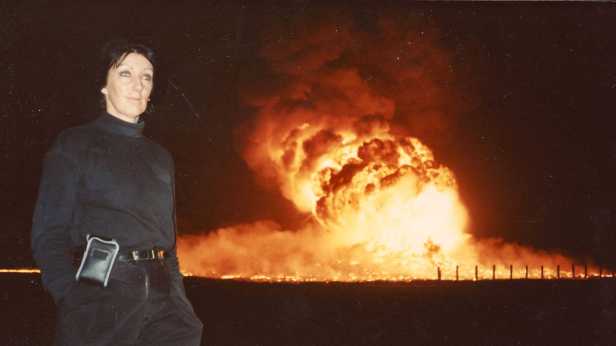
It feels as if Lawless wanted to depict Moth as a rock and roll disrupter who embodies a wild and free life transcending gender while simultaneously being the epitome of the ideal feminine standard, beauty. Instead, Moth’s romantic relationships are the first ways that “Never Look Away” defines Moth, which is disappointing and a reductive typical way that professional women get reduced. On the one hand, it is more exciting to see a montage of photographs and home videos of Moth partying, making out, drinking, and drugging, sometimes topless and other times clothed from head to toe with no skin showing. Moth is shown anywhere but New Zealand. If someone relies on the documentary for details about her life, one could walk away thinking that Moth never spent any of her adult life in her homeland. It also never reveals why Moth changed her name to stand out because her first and last names were common.
“Never Look Away” is stronger when her colleagues describe her. Her best friend/soul mate and colleague, former CNN cameraman Joe Duran, is true to the end and responsible for getting Lawless to take on this project. Stefano Kotsonis, a former CNN correspondent, dominates the segments about her career. If more time was devoted to Sausan Ghosheh, a former CNN producer, and Susan Stein, a former BBC camerawoman, the documentary may have felt more substantial and insightful since they are women and contemporaries who innately understand the unique position that Moth occupied and enjoyed, especially since they shared similar groundbreaking roles. The most notable interviewee is Christiane Amanpour, the instantly recognizable, world-renowned television journalist with a distinct voice. Tom Johnson, a former CNN CEO, and Peter Humi, former CNN Paris Bureau Chief, also provide insight, but if their stories ended up on the cutting room floor, it would not be a tremendous loss. Lawless deserves kudos for not expecting viewers to remember the talking heads by showing their names and titles more times after their first appearance.
Like most documentarians covering events from recent history, Lawless’ crucial mistake is forgetting that everyone watching “Never Look Away” will not know anything about the conflicts, the famous people referenced, or the regions that Moth went to. Lawless does not provide enough context except by zooming and panning to the location on the map, showing the year and the name of the conflict. Kuwait in 1990, Saudi Arabia in 1991, Tbilisi, Georgia in 1991, Sarajevo Bosnia and Herzegovina in 1992, Paris in 1993, and other sites and years provide the setting and answer the where and when, but will everyone automatically associate it with the Persian Gulf War or the Serbian Bosnian War? Even viewers who remember this news cycle era will have a hard time recalling anything about a civil war in a former Soviet republic. It is additionally disorienting that after shifting locations, Lawless will show an interview about an earlier conflict instead of the most recent year and location.
On the other hand, like Alex Garland’s “Civil War,” “Never Look Away” could argue that it is primarily about the journalists, not the people they cover, so it is unnecessary to provide more details. Unlike the critically acclaimed fictional feature, Lawless’ film is more optimistic about journalists’ role in conflicts and credits Moth’s footage with bringing the conflict to people’s attention, which changed influential hearts and minds to curtail the length of the conflict.
If you have limited time to choose between Lawless and Garland’s films about journalism, “Never Look Away” is the obvious winner and will pair nicely as a double feature with the upcoming film “September 5,” which blows them both out of the water. Moth covering war is explicitly equated to one of many drugs and behaviors that she used to self-medicate from whatever demons tormented her. Everyone engages in a bit of armchair psychology to explain why Moth chose this vocation, but one answer sticks: to stand up to bullies.
“Never Look Away” does not explicitly spell out that Moth’s turbulent and abusive childhood gave her the constitution to be calm and fearless under terrifying circumstances because it would feel normal. Lawless introduces Moth’s siblings in the middle of the film. Sister Jan Wilson laughs at a childhood memory of their parents, which has no punchlines but plenty of hits. It also explains how Moth persevered when a mortal wound failed to kill or stop her.
Lawless’s visual vocabulary is strongest during these scenes. A child psychologist would have a field day analyzing Moth’s childhood drawings in ink on paper, which scream the pain of early trauma and are mostly dark. The line movement in the drawing conveys an Edvard Munchian emotionalism with the palette of Edward Gorey—think Tim Burton without the mirth. Lawless takes certain scenes and superimposes the jagged, vibrating ink lines on certain images to convey Moth’s turmoil.
Like last year’s “The Mother of All Lies,” Lawless uses a diorama to recreate the moment when a sniper shot Moth, but unlike her Moroccan counterpart, no one interacts with the model, and it is left empty to symbolize the chasm between life before and after that injury. It is eerie and still, colored in a desolate, dusty fashion. To illustrate her injuries, Lawless uses a drawing of Moth that gets ripped in half without visible hands. The invisible hands and pencil theme continues when Lawless recreates how Moth could not talk and communicated through writing. It is like a voice screaming in the void. Since Moth is no longer alive, it also communicates losing Moth and makes her into a specter. The image of a random, black-haired, topless woman whirling and screaming was excessive since it overshadowed the image of the quiet, agonizing work of physical therapy: Moth on a bed moving her arm with the aid of a female physical therapist. Anything that overshadows Moth feels more about the movie than the subject.
Kotsonis explains, “Tough is what she did. Tough is not how she acted.” Lawless makes a lot of mistakes that first-time filmmakers engage in by getting caught up in the vibe of Moth’s personality as opposed to attempting to do the impossible: showing the unfiltered real person without getting lost in others’ agendas, including her own. The few clips of Moth show a casual and quiet woman who behaved in nontraditional, radical ways, but “Never Look Away” is much flashier. It improves with repeat viewings, so hopefully, viewers will push forward with the material despite starting off on the wrong foot and have the critical power to filter the testimonials instead of taking them as the gospel about Moth.
‘Never Look Away’
Rating: Not rated
Director: Lucy Lawless
Writers: Whetham Allpress, Tom Blackwell, Lucy Lawless
Running time: 85 minutes
Where to watch: Apple TV, Fandango At Home, Prime Video, Spectrum, YouTube
Grade: B
 Boston Movie News