In Mohammad Rasoulof’s poignant drama, an Iranian family navigates love, rebellion, and survival under the shadow of oppression.
By James Verniere/Boston Movie News
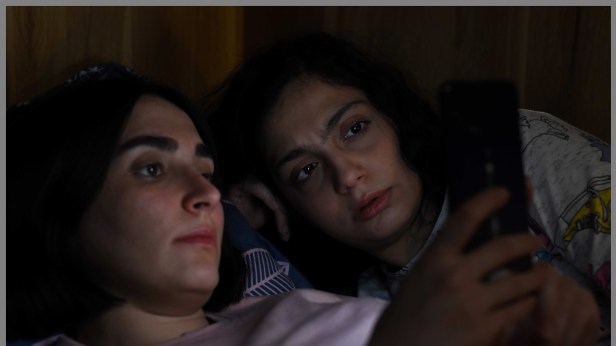
Made clandestinely by writer-director Mohammad Rasoulof (“A Man of Integrity”), who fled Iran and lives in exile after being sentenced to eight years in prison, flogging, and a fine by the Iranian theocracy in 2024, “The Seed of the Sacred Fig” is a fitting, subversive farewell to the filmmaker’s homeland. The film centers on an upper-middle-class family in present-day Tehran. The father Iman (Missagh Zareh) has just been promoted to investigator in the Revolutionary Court of Tehran. He is, therefore, in the fast lane for becoming a judge, a respected, well-paid position in Iran. His wife Najmeh (Shoheila Golestani), whose job is to care for her husband and their two daughters, is thrilled. However, their adolescent daughters, Sana (Setareh Maleki) and Rezvan (Mahsa Rostami), are a constant source of trouble. Iman, whose workload is heavy, cannot find enough time to spend with them. As the male of the house, Iman has the last word in everything in a Muslim society over women, although he finds that he cannot control his girls. They even side with the young women on college campuses, who openly protest the theocratic government’s laws regarding women’s dress. Some of these young women even dare to appear in public without head coverings, something considered sinful under Muslim law. The government’s response to these demonstrations has occasionally been violent.
The plot of “The Seed of the Sacred Fig” was apparently inspired by the case of 22-year-old Iranian-Kurdish woman Mahsa Amini, who died in police custody in 2022 after being arrested for wearing her hijab “incorrectly,” triggering the country’s longest anti-government protests since the 1979 Islamic Revolution. Fearful that the girls’ behavior might jeopardize Iman’s future, the conservative Najmeh tries to rein them in and forbids them from being friends with Sadaf (Niousha Akhshi), another student who has been involved in the protests. Sadaf also paints her nails, and she is considered “bad company.”
On the job, Iman has been asked by a superior to sign a “death certificate” regarding a case with which he is unfamiliar, placing him in a serious moral dilemma. He has also been required to carry a handgun for personal safety. He and Najmeh decide not to tell their daughters about the gun. When the gun goes missing, Iman faces a prison sentence and a hefty fine if it cannot be recovered.
“The Seed of the Sacred Fig” is like the Iranian version of Akira Kurosawa’s “Stray Dog,” the director’s groundbreaking 1949 film noir about a young Tokyo cop whose gun is stolen and used in crimes. But like the dramas of Asghar Farhadi (“A Separation”), “The Seed of the Sacred Fig” (the title is a reference to a tree that strangles another one to survive) is more concerned with questions of familial and political morality than crime fighting or the bleak, visual stylings of film noir. Rasoulof’s film was reportedly shot under difficult circumstances and then smuggled into and edited in Germany. It includes real archival footage of street riots, giving it realism, relevance, and urgency. Sana and Rezvan are obsessed with the protests. Although they are forbidden to do so, they watch them on their phones. Iman learns that his office is bugged. A cloud of paranoia and distrust hangs over everything. Iran appears to be a somewhat moderate country run by fanatics. The final scenes show the family inside a crumbling maze-like village, mirroring the moral complexity in which they are trapped. “The Seed of the Sacred Fig” can feel oppressive at almost three hours long. Like many Iranian films, it is heavy on dialogue and light on visuals and action. But the desire to be free resonates.
‘The Seed of the Sacred Fig’
Rating: PG-13 for bloody images, violence, thematic content. (In Farsi with English subtitles)
Cast: Masha Rostami, Setareh Maleki, Niousha Ahkshi
Director: Mohammad Rasoulof
Writer: Rasoulof
Running time: 2 hours, 48 minutes
Where to Watch: Coolidge Corner Theatre, Landmark Kendall Square
Grade: B
 Boston Movie News