Brady Corbet’s towering three-hour, 35-minute historical drama explores architecture, survival, and the price of genius.
By James Verniere/Boston Movie News
In the vein of “There Will Be Blood” (2007), “Oppenheimer” (2023), and “Citizen Kane” (1941) for that matter, “The Brutalist” traces the trajectory of a great man and his conflicts with the world and the people in it. Laszlo Toth, played by Academy Award-winner Adrien Brody in a major comeback performance, is a Hungarian-born, Bauhaus-educated Jewish architect who survives Buchenwald during World War II. Although the film does not depict his time at the camp, we follow him as he arrives in the sunlit New York/New Jersey Harbor, half-blinded by the height of the Statue of Liberty and the harsh steerage conditions of his journey.
He and his wife Erzsebet (Felicity Jones in a role similar to the one she played in “The Theory of Everything”) and their adolescent niece Zsofia (Raffey Cassidy) were “forcibly separated.” The women remain in Europe, mired in political red tape and unable to join Laszlo in the United States for a long time. He travels to Philadelphia, where he stays with a relative named Attila (Alessandro Nivola), who, together with his beautiful “shiksa” wife Audrey (Brit Emma Laird), builds and sells furniture in a business billed as “Miller and Sons.” “Americans love families,” he declares.
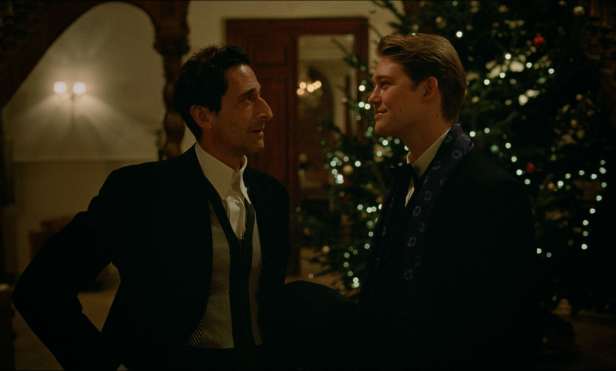
For a time, Laszlo frequents Black jazz clubs, where he scores heroin and has affairs with women. He befriends a down-and-out Black man named Gordon (the great Isaach de Bankole), who cares for his young son William (Charlie Esoko). After designing and building a library in the mansion of a rich man named Harrison Lee Van Buren Sr. (Brit Guy Pearce, outstanding), Laszlo undergoes a symbolic rebirth, although he does not kick the heroin habit. Van Buren discovers that Toth was a master builder who designed several important projects in Hungary. The rich man seemingly adopts Toth, somewhat to the chagrin of Van Buren’s adult twin children Maggie (Stacy Martin, “Nymphomaniac”) and Harry (Joe Alwyn). Van Buren even gives Laszlo the keys to the guest house.
Directed and co-written by former actor Brady Corbet, whose previous credits include the seriously not good “Vox Lux” (2018), “The Brutalist” is on a very basic level about our natural desire to move from darkness to light—in both life and architecture—and about a Jewish artist and Holocaust survivor’s inability to feel at home anywhere, except perhaps Israel, and maybe not even there.
Eventually, Laszlo is reunited with Erzsebet and Zsofia. His wife has been sick and arrives in a wheelchair. Laszlo has been tasked with building an enormous multi-purpose monument—a cenotaph, really—on a hill in honor of Van Buren’s late, beloved mother, who (like writer-director Corbet’s mother) raised him by herself. Lazslo wants to use unadorned concrete—the favorite drug in the brutalist apothecary. Luckily for him, Van Buren thinks he’s a genius. Brutalism emphasizes structural elements and building materials over decoration. Laszlo is pressured by religious groups to include a chapel. His only decoration is a giant slab of Carrara marble adorned with a cross made out of light.
Shot in the 1950s-era process known as VistaVision, a Paramount-branded widescreen technique (and a favorite of Paramount regular Alfred Hitchcock), “The Brutalist” looks both vintage and futuristic, not unlike the buildings Laszlo constructs. Like its central monument, the film’s length is a monumental three hours and 35 minutes (with a 15-minute intermission). Music by composer Daniel Blumberg runs the gamut from plinking pianos to shredding industrial sounds. Cinematographer Lol Crawley invites us to see architecturally, emphasizing the vertical, horizontal, and diagonal. An observant Jew who attends services, Laszlo, ever the minimalist, sums up his experiences during the war with the words, “I am alive.”
The soundtrack is full of such period songs as “Buttons and Bows” and the aching love song “You Are My Destiny.” Laszlo builds a white, scale model. Soon, cranes dot the hilltop. Rebar-reinforced concrete columns like protruding bones appear out of the earth. Corbet, who co-wrote the screenplay with writing partner Mona Fastvold, also builds his film architecturally. Yes, the two artists are doubles. Gordon, we learn, served with the Buffalo Soldiers of the 92nd Infantry Division in Naples during the war. Suddenly, the project is almost literally derailed. But Van Buren and Laszlo travel to Italy to seek a marble slab. Van Buren, just another rich man with vile opinions, says something nasty about Italians. Laszlo, for his part, speaks Italian with the marble cutter, an old friend, and embraces him warmly. As the subject of the film’s fictional biography, Brody, who won his Oscar playing another Holocaust survivor in “The Pianist” (2002), is superb, a bundle of blazing contradictions, drives, and dreams that somehow add up to that mystery that we call genius, another Oppenheimer. The final credits, which are almost impossible to read, are, of course, diagonal.
‘The Brutalist’
Rating: R for strong sexual content, graphic nudity, rape, drug use and some language.
Cast: Adrien Brody, Guy Pearce, Felicity Jones
Director: Brady Corbet
Writer: Corbet, Mona Fastvold
Running Time: 3 hours, 35 minutes with a 15-minute intermission
Where to Watch: Coolidge Corner Movie Theater in 70mm, Landmark Kendall Square, AMC Boston Common, Alamo Drafthouse
Grade: A-
 Boston Movie News