While Pamela Anderson takes center stage as a showgirl facing her final chapter, the film fails to explore the true depth of her emotional journey.
By Dana Barbuto/Boston Movie News
“The Last Showgirl,” a character study of a washed-up dancer played by a seemingly washed-up actress, feels surprisingly irrelevant for a movie about striving for relevance.
Pamela Anderson, the former “Tool Time” girl on the sitcom “Home Improvement” and Hef’s favorite blonde of the ’90s—gracing the cover of Playboy a record 14 times—stars as Shelly, a veteran Vegas showgirl facing the twilight of her career and grappling with what comes next. On-screen, though, the performance feels less like acting and more like a reflection. With clumpy mascara and a tired charm, Shelly comes across as a version of Anderson herself, weathered by fame and seeking a second chance. (Her reputation did unfairly take a heavy hit after the sex tape scandal.) Director Gia Coppola’s approach leans on this blurred reality, relying on Anderson’s lived experiences to anchor the story. It’s as if the mere act of pointing the camera and letting art imitate life could naturally create a character with depth and complexity.
The casting feels calculated—a hyper-meta quality that Anderson fans will appreciate —but the paper-thin script written by Kate Gersten (married to Coppola’s cousin) never fully commits to exploring the layers between Shelly and Anderson. Instead, it settles for surface-level commentary about fallen sex symbols and their reclamation arcs, territory other stars like Demi Moore (“The Substance”) have already tread more effectively and entertainingly.
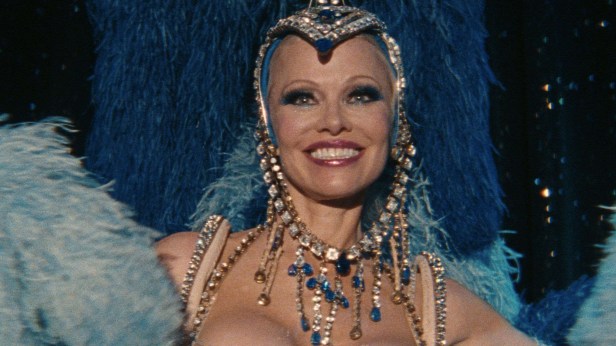
Once you pull back the feathers and remove the rhinestone headdresses, “The Last Showgirl” struggles to find substance. Gersten’s script hints at big ideas—ageism, ambition, and self-worth—but they remain underdeveloped. The plot follows Shelly in the lead-up to the final performance of the nudie revue “Le Razzle Dazzle,” a fictionalized nod to the long-running “Jubilee!” show (I saw it in the mid-90s) at the MGM Grand. As the show shutters to make way for a flashier “dirty” circus, Shelly wrestles with her love for the stage (“We were the ambassadors of style and grace”) and the harsh reality of aging out of her profession.
An undercooked subplot involving Shelly’s estranged daughter (Billie Lourd, daughter of Carrie Fisher) is almost an afterthought. More prominent, though no less thinly drawn, is Shelly’s friendship with Annette (Jamie Lee Curtis), a cocktail waitress with a gambling problem who is also clinging to her past. Curtis, sporting frosted lipstick, a deep orange tan, and a questionable wig, becomes a walking sight gag. Her most cringe-worthy moment—a burlesque performance to Bonnie Tyler’s power ballad “Total Eclipse of the Heart” in front of disinterested daytime slot jockeys—is so cringey it veers into parody.
The supporting cast, including Brenda Song and Kiernan Shipka (little Sally Draper from “Mad Men”) as Shelly’s stage “family,” barely registers, except for Dave Bautista (“Guardians of the Galaxy”). As the quietly caring stage manager, Bautista delivers unexpected sensitivity, making two simple words—”Places, please”—resonate more emotionally than entire scenes.
Jason Schwartzman (terrific in the recent “Queer”), the director’s cousin, playing a smarmy director, spells out the film’s thesis in one blunt audition scene. He dismisses Shelly as “not young or sexy” enough for his new show. Shelly’s defiant response—”I’m 57 and beautiful, you son of a bitch”—lands with some sting, though it feels more like a moment for Anderson than Shelly. Anderson reportedly altered the line to reflect her actual age.
Coppola’s (“Palo Alto”) almost claustrophobic direction does the film no favors. The muted palette and lingering shots of cramped dressing rooms, dinner scenes, and narrow stairwells with the girls rushing up and down create a visual monotony that matches the script’s lack of urgency. Even the required dressing room scenes and backstage banter feel perfunctory rather than revelatory. The few attempts to heighten the drama—a sentimental ending set to Miley Cyrus’s “Beautiful That Way” as we see the show for the first time—come off as forced reminders of the film’s central message.
The buzz surrounding Anderson’s return, her first leading role since “Barb Wire,” seems to be the real point. Her contrived reinvention narrative, which includes multiple comments about making pickles and jam, is a shrewd marketing campaign that has paid off, earning the actress Golden Globe and Screen Actors Guild nominations. Never mind that her performance is pretty one-note, and the story goes nowhere. “The Last Showgirl” may not dazzle, but Anderson still knows how to work a spotlight.
‘The Last Showgirl’
Rating: R for language and nudity
Cast: Pamela Anderson, Dave Bautista, Brenda Song, Kiernan Shipka, Billie Lourde, Jamie Lee Curits
Director: Gia Coppola
Writer: Kate Gersten
Running time: 89 minutes
Where to watch: In theaters
Grade: C+
 Boston Movie News