This visually stunning drama celebrates human connection against a backdrop of endless motion.
By James Verniere/Boston Movie News
The movement is constant in writer-director Payal Kapadia’s luminous Cannes Grand Prize-winning “All We Imagine as Light,” a portrait of the lives of three resilient women in modern-day Mumbai. Prabha (Kani Kusruti) is a 30-ish nurse in a major hospital. She is married. But her husband has taken a job in Germany, and she hasn’t heard from him in over a year. Prabha has caught the eye of a doctor from another part of the country, who asks her about saying something in Hindi, a language in which he is not fluent.
Hospital worker Anu (Divya Prabha) is a mischievous, 20-ish cat lover in a relationship with a handsome young man named Shiaz (Hridhu Haroon). The young man is a Muslim, something of which she is certain her parents, who are sending her photos of eligible men, would disapprove. Prabha and Anu live together in a tiny flat with their cats, one of which is pregnant. For the second time in two months, Anu asks Prabha to cover part of her rent. The third woman in the story is the older Parvaty (Chhaya Kadam). She works a food counter in the hospital and is a neighbor of Prabha and Anu. Developers are trying to force Parvaty out of her home, and because her husband is dead, she has no legal document to prove that she has a right to live there. Parvaty is considering moving.
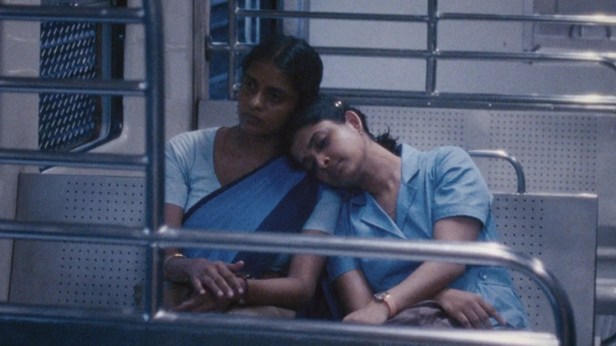
It rains in “All We Imagine As Light” all the time. When it is not raining, scenes are set shortly after the rain ends. In one scene, hospital workers run out onto a roof to collect laundry left hanging during a downpour. The action, colors, weather, flapping sheets, and movements amount to a cosmic dance. Then, a religious procession proceeds in the street, where people dance ecstatically in the heat and humidity. Kapadia transforms the ordinary into something sublime, and the faces of her characters are her most intimate canvases. As the stories unfold, Mumbai never stops. People walk in streets teeming with others, most headed for train stations and bus stops. Colorful produce is on display in open street markets everywhere. The brightly colored and patterned clothing is a beautiful rebuke to the rain clouds. Pregnancy is a refrain (the enamored doctor even gives Prabha’s kitty an ultrasound). The fluid camera of Ranabir Das, who also shot Kapadia’s debut film “A Night of Knowing Nothing” (2021), also constantly moves, following the characters in the streets, in trains, and on buses. Kapadia enjoys shots that move horizontally from left to right of the frame. She captures the endless motion and drive of modern life in super-populated Mumbai. But her characters still make time for hopes and dreams. Her work is rooted in the profoundly humanistic drama of Satyajit Ray with a touch of the fizzy romance of the Irrfan Khan-led, box-office sensation “The Lunchbox” (2013).
The story of Anu and Shiaz also echoes “Romeo and Juliet.” Not enough can be said about the contribution of the film’s piano, guitar, and synthesizer score. Somebody sings, “How did I get here?” Anu finds “4Ever” in a cave, freshly scrawled on a wall beside ancient effigies. Prabha knows about Anu’s secret romance and encourages her to speak to her parents. Meanwhile, Shiaz and Anu cook up a mad plan to have her travel to his village in a burqa. Later, she schemes to get Shiaz to follow her when she and Prabha accompany Parvaty to her new, rural seaside home. An assignation in the woods is in order. An introduction is made to surrogate mother Prabha, who breaks her absent husband’s hold on her by pretending to be the wife of a disoriented man she saved from drowning (another symbolic birth of sorts). The man was a factory worker who toiled so long indoors that he was forced to “imagine the light.” We end enshrined in a radiant, small bistro on the beach. How did we get here?
‘All We Imagine As Light’
Rating: Not rated, mature themes, medical emergency.
Cast: Kani Kusruti, Divya Prabha, Chhaya Kadam
Director: Payal Kapadia
Writer: Kapadia
Running time: 117 minutes
Where to Watch: Coolidge Corner Theater, Apple Cinemas Fresh Pond, and Newton 6
Grade: A-
 Boston Movie News