‘I’m Still Here’ is a powerful portrait of love and survival, starring Best Actress nominee Fernanda Torres
By James Verniere/Boston Movie News
A couple of weeks ago, Fernanda Torres was the surprise winner of the Golden Globe for Best Actress (drama) for her performance in the low-profile Brazilian film “I’m Still Here.” More recently, Torres was nominated for a Best Actress Academy Award, and this deeply moving real-life drama was nominated for Best Picture. Now, you can see why this “little” film has generated such awards heat.
Based on Marcelo Rubens Paiva’s 2015 memoir, Walter Salles’ haunting, marvelously acted effort tells the truthful story of the disappearance of Paiva’s father, political activist Rubens Paiva, during the military dictatorship of 1971 and the rule of right-wing Brazilian military leader and president Emilio Medici. The story unfolds from the perspective of Paiva’s loving, strong-willed wife, Eunice Paiva (Torres), who happily cares for him and their five children when the action begins.
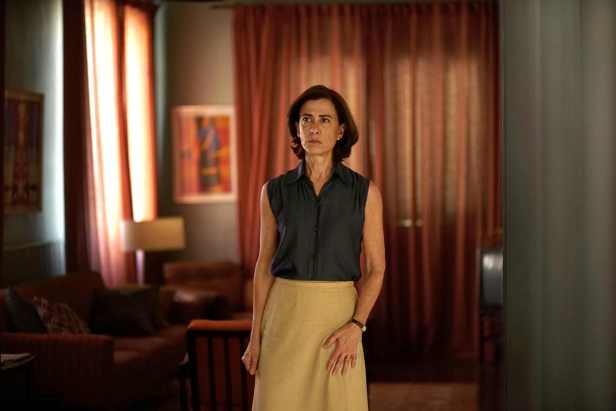
The Paivas are cosmopolitan. Rubens was a liberal congressman who returned to work as an engineer, although he still had political connections. He and his wife are part of an intellectual circle. Eunice speaks French with some of her friends. Her signature dish is a perfect souffle. The family likes listening to the activist-singer-songwriter Caetano Veloso (as well as King Crimson). Veloso’s songs punctuate the soundtrack. Eunice and Rubens’ headstrong, adolescent daughter Veroca (a terrific Valentina Herszage) is a fan of the dissident rock group Os Mutantes. Rubens and Eunice send her to London with friends fleeing the regime. But they and the rest of the children remain behind.
The film will remind some of Alfonso Cauron’s acclaimed 2018 family memoir “Roma,” another intimate story of a close-knit family in crisis in the early 1970s. The Paivas live comfortably in a large house near the beach in Rio de Janeiro. Christ the Redeemer literally stands above them, arms outstretched. But he cannot protect Rubens (Selton Mello) from armed men in civilian clothing when they come to take him. The Paivas, like “Roma,” have a faithful maid named Zeze (natural-born scene-stealer Pri Helena), who is treated like another family member.
Rubens assures Eunice that he will soon be back. But in fact, Eunice and her daughter Eliana (Luiza Kosovski) are also taken to a military barracks, where Eunice spots Rubens’ red Alpha-Romeo in the parking lot. In Eunice, the military finds an especially tough nut to crack. She’s tougher than she looks. In the film’s opening scene, Eunice has an uneasy reaction to a helicopter passing over her while she swims in the sea, perhaps a premonition of how Rubens may face his fate from the military.
The film gives Torres the opportunity to explore Eunice’s character in the way that she interacts with her five children in this crisis and how she struggles on her own after her husband is taken away. We also see how Eunice responds to the terrifying deprivations of her captivity. Building a portrait piece by piece, Salles shows us home movies and family photographs. He uses archival footage to depict some scenes of the military action. Eunice, for example, notices trucks carrying armed soldiers driving through the streets. She can’t withdraw money from the bank without her husband’s permission. The family must settle for burying their beloved dog Pimpao, who is hit by a car, instead of their “missing” husband and father. The strength of Eunice’s love is what Torres, who worked with Salles on his 1995 drama “Foreign Land,” projects with such amazing power, and that reflexively protective maternal devotion makes us gravitate toward Eunice and want her to embrace us.
Salles makes a 25-year-long cut in the third act after the family moves from Rio de Janeiro to Sao Paolo and a less expensive home. Eunice becomes a lawyer and educator fighting for Indigenous people who are being victimized by “land grabbers.” Her grown children are well-adjusted and successful.
But, while the government has admitted that people were tortured and “disappeared” during the Medici regime, it will not accept responsibility. The perpetrators have not been punished. Victims have not been compensated. Will a death certificate bring peace? See the haunting photographs of the real family over the final credits. Eunice, if there were any justice a Brazilian national hero, is played in extreme old age by Torres’ real-life mother Fernanda Montenegro of Salles’ similarly heartbreaking1998 drama “Central Station.” The ensemble cast of “I’m Still Here” is brilliant. But Torres is the film’s lifeblood.
‘I’m Still Here’
Rating: PG-13, profanity, drug use, mature themes, brief nudity. (In Portuguese with subtitles)
Cast: Fernanda Torres, Selton Mello, Valentina Herszage
Director: Walter Salles
Writer: Merilo Hauser, Heitor Lorega, Marcelo Rubens Paiva.
Running Time: 2 hours, 16 minutes
Where to Watch: Coolidge Corner Theater, AMC Boston Common and Alamo Drafthouse
Grade: A-
 Boston Movie News