Catherine Deneuve delivers a sly, simmering turn in this glossy political comedy that turns the sidelined first lady into an unlikely power player.
By Sarah G. Vincent/Boston Movie News
“The President’s Wife” (2023), titled “Bernadette” in France, is a fictionalized biopic about Bernadette Chirac from May 17, 1995 through April 2007 when her husband, Jacques Chirac, was elected to be France’s president through the nomination of his successor after he stepped down for health reasons. Catherine Deneuve stars as the titular character who has a keen strategic mind, but her daughter, Claude (Sara Giraudeau), who acts as an official advisor to her father, and husband, Jacques Chirac (Michel Vuillermoz), have relegated her to the sidelines. Whenever she works or gets the spotlight, they inject themselves into the situation, chide or humiliate her. With the help of her communications adviser, Bernard Niquet (Denis Podalydès), nicknamed Mickey, she becomes more popular than her husband and becomes the secret weapon who can unite her party. Only a movie could transform a woman descended from a baron into an underdog.
Even if you know nothing about French politics, the party reputation or any characters, it probably does not matter since “The President’s Wife” emphasizes how it is not real. The film does not offer any context about the situation. Why is Bernard nicknamed Mickey, and why is it an insult? (Think Mickey Mouse, not Toni Basil.) How did Nicolas Sarkozy anger and betray the Chirac family? What is a préfet? (The national government’s administrator at the local government level.) This film is made for a French audience first, but the humor transcends borders and is a broadly feminist work for a French film. Though it is unclear whether the comparison to Hilary Clinton or Princess Diana is fair, Bernadette is seen as comparable though cowriter and first-time feature director Léa Domenach and cowriter Clémence Dargent also puncture the idea with a few casual asides about the limited celebrity options to support her charity because of her politics and the list of legal charges waiting in the wings until Chirac left office. On the other hand, they are against Le Pen and racists.
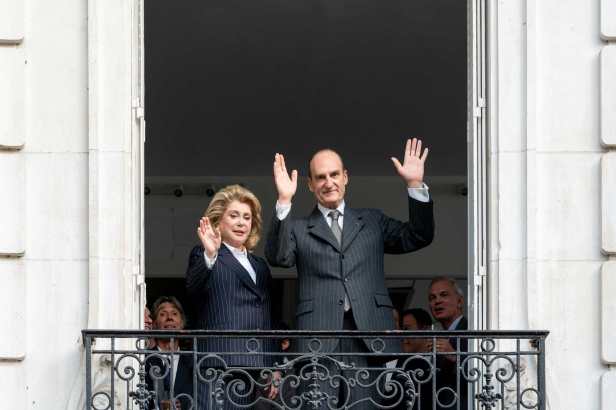
Domenach and Deneuve are great partners at showing all the ways that Bernadette gets disrespected: a lunch seating arrangement, the placement of flowers, her distance from the inner circle of advisers. Even though she is living in the Palais de l’Élysée, the President’s official residence in Paris, she ranks lower than a chauffeur and the butler. Apparently her nickname was the tortoise because she was considered slow and out of date, which is not explicitly referenced in “The President’s Wife,” but is symbolized when her other daughter, Laurence (Maud Wyler), gifts a turtle in an aquarium to her mom. Not recognizing the internalized misogyny, daughters side with fathers and team up against mothers, which is the extra twist of the knife in this story. It is one thing to suffer the indignity of a husband minimizing her accomplishments, but he has a whole team of guys, including her daughter, who are complicit and cheering him on. Bernadette gets extra points with the audience because she refuses to undermine her daughter’s power since she is framed as a mother first. It is an infuriating situation. He can have an affair, but she cannot go to the club. She is like Cinderella, but her prince will not let her go to the ball.
“The President’s Wife” is an engrossing cha cha because every time Bernadette moves forward, her husband or his supporters reign her in, and she does not know how to center herself first. It becomes a tale of empowerment where the trick is for her to remain the faithful wife and get to finally take her rightful place in the spotlight. Cue Bernard, a nerdy dude, cheering her on and in one humorous moment, is bopping to music in shades and a leather jacket which is a stark contrast to his usual fashion choices. Even Chanel’s Karl Lagerfeld (Olivier Breitman) appears to give her a makeover. As her star rises, so does Bernard. The movie is at its best when they are a team, but eventually their paths diverge, and it is not as much fun to have her strategize without a partner in crime.
“The President’s Wife” misses an opportunity to switch gears and have Bernadette team up with Aurore (Barbara Schulz), the only advisor who eventually recognizes the First Lady’s value. No girl power for moviegoers. It also pulls punches when Bernadette finally crosses the line and does something that her husband did not do—publicize a private family member’s medical condition. Of course, the movie uses sad piano music to manipulate viewers into rationalizing that she was just defending herself against unjust charges, but sometimes you just got to take the L and admit that you’re wrong. The win is the consolation prize. You can’t have it all. This portion may be fictionalized since Bernadette’s book, “Conversations,” was published October 19, 2001, but the Maison de Solenn, a clinic for anorexics, was created in 2004. The chauffeur, whose real name was Jean-Claude Laumond, did write a tell-all book, “Twenty-five Years With Him,” which was published on September 11, 2001, but it sounded harsher in its criticism of Chirac! The film calls him Yvon Mollinier (Lionel Abelanski) and shows him in an unflattering light
Domenach uses a choir a la “Ally McBeal” style, a literal Greek chorus for the big screen, to add hilarious exposition and set the emotional tone, but the narrative device gets abandoned for such huge stretches that it feels as if they were added after the fact as a creative way to satisfy the movie’s lawyers so the Chirac family would not sue them. Unsurprisingly the real-life Claude disavows the film. The director is more consistent and technically astute with blending archival video footage with the actors’ performances. It was an interesting choice to not show Chirac’s face when he was in the hospital. Were Denueve and Vuillermoz even in the same room when that scene was recorded? Domenach gets a little trite in a subsequent scene when Claude and Bernadette are in a chapel then Laurence busts in wearing white as the most righteous member in the family never to be seen again. It was a strange loose end that made the film seem unfinished although it implies that they are estranged. (Laurence died of a heart attack in April 14, 2016.) Claude’s 11th-hour 180 degrees felt as if it came out of nowhere because the movie needed a happy ending.
As a technical side note, eagled-eyed viewers should note the evolution of telecommunications in “The President’s Wife”: a phone with a cord, a huge cell phone that looks like a walkie talkie on steroids and a flip phone. There is a running joke of a confessional used to vent about professional setbacks or wheel and deal for professional success. It is an incisive shorthand for the real faith of everyone in this story: not in God, but the validation of the spotlight. All the world is a popularity contest!
If you do not mind a film that is glossy, two-dimensional fun with a simplified message about chauvinism than a rigorous reflection on the politics of the past, then “The President’s Wife” is for you. The acting is seamless. The scenario is closer to a political comedy than a biopic. The filming locations will make you want to book a flight to France yesterday. Still the whole set up feels deeply suspicious as if Domenach is making her audience root for someone who may not deserve it without being willing to embrace her protagonist’s anti-hero qualities or perhaps never wanted the spotlight at all since she has not appeared in public since the death of her husband. Note that the Chiracs had a third daughter, who is a foster daughter from Vietnam and is omitted entirely from the film for unknown reasons.
‘The President’s Wife’
Rating: NR
Cast: Catherine Deneuve, Denis Podaldès, Michel Vuillermoz
Director: Léa Domenach
Running time: 1 hour 32 minutes
Where to watch: In theaters April 18
Grade: B
 Boston Movie News