Love, betrayal and generational ghosts swirl in this hot blend of cultures and consequences
By Sarah G. Vincent/Boston Movie News
“Black Tea” is the latest film of Mauritanian director and co-writer Abderrahmane Sissako, who has not released a film in 10 years since his Oscar-nominated “Timbuktu” (2014). Runaway bride Aya Yohou (Nina Mélo) leaves the Ivory Coast for Chocolate City in Guangzhou, China, where she immerses herself in Chinese tea culture and enters a professional and personal relationship with her employer, Cai (Chang Han), who owns a tea export shop. To begin a life with Aya, Cai must clear the books of his heart and tie up the loose threads of unresolved relationships from the past. Will their relationship see the light of day, or is it an unlikely fantasy?
Aya is a stylish, multilingual, observant and contemplative young woman who initially appears to break free of a generational curse of entering a miserable marriage and ventures to another country to discover happiness. Her sense of adventure means that she is soon at home in Guangzhou, and through Aya, “Black Tea” offers moviegoers a slice of life in a world that most will never see first-hand: the local shops, the market-lined streets, and restaurants. It would have been helpful in the opening scenes to hint at Aya’s passion for tea, but it is not a dealbreaker.
At first, “Black Tea” seems like a beautiful portrait of a neighborhood and its denizens. Douyue (Zhi-Ying Xhu), an aesthetician who works at the beauty shop, Chez Tresor, which Tresor (Emery Gahuranyi) owns, admires Aya’s sense of adventure and commiserates over bad men. Even the friendly beat cop, Tao (Wen-Kuei Chiu), and his sweetheart (Heaven Hso) patronize the place. Aya’s coworker, Wen (Wei Huang), and Mei (Pei-Jenn Yu), the luggage shopkeeper across from the tea shop, are the locals closest to Aya’s age group and peers. Mei’s mom (Wei-Hua Chiang), like other townspeople, is desperate to marry off her daughter and holds her photo in the park. An Arab merchant (Cheikh Ahmed Kenkou) shops for lingerie with the help of an interpreter.
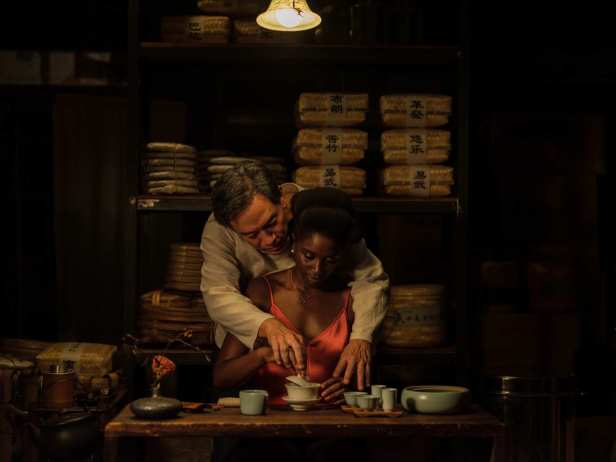
Though older than Aya, the soft-spoken and gentle Cai is hot as can be, and it makes superficial sense that Aya or anyone else with working eyes would be interested. Every scene between them feels like that pottery sequence in “Ghost” (1990), but as Cai’s past is revealed in flashbacks, he seems like a walking red flag, which “Black Tea” seems to not notice or see as a problem. Maybe the film is into radical, unconditional acceptance. In any culture, a man with two different baby mamas, one in Cape Verde, and two kids around the same age is probably known as a player. Practical minds will wonder if Cai at least paid child support. The film is so caught up in the interracial romance that it borders on fetishization, as if just being open to romance with someone of a different race erases all other flaws and transforms someone into a good person. While Cai is separated from his wife, Ying (Ke-Xi Wu), it is unclear whether they are divorced. Their son, Li-Ben (Michael Chang), so approves of his father’s latest relationship and the changes in his neighborhood that he embraces African dance and verbally offers tongue lashings to any racists regardless of his relationship to them. No one seems to mind that Cai cannot keep his pants on off-screen, not even Ying, who seems to fantasize about Aya soon after meeting her, which may explain why everyone is copacetic with Cai moving on.
“Black Tea” is so visually determined to emphasize the African and Chinese culture that the film’s most shocking, unexpected development is its French-like sensibilities over sexual relationships. The film is sensual, not sexual, so it is easy to miss all these salacious twists and turns. Lest our dear readers mistake this pearl clutching for bourgeois sexual respectability politics, a vignette drops out of nowhere about one of Aya’s friends, Touli (Veronique Bailey), who is returning to their hometown for vague reasons related to shopping malls supplanting local businesses. Cai then tells a story that implies that Touli had a whirlwind romance with a long-distance lover. She later discovers the identity of this man. Her lover was her father. If you watch “Black Tea” with that filter over the second half of the film, you would be disturbed too, considering the other events that are revealed throughout the film. Hint: Traditional brides wear red in China. Genetic sexual attraction is a theory that biological relatives who are unaware of their kinship could feel a sexual attraction, but discussing them casually feels like psychologically grooming the audience for Cai’s reason for traveling, which would otherwise seem heartwarming and innocent.
Otherwise, the languid merging of two cultures into a quotidian Sino-African society feels like the utopian alternative to the future as imagined in 1982’s “Blade Runner.” Immigrants and locals speak Mandarin with ease and little friction, though as “Black Tea” unfolds, an ember of ugliness sparks here and there until it erupts into a flame that the natives stomp out to ensure harmony.
When conflict erupts, it is sudden and seems to materialize out of the blue. Is something lost in translation because there are two unfamiliar cultures at play, or just gaps that the writer Kessen Tall failed to fill? It could be as innocuous as two people passing in the street. After expressing that she hoped to see him, Aya snaps at Korka (Bernard Mlandvo Mhlanga) for meddling in her life. Li-Ben shows a clip of a standoff between African men and cops, but it is inscrutable what is happening. Did the jewelry shop close because locals are test-driving Jim Crow? The only upbraid that felt appropriate was when a fellow customer, Vivi (Isabelle Kabano) snaps at a local door-to-door salesman.
For newcomers to Sissako’s work, it is unclear whether he has missed a step in terms of storytelling or if this movie is characteristic of his approach to narratives. Thanks to cinematographer Aymerick Pilarski, “Black Tea” is so consistently visually sumptuous and soothing that throughout the first half, you will not care, but as the film continues, it becomes harder to rationalize that the story will come together and ignore its flaws. At its best, it is a story about (heteronormative) love and seamless belonging where differences only enhance life, not divide it. At its worst, dangerous behavior is like a wolf in Benetton clothing, hoping to get rubber-stamped along with the laudable qualities of the multicultural ordinary life of everyday people.
“Black Tea” will not suit everyone’s tastes, but visually, it is everyone’s cup of tea. At some point, Cai’s story eclipses Aya’s, and the movie is poorer for it. If Aya was the orbit around which everyone revolved, then it could have been Altman-esque instead of disjointed and random, but Sissako is too drawn to Cai’s life that he cannot help but follow him. It feels more like a bait and switch instead of passing the baton to create a kind of round trip to and from the Motherland. The ambiguity of this oneiric tale is only a relief because then Aya would not have fallen for poor treatment just because her suitor does not possess a familiar face. Keep running, Aya!
‘Black Tea’
Rating: Not rated (In Mandarin, English, French, Portuguese with English Subtitles)
Cast: Nina Melo, Han Chang, Ke-Xi Wu
Director: Abderrahmane Sissako
Writers: Kessen Tall, Abderrahmane Sissako
Running time: 110 minutes
Where to watch: In theaters May 9
Grade: B-
 Boston Movie News