Eleanor Coppola’s revelatory making-of doc screens in restored 4K at Somerville Theatre alongside ‘Apocalypse Now’
By James Verniere/Boston Movie News
Among the greatest films about the making of films, we can include Les Blank’s “Burden of Dreams” (1982) about the making of Werner Herzog’s “Fitzcarraldo” (1982); Frank Pavich’s “Jodorowsky’s Dune” (2013), a speculative documentary about what Alejandoro Jodorowsky might have accomplished if he had directed an adaptation of Frank Herbert’s science-fiction landmark “Dune;” and “Hearts of Darkness: A Filmmaker’s Apocalypse” (1991). Attributed to Fax Barh, Eleanor Coppola and George Hickenlooper (“Factory Girl”), “Hearts of Darkness” is about the making of Francis Ford Coppola’s Vietnam War classic “Apocalypse Now” (1979), a visionary and also notorious work that captured the madness of the Vietnam War in unprecedented ways. It has been re-released in a restored 4K version, showing July 18 and July 20 at the Somerville Theater. Film enthusiasts shouldn’t miss the chance to experience this on Somerville’s big screen with its impressive sound system—it’s the next best thing to seeing “Apocalypse Now” itself (which is also screening on July 19). My advice: see them both.
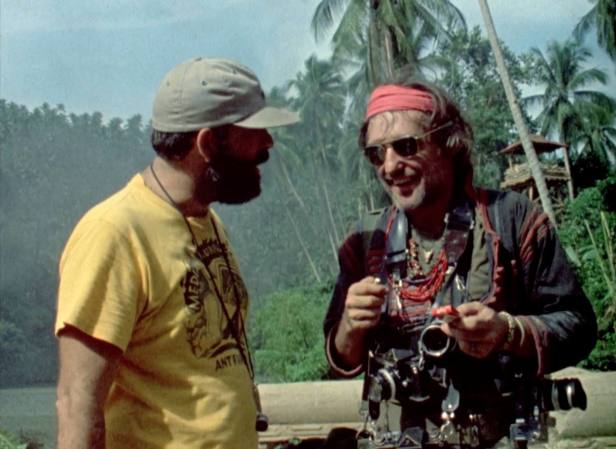
Instead of CGI, Coppola makes extensive use of white, orange and red smoke, literal and figurative fireworks, real wind and rain, extreme heat and humidity, hellish gunfire and a fleet of helicopters borrowed from Philippine dictator Ferdinand Marcos, who was in the middle of a real war with rebels at the time. Instead of green screens, Coppola brought his cast and crew to a real jungle.
Cast members are interviewed during and after the film was shot. Thirdy-six-year-old Martin Sheen, taking over from Harvey Keitel, who was let go after shooting began, plays U.S. Army Captain Benjamin L. Willard, an assassin assigned to murder rogue Colonel Walter Kurtz (Marlon Brando), a Special Forces Officer who has amassed his own army of body-painted Montagnard fighters in a compound in Cambodia, including a ruined temple built by Lowell’s own Dean Tavoularis. Also in the cast are an iconic Robert Duvall as aptly named Lt. Col. Kilgore (“I love the smell of napalm in the morning”), Albert Hall as patrol ship Chief George Phillips, 14-year-old Laurence Fishburne as Gunner’s Mate Tyrone “Mr. Clean” Miller, Dennis Hopper as a drug-addled American photojournalist and Frederic Forrest as Jay “Chef” Hicks, a cook who has a close encounter with a real tiger in a real jungle.
“Hearts of Darkness,” which takes its name from “Heart of Darkness,” the Joseph Conrad 1899 novella that inspired “Apocalypse Now” (along with Michael Herr’s acclaimed 1977 Vietnam memoir “Dispatches”), takes us on a darkly magical journey not unlike the Odyssean one in “Apocalypse Now.” Five-time Oscar winner Coppola (“The Godfather,” “The Godfather Part II,”) invests millions of his own money into the production, risking bankruptcy, and he is not pretending to be losing his mind as the shooting is stalled and complicated by a typhoon and the regal whims of Marlon Brando, who demands a million dollars a week. Coppola is losing his mind. He reminds listeners that “Apocalypse Now” is not “about Vietnam.” “It is Vietnam.” We are reminded that Orson Welles intended to adapt Conrad’s “Heart of Darkness” for the screen in 1939, before he made “Citizen Kane.” The studio refused.
Filmmaker Eleanor Coppola was asked by her husband to shoot documentary footage. She captures the film’s fireworks in and behind the scenes: the jets dropping a fiery swath of napalm, the gunfire, the mini-My Lai massacre on a sampan, the tiger’s obviously insane trainer and more. Co-screenwriter George Milius (“Conan the Barbarian”) is a bit barbarian. Coppola buddy George Lucas is an amused bystander. Academy Award-winning cinematographer Vittorio Storaro (“The Last Emperor”) and Coppola shoot the “Ride of the Valkyrie” sequence. “How can I quit?” asks an exhausted Coppola as the overages pile up and the shooting goes longer than 200 days. Newspapers run stories with headlines such as “Apocalypse When?” Leading man Sheen has a heart attack. Brando, who never read “Heart of Darkness,” shoots a scene in which his gleaming, shaved head is lit like the phases of the moon.
In the end, in addition to being nominated for eight Academy Awards and winning two (the film lost in the best picture and director races to “Kramer vs. Kramer,” for God’s sake), “Apocalypse Now” wins the Palme d’Or at Cannes and becomes a box-office sensation. Imagine a blockbuster based on the Vietnam War today. It was a triumph, snatched from the jaws of defeat. Cue the haunting strains of The Doors’ “The End.”
 Boston Movie News