A Norwegian wilderness school puts troubled youth to the test—with sled dogs, solitude and subzero nights
By James Verniere/Boston Movie News
Arctic boot camp for kids? Well, at least it’s not Alligator Alcatraz. In “Folktales,” a unique, coming-of-age documentary directed by American filmmakers Heidi Ewing and Rachel Grady, who co-directed the 2006 Oscar-nominated “Jesus Camp,” troubled adolescents, for most part from Norway, are sent to a school “gap year” at a camp inside the Arctic Circle where they will bond with each other, their survival teachers and the sled dogs that will take them into and with any luck out of the wilderness.
It’s “The Lord of the Flies” with snow, ice, wind, sled dogs and a deeply insecure young man from the Netherlands named Romain. Ewing and Grady are to be commended for taking the time to introduce us to their three main players. But first, they remind us who the Norns are, the deities who shape the course of human lives by weaving threads and meet Odin at the foot of the ”tree of life”, Yggdrassil, in Norse mythology. The young people in “Folktales” attend one of the 400 “folk high schools” in Sweden, Denmark and Norway. In this case, the school is in Pasvi, Norway, 200 miles north of the Arctic Circle, where the seasoned teachers Thor-Atle and Iselin guide the students into the wilderness and watch over them as they bond with their sled dogs. Each student is required to spend three days alone in their campsite, to care for their dog, keep their campfires going, and feed themselves. It sounds simple enough. But it’s the Arctic. Cinema verite is very verite when it’s zero degrees outside.
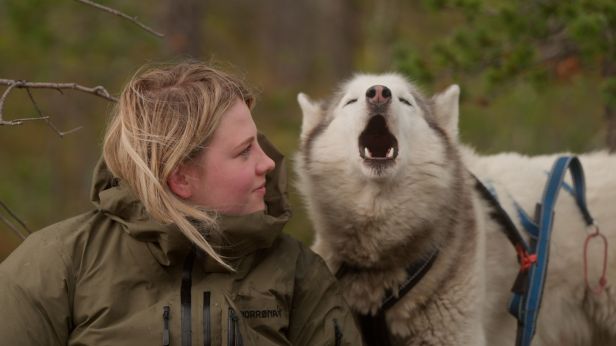
Hege, 19, repeatedly says that she tends to “overthink” things. She deeply mourns the loss of her father, murdered when she was a child, and she is currently navigating the “chaos” that is a young girl’s life in modern-day Norway. Bjorn Tore, also 19, is a big, beefy young man who tells us that he has no friends because people find him “annoying.” Netherlander Romain, 18, who is the only non-Norwegian student in the film (the students and teachers speak English together and on camera for the most part), is almost crushingly lacking in confidence. He seems preordained to fail at life. Bjorn yearns to bond with his dog. But the creature resists the young man’s clumsy attempts to secure its harness, and in the struggle, Bjorn accidentally steps on the dog’s paw. Among other things, students at the school will learn to fish, gut and cook their catch and to operate a dog sled with up to 12 animals in harness.
Iselin, the diminutive-in-size-only primary sled teacher, encourages her students to “wake up your Stone Age brain.” For his part, Odin-Atle takes the students to “baptize themselves in the Barents Sea” and invokes the name of King Neptune. He is also noteworthy for his ability to understand Romain’s insecurity and to assure the young man that he can accomplish things that he thought inconceivable. Odin-Atle’s reassurance is key to Romain’s emergence from the shell in which he has become imprisoned by insecurity. This is one of the film’s most extraordinary accomplishments.
The second is the film’s cinematography, which is breathtaking, especially in the forest at night. It does not take much to imagine a snow giant in the film’s frozen expanses or one of the many, often massive, trees to pull up its roots and walk away. The skies, which are dark most of the day, ripple with Northern Lights. The music of Brooklyn-based composer T. Griffin suggests a slow-motion fist fight between goblins and trolls. While otherwise the opposite of Jean Vigo’s groundbreaking, documentary-like “Zero de conduite” (1933), a recreation of Vigo’s experiences in a repressive boarding school, “Folktales” is yet another portrait of uneasy children on the cusp of adulthood. Mixing universal truths concerning adolescence with a generation that has spent its life gaping at screens, “Folktales” is a Nordic coming-of-age tale as full of wonders as Thor’s journey to Jotunheim.
‘Folktales’
Rating: Not rated
Director: Heidi Ewing, Rachel Grady
Writer: Ewing and Grady
Running time: 1 hour, 45 minutes
Where to watch: Coolidge Corner Theater
Grade: B+
 Boston Movie News