A moving portrait of Roberto Clemente as athlete, activist and humanitarian
By James Verniere/Boston Movie News
Executive produced by, among others, LeBron James and filmmaker Richard Linklater, “Clemente” runs the risk of being branded inauthentic because it was directed by Indiana-born and raised Emmy Award-winning filmmaker David Altrogge. But the film focuses so heavily on Clemente’s roots in Puerto Rico, his wife Vera (to whom the film is dedicated), his three sons and his love for Latino people (you won’t hear the neologism Latinx here), that it’s hard to argue that Clemente’s lifelong commitment to Puerto Rico and Latino and Hispanic people is not given enough attention.
Combining still photographs, home movies, animation, archival footage, including innumerable shots of Clemente on the field at Pittsburgh’s Three Rivers Stadium aka “the House That Clemente Built” and interviews with such Clemente fans as Michael Keaton and fellow Puerto Rican Rita Moreno, “Clemente” is a quietly revelatory look at the life and premature death of one of the greatest athletes in history. Born the son of a foreman on a Puerto Rican sugarcane plantation, Clemente, like other children, played baseball using a paper bag as a glove. His first real leather glove was given to him by a visiting Monte Irvin of the Negro Leagues’ Newark Eagles. Like Irvin, Clemente was recruited by the legendary Brooklyn Dodgers general manager Branch Rickey, who had also signed Jackie Robinson.
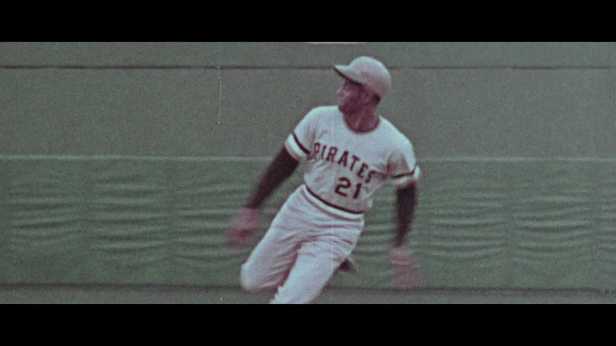
But the Dodgers lost Clemente to the hapless Pittsburgh Pirates, whose fortunes were about to change with the addition of the Puerto Rican, who did not like being called “Bob” by Pittsburgh’s white sports writers. His name was “Roberto,” R’s rolling. Because he was Black and Latino, Clemente was the target of two kinds of racism. But the fact was that he was a handsome man with a “perfect athlete’s body,” a bat that rivaled Thor’s hammer and a legendary arm that cut down base runners.
But Clemente was more than a baseball Hall of Famer. He was a social activist, a supporter of civil rights, a humanitarian and a regular guy. He was all of these things in a period when the Civil Rights Movement was gathering momentum (and bloody backlash). One of the interviewees recalls how, as a white child, he waved at Clemente, who lived in his neighborhood, as the player drove past, how Clemente stopped, got out of his car, and played catch with the kid, and then stayed for dinner with the boy and his stunned working-class parents, who became lifelong friends of the Clemente family.
Clemente’s three sons, who are also producers, lend considerable emotional weight, along with their mother, Vera, who died in 2019. The loss of the sons’ father on a flight to deliver aid to earthquake-ravaged Nicaragua in 1972 remains deeply felt over 50 years later. The film relates the story of an older sister, Anairis, who died after suffering burns when Roberto was a child, and who then appeared to Clemente in his dreams, perhaps a harbinger of her brother’s similarly premature death. Because he was outspoken, Clemente earned the ire of sports writers of the time, who often made him look dumb or angry. On the road, Clemente refused to ride in the bus that would take the team to segregated restaurants where he could not eat. At spring training in the ’60s, people handed out KKK applications in the stands in Fort Myers, FL. Clemente, a natural team leader, was determined to be a model player.
Like many athletes of his day, Clemente visited children’s hospitals. But he did not alert reporters. One of Clemente’s sons says he had a premonition and begged his father not to take the doomed flight.
Among those interviewed for the film are fan and political activist Tom Morello, guitarist with Rage Against the Machine, and Washington Post reporter and Pulitzer Prize-winner David Maraniss, author of the acclaimed 2007 biography “Clemente: The Passion and Grace of Baseball’s Last Hero.” A period TV interview reclaimed by director Altrogge reveals an unsmiling Clemente who has a lot to say with steely eloquence, but is arguably more relaxed and natural expressing himself on a baseball field.
‘Clemente’
Rating: Not rated, mature themes.
Cast: Roberto Clemente, Vera Clemente, Roberto Clemente Jr.
Director: David Altrogge
Writer: Altrogge, Elise Andert
Running time: 1 hour, 41 minutes
Where to watch: Lexington Venue
Grade: A-
 Boston Movie News