Paul Mescal and Josh O’Connor navigate secret passions amid early 20th-century rural New England.
By James Verniere/Boston Movie News
From Oliver Hermanus, the South African director and co-writer of the 2019 South African gay military drama “Moffie,” comes “The History of Sound,” a knockoff of Ang Lee’s “Brokeback Mountain” that exchanges gay cowboys for music researchers on an early 20th-century camping trip to capture folk songs in rural New England. It’s “Brokeback Music.” Shot by Alexander Dynan (“The Card Counter”) in a deep, dark shade of brown and based on a short story by Dartmouth’s Ben Shattuck, who also wrote the screenplay, the film begins in Kentucky, where we meet Lionel Worthing (BAFTA winner Paul Mescal), who, as a boy, claims that he can see sounds. Not much is made of this. As a new university student at Boston’s New England Conservatory, Kentucky boy Lionel meets fellow student and transplanted Englishman by way of Newport, R.I. David White (Emmy winner Josh O’Connor). The two share a mutual love and scholarly command of folk music. David sings, plays piano and challenges Lionel to sing in a crowded Boston pub, a lovely scene.
The two have a dangerous-for-the-times, secret affair and fall in love, but are separated when David is conscripted to fight in World War I and Lionel, who does not serve because of his poor eyesight, returns to the Kentucky farm and his mother (Molly Price, sorely underwritten and underused.)
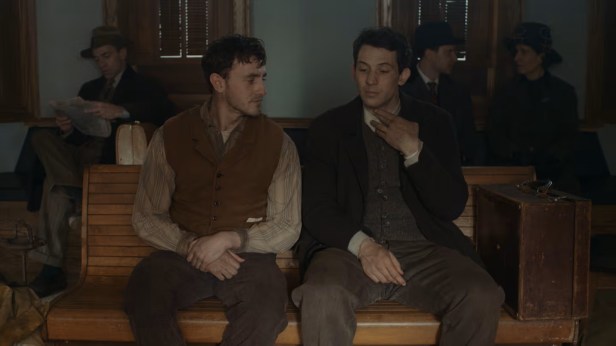
David and Lionel, however, are happily reunited when David is assigned to go out into the rural Northeast and collect folk songs and record them on wax cylinders, using a primitive machine and sleeping out in the open and getting around on foot mostly through the woods.
Like the remote Wyoming sheep grazing pastures of “Brokeback Mountain,” the 1920s backwoods of Maine provide Lionel and David with a woodsy Eden and an escape from the strictures and horrors of the real world. In nature, they are just two beings on a noble quest, one arguably more interesting than their dull romance as a couple of satyrs, enjoying each other in Arcadian freedom in the woods. Oddly, David has no war stories to tell, and Lionel does not ask him very much about the war.
In one of the best sequences, David and Lionel go to an island off the coast that has been settled by former slaves and record a song sung by a beautiful girl (Briana Middleton), only to leave the island, another Eden, just as a group of white policemen arrive, sent by the governor, who has other plans for the place. It’s a bit of terrible American history, rendered in miniature. For reasons not quite clear, the two separate again. Lionel ends up in Rome, where he trains a man’s choir, speaks Italian, and takes a dip in a fountain. He returns to England, teaching at Oxford, and becomes engaged to Clarissa (Emma Canning in another hardly there role). Lionel “meets the parents” in their “Downton Abbey”-ready manor house, where his and Clarissa’s room boasts a painting of Orpheus and Eurydice. Oh, them, again. Lionel takes a shirtless tour of the house at night (?) and has a nap on the carpet (??). Americans, right? The dialogue, like the action, can be stilted; the pauses long. Although it would be a spoiler to say what role he plays, Kingston resident Chris Cooper appears late in the film.
The folk songs we hear in “The History of Sound,” including “The Unquiet Grave” and “Silver Dagger,” brim with loss, loneliness and longing and serve as premonitions, as well as better works of art than this film. ”The History of Music” is lovely, dark and deep, and also a bit slow, dull and sleepy.
‘The History of Sound’
Rating: R for some sexuality
Cast: Paul Mescal, Josh O’Connor, Chris Cooper
Director: Oliver Hermanus
Writer: Ben Shattuck
Running time: 127 minutes
Where to watch: in theaters
Grade: B
 Boston Movie News