Jeremy Allen White broods, sweats and stares — but never finds the beat of Springsteen’s heart
By Dana Barbuto/Boston Movie News
I’m not having a good year with Bruce Springsteen on the big screen. It started when director Benny Safdie used the singer’s “Jungleland” — almost start to finish — in “The Smashing Machine” to score a domestic blow-up between Dwayne Johnson and Emily Blunt in his film about a struggling mixed martial arts fighter. Clarence Clemons’s transcendent sax solo becomes background noise for an emotional meltdown between a pair of doomed lovers. The Magic Rat and Barefoot Girl go through enough in that nine-minute epic song; they don’t need to be dragged into an uninteresting sports drama, too.
Now comes “Springsteen: Deliver Me from Nowhere,” writer-director Scott Cooper’s grim and graceless biopic about the making of the moody and introspective “Nebraska” album. Based on Warren Zanes’s book “Deliver Me from Nowhere,” the film revisits Springsteen’s emotional collapse in 1982, following the commercial triumph of “The River.” His label, Columbia Records, wants another hit; instead, he locks himself away in a Colts Neck, N.J., lakefront rental with a four-track recorder, a guitar, and his ghosts.
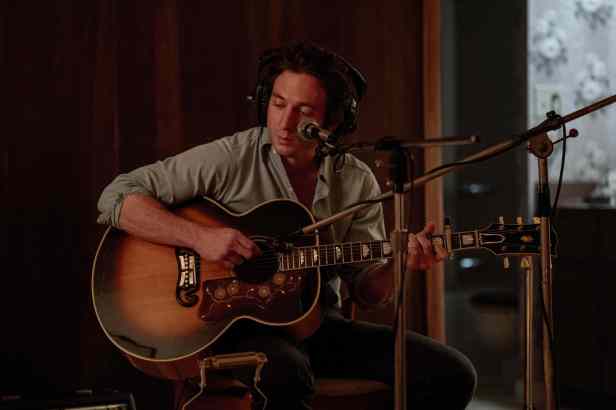
From the outside, things look good. Bruce has a new black Camaro parked in the garage, “Hungry Heart” still burning up the charts, and a sold-out tour behind him. But inside, he’s spiraling — a man terrified of his own success and haunted by a father he can’t forgive. Cooper gives us plenty of brooding shots to prove it: Springsteen guns his new car down deserted streets, eventually spinning out of control. He stares into space as if waiting for something — anything — to make sense. He anxiously taps his fingers on coffee cups and books. When a car salesman tells him, “I know who you are,” Bruce replies, “Well, that makes one of us.” Much of Cooper’s dialogue is this obvious and amateurish.
I was braced for impact from the start, with an opening black-and-white flashback to 1957, when an 8-year-old Bruce is sent into a dingy bar to tell his father it’s time to come home. Dad’s hammered… again. A fight with Mom is heard off-screen. A scared Bruce reads a comic book in bed. It feels like the setup for a Lifetime movie.
Cut to the first sight of Jeremy Allen White (“The Bear”) performing as Springsteen, shirt soaked in sweat, banging out “Born to Run” on a Cincinnati stage. It shook me more than expected — in all the wrong ways. White, his big puppy-dog blue eyes hidden behind brown contacts, looks like an alien Springsteen. He seems even more ridiculous mimicking Springsteen’s expressive, half-grimacing guitar-playing faces. He’s an auditory nightmare, too, sounding like a guy forced to sing karaoke on a dare. Later in the movie, White manages to turn the sensual ballad “I’m on Fire” into a dumpster fire. Thanks, Chef.
Luckily, not all the vocals are his. Some songs use Springsteen’s actual voice. Not even 10 minutes into the movie at the press screening, I was curled up in my seat, furious that my favorite singer was being done so dirty. (Yeah, I know Springsteen gave his blessing to the project, showed up on set, and all that — but this is still a disaster.) I just hope White doesn’t end up hosting “SNL” and performing songs, like Timothée Chalamet did to promote last year’s terrific Bob Dylan biopic. And God help us all if there’s an Oscar campaign.
Offstage, White delivers a tightly wound performance that never quite breathes. His Bruce feels like a variation of his angsty chef. I know he’s a Calvin Klein underwear model, but White has none of Springsteen’s sex appeal or rascally charm — two intangible qualities that would go a long way toward showing just how lost in the flood of depression The Boss eventually falls. Instead, Cooper crams the movie with repetitive flashbacks, other characters spewing exposition dumps about Springsteen’s state of mind, and drive-by gestures toward literary and cinematic influences. Springsteen is seen reading Flannery O’Connor and watching Terrence Malick’s “Badlands,” the latter of which is loosely inspired by the Starkweather killing spree that shaped the song “Nebraska.” Cooper clearly wants the audience to understand the darkness behind the music, but the references are just heavy-handed markers rather than insight. Springsteen literally flips through O’Connor’s book for about three seconds.
The story leans far too heavily on those endless flashbacks: young Bruce swinging a baseball bat at his father, fearfully watching “The Night of the Hunter,” and dancing with his mom (OK, I liked that one). Each moment tries to literalize what Springsteen expressed in song — inherited fear, shame, and working-class rage — but Cooper’s insistence on spelling everything out flattens the mystery. “Mansion on the Hill” plays over shots of Springsteen and his sister running through cornfields in front of a big house on a hill.
Jeremy Strong, as longtime manager and confidant Jon Landau, spends a chunk of the movie explaining Springsteen’s psyche to his wife (Grace Gummer) — scenes written for viewers who apparently can’t connect the dots themselves. Stephen Graham’s Doug Springsteen is grim and shadowed; the pain is there, but the complexity isn’t. Paul Walter Hauser brings some relief as the loyal tech who helps record the “Nebraska” demos. “These are kind of hard to dance to,” he tells Springsteen — a rare line that’s both funny and telling. The home recording sessions — the hiss of tape, Springsteen’s meticulous care, the fragile voice in a small room — are the only moments that capture the real story: an artist trying to build something raw, stark and true.
Cooper doesn’t do his female characters any favors, either. If only he could write about women the way Springsteen sings about them. In this movie, they’re one-note figures existing solely to prop up Springsteen’s story. Mom (Gaby Hoffman) tries to protect her son from his abusive father. Landau’s wife listens to her husband psychoanalyze Springsteen in silence, rubbing lotion on her hands. Then there’s the invented romance with Faye (Odessa Young), the pretty single mother conjured up only to be blond and to tell Springsteen to face his demons. The relationship is an unnecessary subplot meant to show warmth. He tells her she smiles a lot. But these two occupy far too much screen time, and their whole relationship only shows that Springsteen was a lousy boyfriend. His real struggle — his creative and emotional journey while making “Nebraska” — already has all the tension the film could want.
By the light of day, that doesn’t matter much. Ultimately, the movie misses the heart of “Nebraska” — it’s not a retreat but a reckoning. Cooper reduces the album to a therapy session, all pain and guilt. He forgets that amid the murder ballads and isolation, Springsteen was chasing authenticity, trying to “find something real in all the noise.” “Springsteen: Deliver Me from Nowhere” just adds more noise — and misses the music entirely.
‘Springsteen: Deliver Me From Nowhere’
Rating: PG-13 for thematic material, some sexuality, strong language, and smoking.
Cast: Jeremy Allen White, Jeremy Strong, Paul Walter Hauser, Stephen Graham, Odessa Young, Gaby Hoffman
Director/Writer: Scott Cooper
Running time: 120 minutes
Where to watch: In theaters
Grade: C
 Boston Movie News