Richard Linklater’s playful behind-the-scenes look at the making of Godard’s 1960 classic is a cinephile’s dream—brimming with wit, style and cigarette smoke
By James Verniere/Boston Movie News
Who would have guessed that a feature film about the making of the 65-year-old French New Wave landmark “Breathless” aka “A bout de souffle” could be so much fun? Welcome to “Nouvelle Vague,” American filmmaker Richard Linklater’s tribute to film critic-turned-filmmaker Jean-Luc Godard’s ramshackle, revolutionary first feature film. The preening, incessantly quoting “genius” Godard (Paris-born actor Guillaume Marbeck) is piqued that his fellow critics Jacques Rivette (Jonas Marmy), Claude Chabrol (Antoine Besson) and Eric Rohmer (Come Thieulin) have already made their directing debuts. He even has to stand by while fellow Cahiers du Cinema critic Francois Truffaut (Adrien Rouyard) enjoys a triumphant start in 1959 with “Les Quatre cents coups” aka “The 400 Blows,” a slightly disguised portrait of Truffaut’s own troubled childhood in postwar Paris.
The critics of Cahiers du Cinema, inspired by the work of the neorealists of postwar Italy’s Vittorio De Sica, Luchino Visconti and especially Roberto Rossellini (Laurent Mothe), demand that the filmmakers of France take the camera out of the studio and make less stodgy, pseudo-Hollywood films more representative of lives of people in the modern world on real-life locations instead of sets.
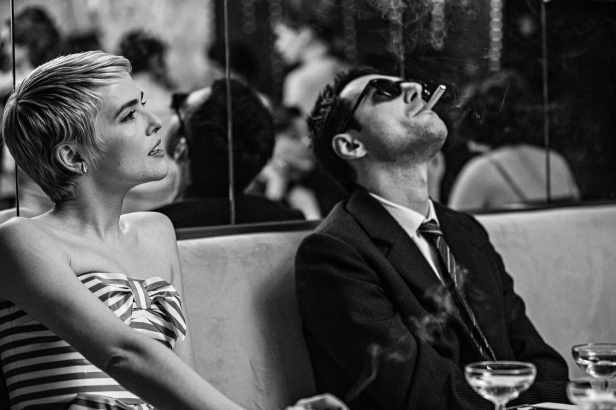
A bit of a slacker, dark shades-sporting Godard prefers to make such pronouncements as “all you need to make a film is a girl and a gun.” Armed with a screenplay by Truffaut loosely based on a true story of a young French criminal who worshiped American movie stars, the support of his colleagues and pithy quotes he unleashes like slashes of a knife, Godard gets producer Georges de Beauregard (Bruno Dreyfurst) to put up money to make a modest film on location in the streets of Paris. He hires an affable young actor and amateur boxer he has befriended named Jean-Paul Belmondo (Aubry Dullin) and manages to convince the rich, charming French husband (Poalo Luka-Noe) of Iowa-born American actress Jean Seberg (Zoey Deutch) to offer Columbia Pictures, to whom she is contracted, $15,000 or one half of the potential grosses to let her act in his film. Columbia takes the cash.
The plan is to shoot the film in 20 days. Cannily, Godard hires former war photographer Raoul Coutard, who would work with him on such films as “Alphaville” (1965), as cinematographer. Godard asks Coutard to get a Cameflex Eclair camera (which had already been used by Truffaut for “The 400 Blows”). But Godard has Coutard sit in a wheelchair with the camera on his shoulder, with Godard pushing him around, creating fluid, tracking shots without the use of dollies or tracks (and anticipating a famous sequence in Stanley Kubrick’s “The Shining”). The Cameflex camera can also be handheld.
French film figures such as Juliette Greco flicker in and out of scenes. Everyone smokes. Such nouvelle vague titles as “Le beau serge” (1958) are name-dropped. Godard pays a visit to the small Paris studio of established director Jean-Pierre Melville (“Le Samurai”), the spiritual godfather of the New Wave.
As Seberg, who was 22 at the time of shooting, Deutch, 30, is a lot of fun, imitating the intimidating “Herr” Otto Preminger (“Laura,” “Anatomy of a Murder”), the famous Jewish-German director who would play a lot of Nazis on the screen, and teasing Godard with her impression of him. She even teaches Belmondo to dance the Hully Gully. After filming for half a day, Godard and his cast retreat to Brasserie Lipp for a drink and a break to the tune of a jazzy saxophone. Godard’s ultimate goal was a “sexy slice of film noir,” but his work ethic suggested a tiny slice, indeed.
When Beauregard complains about Godard’s slowness, Godard says, “Money is not important to me.” Of course, he’s spending Beauregard’s money. A radiant Robert Bresson (Aurelien Lorgnier) makes a cameo, shooting “Pickpocket” in the Paris Metro.. Belmondo refines his Bogart-isms.
“Nouvelle Vague” makes me want to re-watch “Seberg” (2019), the biographical film starring Kristen Stewart in the title role. But what really sets “Nouvelle Vague” apart is that it is a comedy of manners about young French filmmakers (and a young American rising star) performing a cinema-transforming experiment on the streets of late 1950s Paris. During one driving scene, I couldn’t help but marvel at the vintage French cars. The cast is charming and funny. The subject is fascinating.
‘Nouvelle Vague’
Rating: R for profanity
Cast: Oscar Zoey Deutch, Guillaume Marbeck, Aubry Dullin
Director: Richard Linklater
Writers: Holly Gent, Laetitia Masson, Vincent Palmo Jr., Michele Petin
Running time: 1 hour, 46 Minutes
Where to Watch: in theaters
Grade: A-
 Boston Movie News