Amanda Seyfried leads director Mona Fastvold’s audacious portrait of a feminist mystic
By James Verniere/Boston Movie News
Directed and co-written by Mona Fastvold, who co-wrote the screenplay for “The Brutalist” (2024) with her husband, director Brady Corbet, “The Testament of Ann Lee” is another bold endeavor to tell an offbeat story in an unorthodox manner. In this case, Fastvold tells the story of Ann Lee (Amanda Seyfried), the founder of the Shaker movement, also known as the United Society of Believers in Christ’s Second Appearing. After an opening sequence in which women dressed in period clothing appear to vogue in the woods, we meet Ann as a child in the North of England, in Manchester in 1736, “raised in the shadow of Christ Church” by a poor blacksmith and his wife. Devout and thoughtful, Ann works at a cotton factory, where the conditions are dangerous. As an adult, an illiterate Ann enjoys listening to a Protestant dissenter condemning the Church of England outside the gates of the nearby church. She gets a job cooking at a Manchester insane asylum and meets and marries a handsome, black-bearded blacksmith named Abraham Standerin (Christopher Abbott). Their vigorous sexual relationship becomes decidedly kinky, and they have four children, all of whom tragically die in infancy.
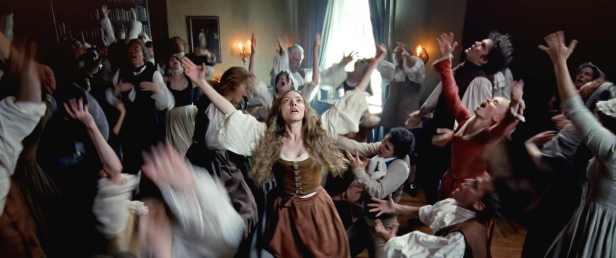
In 1758, Ann and Abraham join the English sect known as the Shaking Quakers—because of the manner in which they pray and atone for their sins by chanting and wildly dancing, writhing and gesticulating—founded by Jane Wardley (Stacy Martin, “The Brutalist”) and her husband James Wardley (Scott Handy). Soon, Ann has visions and is recognized by Jane and James as the Second Coming of Christ in the form of a woman. After several arrests and imprisonments for heretical beliefs and practices, Ann and eight followers, including her husband, set sail in 1774 for the New World, where she hopes to establish her new religion among more receptive and liberal people.
Fastvold, who shot the film, like “The Brutalist,” on 35mm VistaVision (principal photography took place in Budapest), might be described as one of the “children of Terrence Malick,” a filmmaker who seeks to awe the viewer with religious, semi-religious and nature-based visuals, transforming the film-going experience into something akin to entering a house of worship in search of religious inspiration through prayer or the presence of religious figures and objects. (Others have explored the similarities between film-going and houses-of-worship-going at greater length). Fastvold has made this more obvious by choosing a religious figure as her subject. But Lee is an ambiguous figure at best. Although she is certainly a pioneering feminist in her lifetime and in one scene hisses, “Shame,” at slave traders in New York City, her decision to preach celibacy as the only road to redemption is obviously flawed, if not crackpot. For one, her followers could not (or weren’t supposed to ) have children (there are now only three Shakers left in the United States). Two turned-on young Shakers in the New World are caught in the act in a shed and sent packing. “8 becomes 6,” Lee observes of her dwindling followers.
Will “The Testament of Ann Lee” produce any new converts? While the film tells a story, complete with a hushed voice-over by Thomasin McKenzie, who also plays Lee follower Mary Partington, “The Testament of Ann Lee” is almost a musical. People chant, sing, move their hands in and out as if they are doing push-ups, dance in circling wheels, twist and shout, writhe and wiggle.
Being a Shaker looks, at times, like a form of dance class. In fact, these scenes look too carefully choreographed. Are we to believe that these uneducated 18th-century “hempen homespuns” are trained hoofers? Ann speaks of the “sinfulness and depravity of human nature.” Is she recalling her kinky sexual relations with her husband, the painful, difficult births and the even more difficult deaths of her infant children? There is power and mystery in “The Testament of Ann Lee.”
But the film is repetitive to a fault. The dancing, singing and writhing get to be a bit much, really. The music of Daniel Blumberg (“The Brutalist”) and sound effects pound away. Is this the 18th-century Shaker version of “Wicked: For Good?” As great as Seyfried is in the title role and as admirable as many of the achievements of the Shakers are, Seyfried and Fastvold cannot overcome the problem that “Mother Ann” presents as a Christian oracle. “The Testament of Ann Lee” is an attempt to tap into and supercharge the awe and vague fevers we once felt seeing such films as “The Song of Bernadette” (1943), another film about a young woman who had visions, in this case of Our Lady of Lourdes.
But the troubles of the world do not stem from sexual relations as Ann believes. They stem from greed, hatred, ignorance, and, yes, religion. In America, Ann is declared a witch (of course) and met with even more violence, some of it brutally sexual. A beautiful, wooden, notably non-Brutalist and thoroughly glazed Shaker dwelling rises high in the Malick-ian wilderness. It is attacked by vile white men. Later, the camera stares imploringly up into a starry sky. You there, God?
‘The Testament of Ann Lee’
Rating: R for sexual content, graphic nudity, violence and bloody images
Cast: Amanda Seyfried, Louis Pullman, Thomasin McKenzie
Director: Mona Fastvold
Writers: Fastvold, Brady Corbet
Running time: 2 hours, 17 minutes
Where to watch: In theaters
Grade: B-
 Boston Movie News