Caleb Landry Jones can’t sink his teeth into Luc Besson’s ‘Dracula’
By James Verniere/Boston Movie News
Bram Stoker’s Dracula has reportedly appeared on film screens over 200 times, most recently in Robert Eggers’ overrated “Nosferatu” (2024), a remake of sorts of F. W. Murnau’s 1922 German Expressionistic silent film masterpiece “Nosferatu: A Symphony of Horror,” famously featuring the actor Max Schreck, one of stage producer-director Max Reinhardt’s stock company, in the title role. Murnau’s film plagiarized Stoker’s novel. Nevertheless, it is one of the greatest adaptations of it.
The other best versions include Universal’s 1931 early sound-era Tod Browning-directed “Dracula” with the great cape-clad Hungarian actor Bela Lugosi in the title role. “Dracula,” which ironically enough borrows elements from Murnau’s plagiarized classic, was not only an early “talking picture” smash hit. The film also helped Universal Pictures weather the Great Depression and paved the way for James Whale’s “Frankenstein” (1931) and other Golden Age of (Universal) Horror classics.
Dracula was then reincarnated, so to speak, in Technicolor in the 1950s by Britain’s Hammer Films in the Terence Fisher-directed effort titled “Horror of Dracula” (1958) in the United States, featuring icons-to-be Christopher Lee and Peter Cushing in the title role and as vampire hunter Doctor Van Helsing, respectively, complete with gory violence and pumped-up eroticism.
In the 1990s, Francis Coppola gave Stoker’s classic an A-film makeover with even more eroticism in “Bram Stoker’s Dracula” (1992), complete with cinematographer Michael Ballhaus (“Goodfellas”), production designer Thomas E. Sanders (“Crimson Peaks”) and costumer Eiko Ishioka (“The Cell”).
Now, we have this French-fried version of “Dracula,” aka “Dracula: A Love Tale” from scandal-plagued Paris-born writer-director Luc Besson (“The Fifth Element,” “La Femme Nikita”) with pale, blue-eyed, ginger-haired, Texas-born Caleb Landry Jones miscast as the blood-sucking Prince of Darkness.
What do Besson and Jones bring to the table? Not much, outside of a lightweight imitation of Coppola’s vision and another attempt to transform Stoker’s shape-shifting, wall-crawling, mustachioed blood-sucker into the world’s most misunderstood lover. In effect, Besson, like Coppola before him, borrows the idea of “immortal love” from Karl Freund’s 1932 box-office success “The Mummy” and creates a backstory for Dracula and his beloved wife Elisabeta (Zoe Bleu, daughter of Rosanna Arquette) and then has Dracula encounter her in transmigrated form. This treatment attempts to transform Dracula’s blood-soaked, erotically charged reign of terror into a grand romantic quest.
The film opens in the 15th century with some annoying love play between the married Elisabeta and Vlad, including a food fight, rose petals, feathers and writhing beneath sheets. Horsemen in armor arrive to drag Christian Vlad away to lead his troops against the Muslim Ottomans. Jones’ Vlad is a pale imitation of the Dracula of Gary Oldman (“Mank,” “Slow Horses”) from Coppola’s version.
The design of Besson’s film is also more diluted Coppola. Elisabeta resembles a Disney princess. Jones’ Vlad wears armor vaguely reminiscent of the signature, Academy Award-winning work of Ishioka for Coppola. The dragon-head-shaped helmet Jones wears looks like it would snap the neck of its wearer. Later, instead of boarding a ship for a voyage to England, Jones’s cardinal-murdering, newly-minted vampire Vlad, whose transformation is accompanied by thunder, lightning and a chorus of voices, arrives in Belle Epoque Paris for the 100th anniversary of the French Revolution.
At this point, we also meet the film’s only interesting character, an unnamed (?) “Bavarian priest” played by two-time Oscar winner Christoph Waltz. The priest is the film’s Van Helsing figure, and we get to know him in a Parisian insane asylum sequence, where a “second generation vampire” named Maria (an amusing Matilda De Angelis), who, in a ludicrous bit, attacks a cleric at her wedding reception, is kept in chains, still wearing her wedding dress. Maria is a dear friend of Mina Murray (also Bleu), the reincarnation of Vlad’s beloved Elisabeta. Unfortunately for us and the film, Bleu is a dud as this film’s object of immortal desire, and she and Jones have abysmal screen chemistry.
Like Coppola’s Dracula, Besson’s is both a sexual predator and a romantic hero (hmm), defying time, searching through centuries for his reincarnated beloved. Instead of preying upon a besotted Lucy Westenra (Sadie Frost), Besson’s Dracula “seduces” a convent full of crazed nuns.
This new screen Dracula has some unique characteristics. He possesses telekinesis and can open and close doors and gates. In Florence, he also bizarrely concocts a perfume that forces the nuns to go screaming mad for his hunky Prince of Wallachia. This Prince also has a host of living gargoyles at his beck and call, both in his French abbey and Romanian palace. They are this film’s demonic minions, and you are almost guaranteed not to like them as much as Besson does. Besson also has a thing for brigades of unattended lighted candles, so you know what to get him for Christmas.
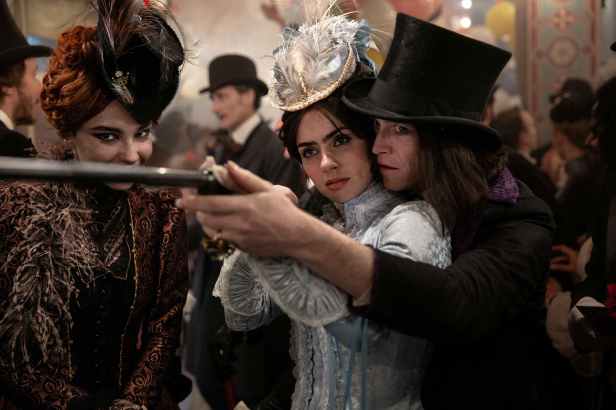
In a flashback, the newly-made vampire Vlad tries to commit suicide to be with his dead wife by hurling himself out of a window of his palace. In tone, Besson’s film often recalls the flamboyant 1974 “Blood for Dracula,” produced by the artist Andy Warhol and starring the great Udo Kier in the semi-comical title role. In “Dracula,” Vlad and Mina go on a date to a Parisian circus, where they encounter a puppet show, a bearded lady, conjoined twins and a mermaid dubbed “the Beast.” Why?
The film’s score, which was composed by the legendary Danny Elfman, features a theme very reminiscent of the lullaby from “Rosemary’s Baby.” Are you ready for gargoyle jiu-jitsu? Why is the army firing cannons at Vlad’s palace while its soldiers are inside trying to kill him? It may be a metaphor for this completely self-defeating, dopey, copycat “Dracula.”
‘Dracula’
Rating: R for violence, some gore and sexuality
Cast: Caleb Landry Jones, Zoe Bleu, Christoph Waltz
Director/writer: Luc Besson
Running time: 129 minutes
Where to watch: In theaters
Grade: C
 Boston Movie News