A diverse selection of animated shorts showcases a range of styles and stories.
By James Verniere/Boston Movie News
Per usual, this year’s “Oscar-Nominated Shorts: Animation” are a mixed bag.
From Israel, Cyprus and Russia comes Konstantin Bronzit’s “The Three Sisters,” which has little to no connection to Chekhov’s siblings of the same name. On a tiny, semi-circle-shaped, minimalist island, three sisters (one very tall) live together in seeming harmony. But one day, hungry gulls cause them to lose their pouch of coins in the sea, and they must rent one of their three adjoining, tiny houses. A smelly, portly, bearded, old sailor moves in, and soon the women are changing out of their drab clothing and prettying themselves up to win him over. Unlike Chekhov, the 2-D, hand-drawn “The Three Sisters” has no dialogue, only audible grunts. Its content is arguably retrograde. But its visuals are quite striking.
In “Forevergreen,” another 2-D effort, a bear cub develops a relationship with a paternal, animated pine tree. Both the bear and the tree look like they have been carved out of wood. The tree shows the bear how it can find food in the pine nuts it produces and shelter among its branches. But the bear is lured away prodigal son-style by junk food from human campsites and ends up in danger on a precipice separated from the tree by a chasm and a river. Another dialogue-free effort, “Forevergreen” features a wooden porcupine and explores themes of sacrifice, loyalty, temptation, nature, and courage. Visually, the film is CG with stop-motion-resembling, wooden-form characters.
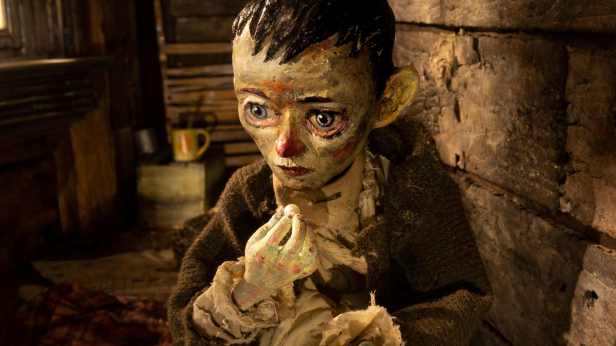
Perhaps the best of the lot is the dark, fairy tale-like “The Girl Who Cried Pearls.” Directed by Chris Lavis and Maciek Szczerbowski of “Madame Tutli-Putli” and a National Film Board of Canada production, this stop-motion effort begins with a rich grandfather telling his grim origin story to his young granddaughter. As a boy, he “prowled the docks” of Montreal by himself, seeking food and refuge. Squatting in an empty room next door to a family, whose kitchen might provide warmth through the connecting wall, the boy spies an abusive father and a daughter with whom he falls in love. Magically, her nocturnal tears turn into pearls that the boy sells to a greedy pawnbroker. Recalling the tales of Hans Christian Andersen, “The Girl Who Cried Pearls” features the voice of acclaimed Canadian actor Colm Feore a glimpse of Montreal’s Notre-Dame Basilica and is the likely winner of the Oscar, although I would have liked to watch the subtitled French-language version.
“Papillon” (“Butterfly”), another contender, tells the story of the real-life French-North African swimmer Alfred Nakache, whose life starts like an inspirational tale of an insignificant boy who grows up to become a world champion swimmer until the Nazi scourge intervenes and the grown boy swimmer and his wife and child are separated after being sent to the death camps, where the wife and child are murdered. Rendered in dreamy, Gauguin-like “paint-on-glass” images by director Florence Miailhe, whose father knew Nakache during WWII, “Papillon” has a haunting quality that the visuals reinforce, the sense that Nakache swims through the liquid repository of his memories. Nakache was one of only three Jews to compete in the Olympics after surviving the Holocaust.
In “Retirement Plan,” the somewhat dull, vaguely-drawn male main character Ray (voiced by Domhnall Gleeson) ponders the different (cliched) things he will do when he retires (read books, hike, learn the names of trees, be aggressively present, cry more), all to the piano accompaniment of John Carroll Kirby’s lonesome “Walking Through a House Where a Family Has Lived.” After dying, the man vows to “haunt his sixth-grade enemy.” Shoot the piano player, to coin a phrase.
As an added treat, the distributor includes first-time director Giovanna Ferrari’s hand-drawn “Eiru,” a Celtic tale of ginger-haired, mythic “Clan of Flame” waging war with rival clans until its only well runs dry, and it sends a fierce, tiny, would-be girl-warrior Eiru (Coco Teehan Roche) down the well to find out where the water went. Amusing, a bit Disney-fied, also nightmarish, “Eiru” deserves its place among these Oscar nominees.
‘Oscar-Nominated Shorts: Animation’
Rating: Some content not suitable for children
Running time: 1 hour, 23 minutes
Where to Watch: Coolidge Corner, Landmark Kendall Square, Plimoth Cinema, The Natick Center for the Arts, Institute of Contemporary Art, Cinema Salem, Capitol Theater, Warwick Place Cinema, Fine Arts Theatre Place, AMC Methuen 20
Grade: A-
 Boston Movie News