Sophie Dupuis’s third feature film masterfully explores the joys and challenges of a young drag queen’s life, with Théodore Pellerin delivering a standout performance.
By Sarah G. Vincent/Boston Movie News
Simon (Théodore Pellerin) is on top of the world with a loving family, a group of friends, a fulfilling day job as a makeup artist, and living the dream as a performing drag queen, Glory Gore, at night. A newcomer, Oliver (Félix Maritaud), whose stage name is Dragona, sweeps Simon off his feet. They decide to collaborate and combine their acts. As their relationship begins to pull Simon away from the ones he loves, he must face the conflicting emotions of reuniting with his mother, a famous opera singer, Claire Desjardins (Anne-Marie Cadieux), who is briefly returning from Europe. Will Simon lose himself while trying to secure love from two people who cannot give him what he needs? “Solo” is up-and-coming Quebecois director and writer Sophie Dupuis’s third feature film and is an emotionally powerful coming-of-age story.
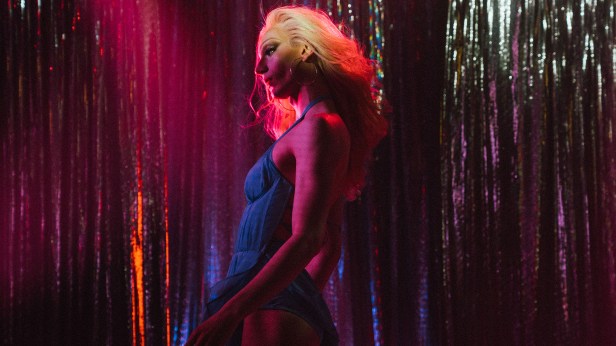
When introducing Simon, Pellerin, who has appeared in every Dupuis film, nails the youthful confidence of someone comfortable in his skin embracing his glorious androgyny. Thanks to some progress in the world, it is refreshing to have a film where a queer protagonist can exist without going through angst about establishing his identity against a tide of intolerance and hatred. His sexual orientation and drag persona are essential identity markers, not controversial. They are a source of joy, and continued celebration as Dupuis seamlessly cuts from his off-stage self and drag persona. This film exists in a space that is not heteronormative, although it acknowledges that the surrounding world is.
“Solo” addresses themes different from “Femme” (2023), another film with a drag queen protagonist. Dupuis’s film has the edge in showing complete performances, reflecting each character’s emotional state during each part of the narrative. Drag is not just dressing up and lip-syncing. These performances could be equated with the characters reading their private journals out loud to anyone willing to listen. Simon’s mental health can be gauged by how often he accesses his feminine side and performs with complete creative freedom without being awkward. Pellerin, who does not typically perform drag outside of this role, seemed like an expert.
Love surrounds Simon. His sister, Maude (Alice Moreault), seems to exist solely to cheer him on and provide a fabulous wardrobe. His father, Roger (Roger Léger), and stepmom, Aline (Josee Deschenes), are enthusiastic, authentic supporters of their two children. Frida (Jean Marchand) is the drag mother who runs the club where Simon performs with the mustachioed Edouard (Vlad Alexis), a comedic MC, Denise (Tommy Joubert), and Nicolas, nicknamed Nico, aka Tracy Trash (Marc-André Leclair), who brings the continental French Oliver to the club.
Even though Simon appears to have everything he could want, he is missing two types of love: romantic and maternal. Oliver initially seems to complete and enhance Simon’s already perfect life, but when Simon’s dad announces that Claire wants to see her adult children instead of their biological mother contacting them directly, Oliver witnesses the fragility of Simon’s relationships and how easily they buckle at the slightest pressure. Dupuis then shows Oliver implement the steps of the toxic playbook, which the inexperienced Simon is oblivious to, and others see but would sound crazy if they pointed out seemingly innocuous acts that could be rationalized as everyday escapades for two people in the early stages of falling in love.
“The People’s Joker,” which was a coming-of-self story about a transwoman, pointed out that there were no media examples of what a toxic relationship looks like in a queer relationship. Toxic does not always mean physical or sexual abuse, although Dupuis hints at some coercion in Simon and Oliver’s bedroom. It can also mean undermining another person’s sense of self to feel bigger. Dupuis does not reduce her characters into two-dimensional villains, but she does call out bad behavior when it appears on screen.
As Simon relies only on Oliver to fulfill all the roles that everyone else did before their meeting, Oliver begins to change the terms of their relationship rather than for their mutual benefit. Simon prioritizes his boyfriend and compromises his own needs, preferences, and desires until he is policing himself on Oliver’s behalf, thus betraying himself.
Simon does have experience in pretending to be cool by making himself small. He learned it from his relationship dynamic with his mother, and whenever you hear opera, he is not simply a fan of the genre but thinking of her. This portion of “Solo” is the most surprising, even as it is predictable, because it becomes retroactively obvious why Simon wanted to become a drag queen. Despite their different work, he feels a kinship with his mom’s faithfulness to her vocation. Dupuis’s junior film feels like a simplified reboot with less melodrama of Pedro Almodóvar’s “High Heels” (1991). As Oliver tries to talk himself into feeling satisfied with the scraps of time that he gets with his mom—he does not even rank high enough to share a meal with her, the added insecurity of his relationship with Oliver finally begins to affect his other relationships as he imitates their bad behavior or releases his valid anger in inappropriate ways long after the offense is committed, which makes him seem more irrational and isolates him further. It becomes a vicious cycle, and Dupuis and Pellerin just chronicle the quotidian horror of Simon’s two-fold and rising heartbreaks as he self-sabotages. Joubert makes a meal from a morsel and does some great work as he silently recognizes all the signs but refrains from intervening because he wisely understands that Simon must arrive at the same conclusions on his own terms in his own time like a caterpillar coming out of his cocoon. Marchand’s wordless, comforting pat on his fellow actor’s head comes out on top as Frida sees a wound aimed at Simon’s heart before Simon does.
“Solo” refers to performing alone but also signals that Simon must learn how to exist as an individual and not need others to define him. When he hits rock bottom, he recognizes that everyone who seems to exist for his benefit acts and reacts independently of his moods. As the movie unfolds, Dupuis often shows how Simon is at the center of the frame, but the diegetic sound or action at the edges of the frame contrasts with his mood. Simon realizes that people are the stars of their own movies. This realization shakes him as he considers what it means for him.
Dupuis never makes “Solo” feel like an “Afterschool Special” with heavy-handed dialogue. The dialogue feels organic, although the tell-tale sign of undermining is glaring. The subtext of every scene is obvious. Indeed, one central turning point between Simon and his mother happens at his lowest point when she validates him as a performer in a healthy and supportive way, finally focusing on him rather than her own fabulousness. The filmmaker keeps the dialogue to a minimum, using the dynamic energy of the camera and the seamless performances to convey the narrative and its characters’ psychological makeup.
The early scenes between Oliver and Simon are bathed in sunlight and happiness, while the club’s colorful lights express the freedom and joy of Simon’s world. As Simon begins to doubt himself, Pellerin transitions from grand, graceful movements to jittery, close-to-the-body gestures with a furtive refusal to make eye contact. The scenes become darker, with the most painful moment occurring when Oliver comments that one of Simon’s tops is not the right color for his complexion, even though green is Simon’s signature color throughout the film. These tiny wounds cut deeply.
Maritaud, one of the shorter actors in “Solo,” uses his physicality to possess and dominate. In a late backstage scene, Oliver bestows his attention on everyone, but when Maude enters, he rushes to Simon’s side and immediately begins to smother him, fearing that Maude might reclaim her brother and disrupt his monopoly over Simon. When the (conditional) loves of Simon’s life meet, Dupuis places them in a well-lit backstage room filled with mirrors, positioning Oliver and Claire closer to each other than to Simon. This physical representation of their relationship shows them more at ease with each other, delighting in superficial markers of fame rather than engaging in Simon’s raw, exuberant love. Simon internalizes their inability to accept and reciprocate the love he offers, which acts like a poison. It is a devastating depiction of an elemental relationship flaw that could feel trite but feels fresh under Dupuis’s watchful eye.
“Solo” has few flaws. There is ambiguity whether Simon’s use of drugs, which Oliver introduces to the group and alcohol are recreational or beginning to impact him as negatively as the unreliable Oliver claims. Praise Dupuis for not defaulting to the usual handwringing and just making it a factor but not a defining one. It is harder to watch Simon unravel, and Oliver manipulate everyone like a snake entering the Garden of Eden, but Dupuis and Maritaud provide enough margin to sympathize with someone who also could live a drama-free life as he claims to want but is the pot-stirrer creating conflict. They keep the viewers in the dark regarding what drives Oliver’s compulsions and insecurities to infect Simon with feeling as alone as he feels, but it is strongly implied that he did not have the same unconditional support.
‘Solo’ is one of the best movies released this year. It addresses common themes about bad boyfriends and mommy issues without feeling trite by setting it in a new context, a free and light queer world where the hate tree is not even visible. People are people with the same problems, just different packaging.
‘Solo’
Rating: Not rated
Cast: Théodore Pellerin, Félix Maritaud, Anne-Marie Cadieux
Director-writer: Sophie Dupuis
Running time: 1 hour 41 minutes
Where to watch: Apple TV, Fandango at Home, Google Play, YouTube
Grade: A
 Boston Movie News