Amid the chaos of war, Ukrainian artists sculpt beauty and defiance.
By James Verniere/Boston Movie News
What is it like to be an artist in a country under siege? An answer can be found in the award-winning non-fiction film and Sundance Grand Jury Prize winner “Porcelain War.” Directed by American Brendan Bellomo (“Beasts of the Southern Wild”) and Slava Leontyev, the film focuses on the artists Leontyev and Anya Stasenko, whose romantic and artistic partnership produces jewel-like, intricately decorated porcelain figurines, modern-day Faberge eggs in a sense. When he isn’t out in the wild, photographing nature with his partner Anya and their playful little dog Frodo, or in the studio, firing and assembling figures with her, Slava is an expert marksman, teaching former schoolteachers, lawyers, librarians, and carpenters how to fire and care for AK-47s and other firearms. Eventually, Slava’s students will be sent to the front to test their newfound skills against Russian invaders.
“Porcelain War” is an odd and edifying portrait of people trying to make the best of a miserable situation. In addition to Slava and Anya, whose bond is one of the film’s strengths, we meet their cameraman, Andrey Stefanov, who once lived idyllically in Crimea with his wife and two young daughters. But they all had to move from Crimea to Kharkiv to share digs with friends Slava and Anya. But after the Russians stepped up attacks in Kharkiv, Andrey’s wife and daughters were evacuated to Lithuania, and he has not seen them for a very long time. Andrey was also a painter, and we see him sitting beside one of his canvases, upon which we discern a dark, alien, abstract landscape. “Porcelain War” makes a case for the necessity of art during wartime as an act of rebellion and of creating beauty in the face of barbaric ugliness, and I wish we had been given a better look at Andrey’s paintings.
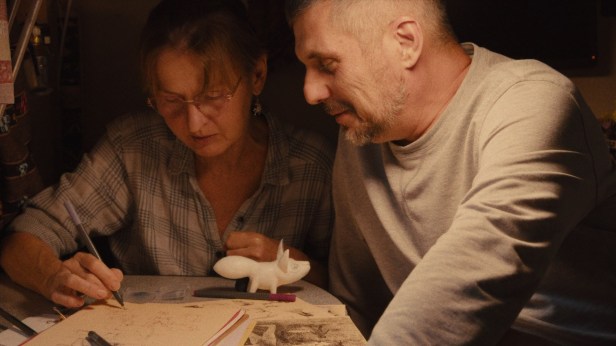
The porcelain figurines of Slava and Anya, snails, reptiles, and owls covered in sometimes animated painted scenes from folklore and from the artist’s imagination Anya, are beautiful and amusing. But I wanted to see more of the darkness conjured in Andrey’s art by the war and displacement of his family. At one point, he laments that a year and a half of their lives has been “ripped out by the war.” Andrey is also the cinematographer of the film, and his images show us the stark contrast between the natural beauty surrounding Kharkiv and the wholesale destruction of the rubble-covered city under constant bombardment from Russia. Even in the surrounding woodlands and wetlands, you feel that the bucolic adventures of the artists could be interrupted at any moment by Russian enemy soldiers. In one scene, Slava and Anya go mushroom hunting, and suddenly, Salva asks Anya to pick Frodo up. They have stumbled upon a minefield in the wild. One is reminded of Otto Dix, the German artist whose hallucinatory, nightmarish portraits of WWI trench warfare were condemned by the war-mongering Nazis as “degenerate art.” That would hardly be the case for Slava and Anya’s whimsical beasts. But the beasts do argue that all art created by victims of aggression is somehow political.
The closest “Porcelain War” gets to an artist engaging in an act of outright subversion is when Anya decorates a Ukrainian drone and smiles when the colorfully striped thing is deployed and later hovers precisely over targeted Russian foot soldiers, a tiny, buzzing bringer of death. A scene in which enchanted Ukranian soldiers play with one of Slava, and Anya’s creations make the pessimists in the audience wonder, after so much has been broken, who is going to be the one to drop the thing. The eerily plaintive score by the Ukrainian quartet DakhaBrakha is another of the film’s strengths. One may object to the obviousness of the film’s metaphors (Ukraine and porcelain are both “easy to break, but impossible to destroy” is only one of them). But is there anything more obvious than a land mine?
‘Porcelain War’
Rating: R for language. In Ukrainian, with subtitles
Directors: Brendan Bellomo, Slava Leontyev
Writers: Bellomo, Aniela Sidorska, Paula DuPre Presmen
Running time: 1 hour, 27 minutes
Where to Watch: Coolidge Corner Theater
Grade: A-

