A moving portrait of autonomy, grief, and resistance, this Puerto Rican drama delivers heartbreak with meditative beauty
By Sarah G. Vincent/Boston Movie News
Filmmakers, take notice! “The Fishbowl” (2023), originally titled “La Pecara,” is how you make a bleak film into a watchable, elegiac force. Writer and director Glorimar Marrero Sánchez, in her feature debut, tells the fictional story of Noelia (Isel Rodriguez), a visual artist who has colon cancer and can no longer ignore what she instinctively knows. It has metastasized, and all the options are long shots. She leaves her home on the main island of Puerto Rico to return to her birthplace in nearby Vieques, a smaller island off the east coast. Will she live the way that she wants?
Rodriguez found the perfect balance when transforming into Noelia. On one hand, she appears to be the ideal image of health, still vibrant, joyful, and curious, but she can erase it just as quickly when her body betrays her with pain or leakage, indicators of internal decay. There is nudity, but it is not sexual. This nudity is almost fetal, a return to her original form through impending death and facilitating the link between her body and water. Dying is a personal journey that she wants to own herself, not have others decide how she should navigate it.
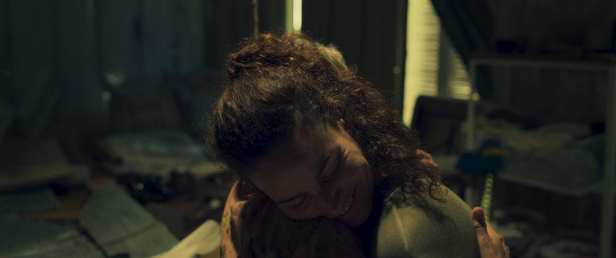
Noelia is rich in love. Jorge (Maximiliano Rivas) is clearly auditioning for partner of the year. Some men leave their women partners if they are sick, but Jorge is a smitten, devoted caretaker, which Noelia finds smothering despite his good intentions. Rivas’ performance never comes off as controlling; he’s more caring. He has a gentle, slight demeanor, and he still sees her as a romantic partner, not just a project to fix, but fragile. The best scene is when he wordlessly reminds her to take her pills, which editor Clara Martinez Malagelada also conveys to the audience by showing the character’s perspective, not only the gesture. For him, it is a wordless action of love, but for her, it is annoying. She would like not to spend every moment devoted to tending to illness.
Noelia’s life in San Juan is full. She has friends, her work, and her medical team, but with her health spiraling, she is not so much running away from anything as running towards acceptance, her work, her childhood comfort, and the final transition, which are all intrinsically linked to each other. While Noelia and other characters are fictional, the island of Vieques is not. Vieques has been a site of colonialism for centuries, starting with the Spanish, Scottish, and finally the U.S. In 1941, the U.S. Navy used Vieques for military exercises, which stopped in 2003, but they left unexploded ordnance and toxic chemical contamination, which includes uranium. The locals protested the shift in ownership from the land class to the U.S., but it culminated in 1999 because civilian lives were lost during these exercises, and cancer rates increased for people who live in Vieques compared to Puerto Rico’s main island. So, Noelia’s art and her hometown are devoted to examining how this affects their lives and trying to expose it to the public. “The Fishbowl” should feel heavy-handed, but it does not because protest is an organic part of quotidian life, not obstreperous.
The healthy characters in Vieques demonstrate how they protest the violence done to the island and its people. Noelia’s mother, Flora (Magail Carrasquillo), works to find unexploded ordnance so that more land can be used, rather than being restricted and cordoned off from the public. This fictional character is not far-fetched since a single mother in the documentary “There Was, There Was Not” (2024), and women as famous as Princess Di or as ordinary as Armenian Sveta Harutunyan are symbols of protection who venture into danger to defuse mines or bring awareness to the problem. Coffins and celebrations of life are an everyday sight in Vieques, and though the cause of these deaths is not mentioned, going home becomes a symbol of accepting death since it is such a fixture of daily life. Noelia’s former childhood friend and possible love interest, Juni (Modesto Lacen), is introduced transporting a coffin. Unlike Jorge, Juni does not try to curtail Noelia’s desire to live an ordinary life while seemingly aware of her final health battle. Noelia is franker with him about how she feels than anyone else, and while Juni can be seductive, his flirtation uses her body as an improvised map to describe the pollution that the island suffers; thus, suggesting his unconditional love and desire, not revulsion, of Noelia and her body despite its physical corruption. Maria (Anamin Santiago) oversees dives to document the U.S. Navy’s wreckage left behind, among other things. Maria functions as a gauge regarding where Noelia lies on the spectrum of dire circumstances, and Noelia is not in the worst-case scenario compared to others who remained in Vieques. It is a subtle way for “The Fishbowl” to remind moviegoers that while they may find Noelia’s story heart-wrenching, reality is much harsher.
Marrero Sánchez is clearly using Noelia as an onscreen surrogate in the way that the protagonist captures images. Initially these images seem disparate: a mixture of tourism porn (wild horses, a watery horizon, flags waving in the wind) and health still lifes (strips of her hair stuck to paper, placed in plastic bags, X-rays, etc.), but they are related. On closer look, the horses have tumors. The flags of the U.S. and Puerto Rico are symbols of the predicament they are in, namely, the lack of autonomy. These images silently protest and preserve history. Zora Neale Hurston wrote, “If you are silent about your pain, they’ll kill you and say you enjoyed it.” Noelia’s desire for autonomy, at least in death, is akin to the locals of Vieques’ desire to be free of the U.S.’s battleground, even if it is too late. The constant sound of coquis and horses neighing makes the location more specific than it already inherently is. Noelia is simultaneously saying farewell, has found a place steeped in death where she can exist without fear and without pity, and can fulfill her life’s work.
While “The Fishbowl” may sound melodramatic, it is not. It is a tranquil movie. Even with Hurricane Irma approaching, the outdoors and ocean do not seem threatening, but only like an outward manifestation of the storm brewing inside Noelia. It is a lyrical movie. As Noelia’s body leaks blood or fecal waste into water, it is almost as if she is painfully dissolving into the primeval waters from which all life emerged. These images are usually shown in body horror of the David Cronenberg variety, but in Marrero Sánchez’s hands, the horror is the pain, but the water is the right place to dispose of these biological elements.
“The Fishbowl” is entirely in Spanish, so if you do not speak the language, then you will need to read subtitles. Even if it is usually a dealbreaker, Marrero Sánchez’s film is a rare opportunity to see a nuanced, realistic portrayal of the end of a person’s life with a message embedded within the protagonist’s mortal struggle, without making it a preachy film or detracting from the intimate human story. It also defies the standard beats of movies about people with cancer. The movie’s primary purpose is not to be inspirational, but a countercultural image of revolution: embracing death without excusing or forgiving it.
‘The Fishbowl’
Rating: Unrated
Cast: Isel Rodríguez, Modesto Lacén, Maximiliano Rivas, Anamín Santiago,
Director-Writer: Glorimar Marrero Sánchez
Running time: 92 minutes
Where to watch: Apple TV, Prime Video, Vimeo on Demand
Grade: A

