Benicio del Toro stars as a flawed patriarch on a journey of self-discovery in Wes Anderson’s ‘The Phoenician Scheme’
By James Verniere/Boston Movie News
Wes Anderson is back with his flat, “panimetric” compositions, broken families and flawed patriarchs. In the case of “The Phoenician Scheme,” it is 1950, and the patriarch is Anatole Zsa-zsa Korda (played by Benicio del Toro, an Anderson repeater from “The French Dispatch”). Korda is a global dealmaker (wink, wink, nudge, nudge) with a plan to corner the market in rivets (or something). This will involve persuading other dealmakers to adopt his plan and join him in it, which is not an easy task.
The action begins aboard an airplane over the “Balkan flatlands,” where a bomb intended for Korda (Is the character named after the famous Hungarian-British producer-director of “The Thief of Bagdad?”) blows the upper half of an assistant out of the plane, which then crashes into a cornfield (it’s Korda’s sixth plane crash). Although seriously injured, Korda survives, and among those providing care to him is his young daughter Liesl (Mia Theapleton, making a strong showing), a novitiate nun who has been raised in a convent. Korda also has many young sons, who live together in a dormitory across the street from his art-filled palazzo. Some of the boys are adopted. Liesl is Korda’s only daughter.
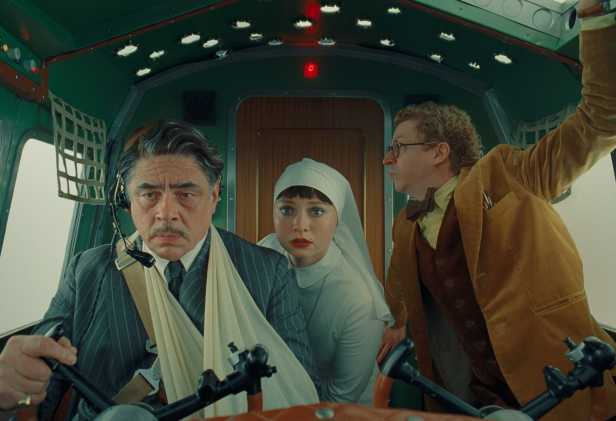
The relationship between Liesl and Korda, daughter and father, is central to the film. Like her very red lips, Liesl’s strong will and rebelliousness stand out in a young woman planning to devote herself to Jesus by symbolically marrying him. Korda, whose nickname is “Mr. 5%” and who likes to have a box of hand grenades handy, shows his daughter several cardboard boxes of different shapes and sizes, perhaps symbols of Anderson’s ouvre, in which he has meticulously stored files on a variety of subjects—dam, canal, tunnel, etc.—relating to his newest scheme (it is this film’s MacGuffin).
Throughout “The Phoenician Scheme,” which can be seen as a metaphor for making a film, we cut to a group of rival dealmakers seated around a big, curved table that will look familiar to fans of Stanley Kubrick’s “Dr. Strangelove or: How I Learned to Stop Worrying and Love the Bomb” (1964). Also, throughout the film, Liesl confronts her father, demanding to know if he murdered her mother, a crime of Greek and Shakespearean proportions. Into the fray comes a tutor named Bjorn (an absolutely divine Michael Cera, whose Nordic accent is worth the price of admission). Bjorn falls hard for Liesl, who wears only her nun’s habit and wimple (the rosary was made by Cartier). Bjorn becomes very jealous when Prince Farouk (Riz Ahmed) shows Korda and company the tunnel being made by his workers and flirts with Liesl. This is where ”train geek” Anderson gets to indulge in another passion.
The plot further involves Korda’s brother, Uncle Nubar (a particularly hirsute Benedict Cumberbatch). There may be more to Cera’s besotted tutor than meets the eye. Mathieu Amalric is hilarious as an apoplectic gangster-like businessman named Marseilles Bob. In a case of the apple not falling far from the tree, Liesl starts to carry a bedazzled dagger on her person. We get the usual percussive dialogue delivered by a starry cast: Charlotte Gainsbourg, Tom Hanks, Bryan Cranston, Richard Ayoade and more. Jeffrey Wright, another regular, gives the film a comedic jolt. Scarlett Johansson, from the director’s “Asteroid City,” is funny and captivating as Cousin Hilda. Is there time for basketball? Can we meet God?
Fans of Anderson’s trademark, eccentric style, offbeat characters, and distinctive visuals (as usual, the production design of Academy Award-winning, Anderson regular Adam Stockhausen is dazzling) will be in heaven watching “The Phoenician Scheme.” The score mixes original music by Alexander Desplat (“The Grand Budapest Hotel”) with works by Igor Stravinsky. With its gangster-like businessmen, plane crashes, neglected children, intricate plans, family secrets, media attention, self-referential elements, stylistic choices, and bags full of money, “The Phoenician Scheme” is a delightful tribute to the rascally art of filmmaking. What better place to make such a film than the legendary Anderson favorite Babelsberg Studio in Germany, where Fritz Lang made “Metropolis” (1927). In fact, a model illustrating Korda’s plan bears an eerie resemblance to the “Moloch machine” from “Metropolis.” “The Phoenician Scheme” presents a compelling argument for continuing to allow American artists to shoot abroad.
‘The Phoenician Scheme’
Rating: PG-13 for violent content, bloody images, some sexual material, nude images, and smoking throughout.
Cast: Benicio del Toro, Mia Threapleton, Michael Cera
Director: Wes Anderson
Writers: Anderson, Roman Coppola
Running time: 101 minutes
Where to watch: In theaters
Grade: A-

