Amy Berg’s haunting tribute dives into the music, madness and melancholy of a fragile talent
By James Verniere/Boston Movie News
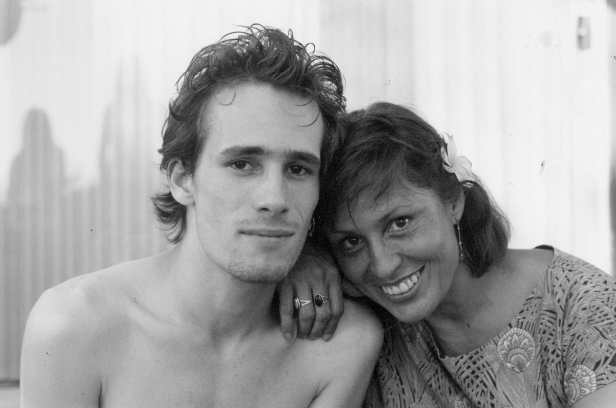
It’s impossible to gauge the effect of music (or a film or most art) that we experience at an impressionable age, and it’s not something that one who was not affected in the same way can always comprehend, such as people who revere “The Goonies.” However, director Amy Berg, of the revelatory 2006 Catholic Church expose “Deliver Us from Evil,” captures the magic of that sort of experience in “It’s Never Over, Jeff Buckley.” The film is a tribute to the late, beloved musician Jeff Buckley, one of People Magazine’s “Most Beautiful People” of 1995, who died by drowning at age 30 on May 29, 1997, leaving behind a generation of fans and music critics who had been touched by his artistry and singularly raw vocals. Berg interviews Buckley’s musician mother, Mary Guibert, who says that no one in her life loved her “better than he,” as well as his former girlfriends Rebecca Moore and Joan Wasser. Buckley recruited the latter to buy up every copy of People Magazine that they could find in their East Village neighborhood because he was so ashamed of being on its “beautiful” list.
Berg’s film is in effect an emo movie with lots of tears, declarations of love, naked feelings and animated visions of a body in free fall about an artist who put such a distinctive stylistic stamp on his and other people’s music that his version of Leonard Cohen’s classic “Hallelujah” is preferred by many to the original. A prodigy and inspired guitarist (he played several other instruments as well), Buckley was the out-of-wedlock son of the 1960s and 1970s folk rock singer Tim Buckley. He only met his father once as a child, and he is adamant that he is not connected musically to him at all. But his vocal style certainly recalls his father’s five-octave range. Buckley refers to Anaheim, where he lived as a boy, as a “hellhole.” His mother observes that both she and Jeff’s father came “from abusive homes.” She recalls that one of her son’s childhood favorites was Judy Garland’s “The Man Who Got Away.”
No commentary is necessary about that. But the film often feels like it is pushing an agenda: the idea that Buckley was another one of the beautiful losers fated to die young, sacrificed to our flaws. In one of the archival interviews, a journalist asks Buckley where he expects to be in 10 years. He says prophetically, “I don’t see myself in 10 years.” He also says that he does not want to end up like his father, who overdosed at age 28, with “a tag on my toe.” Aimee Mann, another friend, explains with sardonic exactitude how big record companies get young artists into debt and use that to control them.
Among his many musical influences are Led Zeppelin, Jimi Hendrix, Queen and Qawwali, the devotional Sufi music performed most famously by Nusrat Fateh Ali Khan. In a filmed meeting with Ali Khan, Buckley, who was a big fan, breaks into one of Ali Khan’s songs, much to the master’s delight. Buckley was also known to perform a cover of Edith Piaf’s “Je n’en connais pas la fin.”
He plays at an East Village bar, where he tries out new material and develops a growing following. After concerts, Robert Plant, Jimmy Page and Paul McCartney come backstage to meet and compliment him. Patti Smith and David Bowie heap praise upon him. Nevertheless, Buckley is plagued by imposter syndrome, depression and drugs. Someone ominously invokes the prematurely dead trio: Hendrix, Joplin and Morrison. Does Buckley deserve to be in their company?
During his career, Buckley only produced one studio album, the now legendary “Grace.” Columbia exerted pressure on him for a second, which he was working on at the time of his death. Brad Pitt, who wanted to play Buckley in a biographical film, is the executive producer of Berg’s documentary.
Berg uses existing footage, photographs, animation, photo montage, interviews and recorded phone calls to summon the spirit of Buckley. She creates a trembling mood, recreating the one conjured by his music. She summons a cinematic chimera, a bite of the madeleine of past time. But it is hard to paint a picture of him and the butterfly images at best do not work. Even the final musical clip in the film is his cover of Cohen’s “Hallelujah.” Still, “one of the greatest singers of all time” sings no more.
‘It’s Never Over, Jeff Buckley’
Rating: Not rated
Cast: Mary Guibert, Aimee Mann, Rebecca Moore, Joan Wasser
Director: Amy Berg
Running time: 1 hour, 46 minutes
Where to Watch: AMC Boston Common, Coolidge Corner Theater
Grade: B+


Comments are closed.