François Ozon delivers a haunting take on Camus’ existential landmark
By James Verniere/Boston Movie News
Boasting a fiercely indifferent Benjamin Voisin in the title role, Francois Ozon’s adaptation of Albert Camus’s “The Stranger” may signal both the belated birth of a star and a timely adaptation of a seminal work of existentialism. Living in a time when we feel forced to take a stand and cannot afford to be indifferent, we may find Meursault (Voisin), Camus’s expensive wine-named French-Algerian anti-hero, a bit absurd himself. The film is a faithful, sensual and visually striking— with alternately stark and dream-like black-and-white photography—adaptation of Camus’s groundbreaking 1942 novella.
The action begins with a flash forward to the protagonist in jail for murder. We then flash back to the day the chain-smoking, fit and handsome Meursault receives the fateful telegram informing him of his mother’s death at the nursing home where she has lived with his financial support for a few years.
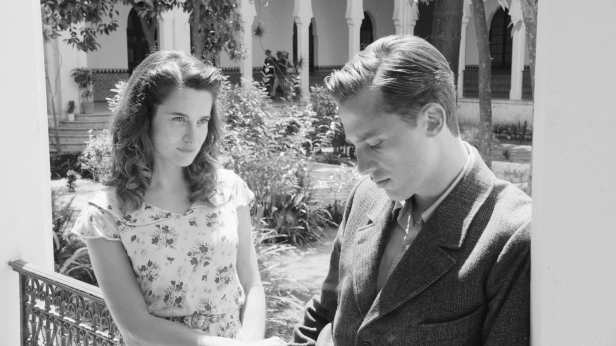
He receives the news with no emotion, washes, shaves, dons a suit, black tie and armband, and takes a bus to the home. He expresses no grief as he sits in vigil before his mother’s pine casket, while an old man, introduced as his mother’s “fiancé,” weeps openly. A sullen Meursault marches behind the horse-drawn hearse during a Bergman-evoking procession to a Calvary-like hill beneath a blazing sun.
Back in Algiers, where he has been given two days off from his office job for his mother’s funeral, Meursault goes to the beach, where he meets a pretty typist named Marie Cardona (Rebecca Marder of Ozon’s “Mon Crime”). They swim and sunbathe together and go to the movies, where they see “Le Schpountz,” a 1938 comedy about a deluded young man (horse-faced comedy star Fernandel) who believes that he could be a film star directed by Marcel Pagnol. Le spountz, indeed. Camus’s choice of a film is surely a comment on his arguably “deluded” protagonist.
Meursault and Marie become lovers and also become involved with Meursault’s brutish, but affable neighbor Raymond Sintes (a memorable Pierre Lottin), who takes them to a beach house owned by a friend, where they encounter Moussa Hamdani (Abderrahmane Dehkani), the Algerian brother of Raymond’s mistress (Hajar Bouzaouit), whom Raymond has physically and sexually abused.
In many ways, the sexual entanglements of Raymond mirror France’s colonization of Algeria. A series of incidental events, including a meal, lead to Meursault encountering Moussa alone on the beach with a gun in Meursault’s pocket. Mousa brandishes a knife. Meursault fires once, arguably out of fear, hitting Moussa in the chest, and then inexplicably fires another four times. Because this is a film by Ozon, the male-on-male encounters, including the shooting itself, reverberate with homoerotic tension.
Also among the film’s characters is a disheveled and dyspeptic old man named Salamano (French film icon Denis Lavant), who abuses his equally old and squalid dog but becomes almost sympathetic when he loses it and is utterly distraught over the loss of his companion.
Voisin, who played one of the two young, gay lovers in Ozon’s “The Summer of 85” (2020), may be a bit too good-looking to play a man most readers picture as a cipher. But he is quite good at projecting Meursault’s sense of life’s absurdity, a major existential theme. He also evokes Melville’s immortal Bartleby of “Bartleby the Scrivener: A Story of Wall-Street,” although Meursault’s constant refrain is not, “I would prefer not to.” It is the more philosophical, Kantian “I do not know.” It is the enormously unromantic answer he gives Marie when she asks him if he loves her.
The second half of “The Stranger” is a courtroom drama in which the prosecutor (the excellent Jean-Charles Clichet) tries to undermine Meursault by highlighting his seemingly heartless behavior and lack of sorrow at his mother’s funeral in order to make the sweaty courtroom spectators hate him. Moreover, Meursault is his proverbial own worst enemy in his testimony and his seeming lack of interest in the goings-on. Voisin’s Meursault acknowledges the meaninglessness of life to the utter disdain of the angry, crowded onlookers. He cannot explain why he shot Moussa. Seeking an explanation, he offers that he is being tormented by the heat and the sun.
Unlike Gillo Pontocorvo’s landmark semi-documentary film “The Battle of Algiers” (1966), we don’t get much of a sense of the history of French colonialism in Algeria in “The Stranger.” We see a sign reading, “No Indigenous,” at the movies and sense a seething hatred and scorn between native Arabs and the French-descended population. Camus’ “The Stranger” has been adapted three times now. The first adaptation was an Italian film directed by Luchino Visconti and starring Marcello Mastroianni and Anna Karina, no less. The second film was the award-winning 2001 Turkish drama “Yazgi,” which I have not seen. In addition to a fine score by Fatima Al Qadiri blending electronica with Arabic instruments, Ozon makes fitting use of The Cure’s 1979 song “Killing an Arab” over the end credits. When Meursault is confined in prison, awaiting news of his appeal, which, if it fails, will lead him to the guillotine, he comes across like the existential version of Edmond Dantes of Dumas’ classic “The Count of Monte Cristo.” Unlike Dantes, however, we do not like Meursault, who seems as much a product of Kafka as Camus. He is merely human and an unfathomable mystery.
‘The Stranger’
Rating: Not Rated
Cast: Benjamin Voisin, Rebecca Marder
Director: Francois Ozon
Running time: 2 hours, 2 minutes
Where to Watch: In theaters
Grade: A-

