Matt Damon anchors an awe-inspiring retelling of Homer’s epic
By James Verniere/Boston Movie News
Christopher Nolan’s “The Odyssey,” an adaptation of one of the greatest and most influential stories in Western civilization, is a remarkable achievement. Shot for the first time ever entirely in IMAX by Academy Award-winning and frequent Nolan collaborator Hoyte van Hoytema (“Oppenheimer”) in six countries from Morocco to Iceland and on the open sea, the film is an enthralling, super-deluxe retelling of Homer’s epic poem with a star-studded cast led by Boston’s own Matt Damon. As others have pointed out, “The Odyssey” is Nolan’s “Lawrence of Arabia.”
The warrior-king of Ithaca, Odysseus, is the haunted chief engineer of the flame-engulfed, throat-slashing, tower-tumbling sack of Troy that we glimpse throughout the story in flashbacks (and which connect this epic to Homer’s earlier classic “The Iliad”). “The Odyssey” is the tale of Odysseus’ decade-long attempt to return to his beloved island home and wife Penelope (Anne Hathaway) and coming-of-age son Telemachus (Tom Holland). Mother and son are victimized by Ithacan suitors, who squander Odysseus’ family fortune by depleting stores of wine and food and engaging in sexual relationships with Penelope’s women servants. The suitors want Penelope to accept that Odysseus is dead and to remarry one of them, thereby making him regent (and possibly the father of a future heir). Their leader, Antinous (a fun, fittingly loathsome Robert Pattinson), who is involved in a liaison with the beautiful servant Melantho (Mia Goth), also schemes to have Telemachus killed. Penelope delays making her choice by working on a shroud she must finish, only to unravel her work every night.
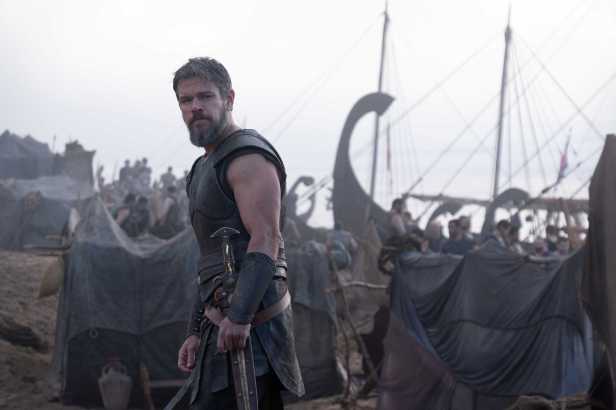
Adapted by former literature major Nolan, “The Odyssey” offers a weird and at times notably not-quite-congealed mix of realism and contemporary jargon with magical creatures and beings (like Zendaya’s rather dull Athena) and battles, featuring war helmets that would make Dr. Doom swoon.
Unlike “Ulysses,” the underappreciated 1954 Italian adaptation by Mario Camerini, featuring a terrific Kirk Douglas in the title role, “The Odyssey” seldom reconciles its realistic approach with its supernatural elements, and at times the sound overwhelms the dialogue (a not-unusual occurrence in a Nolan film). But the spectacle (production cost a reported $250 million) is here, and Damon and Hathaway excel as the loving couple torn asunder by events out of their control.
From an island of the dead recalling scenes from Peter Jackson’s “The Lord of the Rings” to the horrible result of sailing within reach of the ravenous jaws of Scylla, this “Odyssey” is a visual wonder. Fight scenes are exciting and brutal, especially those with the giant, armor-clad (and unidentified) Laestrygonians. But some action is at times too rapidly edited by Oscar-winning Jennifer Lame (“Oppenheimer”). The dreaded shaky-cam comes back from the dead and is an unwelcome specter indeed. But on the whole, Nolan lives up to his reputation as an artist who delivers a sense of wonder in his work from “Oppenheimer” to “Interstellar” and his Dark Knight trilogy.
Homer’s Bronze Age epic inspired everything from James Joyce’s “Ulysses,” several operas, poems such as Tennyson’s revered “Ulysses” and Margaret Atwood’s “Siren Song,” paintings by such artists as Herbert James Draper and Arnold Bocklin, as well as a cottage industry of recent YA bestsellers, including Madeline Miller’s “Circe.” It has inspired several big and small-screen adaptations as well.
Nolan had a bigger budget to work with than anyone before him, and it is up there on the screen, as they say. Storms at sea have rarely been as terrifying. Nolan removes Odysseus’ father, Laertes, and cuts Elpenor and Nausicaa from the story as well. An emotional John Leguizamo arguably steals the film as Odysseus’ loyal, long-suffering, blind herdsman Eumaeus. There are times when Damon is upstaged by his beard. He is best as the disguised beggar abused by suitors and about to reveal his true identity. In these scenes, Damon delivers the deeply flawed, long-lost hero we crave in these dark times.
Indeed, the final slaughter is the purgative jewel in the crown of Nolan’s almost three-hour adaptation. Bill Irwin’s earlier, shadow-cloaked Cyclops is a complete fright, evoking Goya’s shocking masterpiece “Saturn Devouring His Son.” The dog Argos’ loving recognition of his master is a sweet prelude to murder. It’s easy to believe that Lupita Nyong’o is both Helen of Troy and her fatal twin Clytemnestra. Those giant Laestrygonians and Circe’s messy transformation of Odysseus’ men into swine veer close to the shores of Monty Python. The surprisingly languorous sirens are a disappointment. The iconic Trojan Horse makes its (funny?) entrance, aping a certain Statue of Liberty. Images of Troy’s ruination recall lines from W. B. Yeats’ 1923 sonnet “Leda and the Swan.” Why would anyone want to leave Charlize Theron’s Calypso? We know that Hathaway can turn on the waterworks. Holland’s somewhat bland Telemachus (a reflection of the epic’s repeated line, “Few sons are the equals of their fathers”) is nonetheless sympathetic, principled and brave. Some things, admittedly, work better than others in Nolan’s “The Odyssey.” But his version of Homer’s classic is an absolute must-see.
‘The Odyssey’
Rating: R for violence and some language
Cast: Matt Damon, Anne Hathaway, Tom Holland, Lupita Nyong’o
Director: Christopher Nolan
Writers: Nolan, Homer
Running time: 2 hours, 52 minutes
Where to Watch: In theaters
Grade: A-

