Sandra Hüller gives a commanding performance as Thomas Mann’s daughter in Pawel Pawlikowski’s haunting portrait of family, exile, and postwar Germany.
By James Verniere/Boston Movie News
The title “Fatherland” suggests so many things. In “Fatherland,” the post-WWII, German-English-and-French-language road movie by Poland’s Pawel Pawlikowski of “Ida” and “Cold War” fame, it means at least one’s relationship to the land of one’s origin. In the case of Nobel Prize-winner Thomas Mann (Jean-Luc Godard favorite Hanns Zischler), the author of “Buddenbrooks,” “Joseph and His Brothers,” and “Death in Venice,” that land is Germany, where the aristocratic artist was born and where he lived when he was awarded the Nobel Prize in Literature in 1929. Mann famously relocated to Switzerland after Adolf Hitler rose to power in Germany. The Germany Mann returns to in “Fatherland” in 1949 has been devastated and defeated by the Allies and divided into a Soviet East Germany and a U.S., French and British German zone in the West. Germany’s postwar miracle (Wirstschaftswunder) lies ahead.
The film “Fatherland” is a fictionalized account of Mann’s return to his birthplace. The occasion is the 200th anniversary of the birth of Johann Wolfgang von Goethe. Mann, along with his scholarly and multilingual adult daughter Erika Mann (Sandra Hüller), has been invited to return to his fatherland and deliver a series of lectures about Goethe. Meanwhile, Erika is on the phone with her beloved, rakehell brother Klaus (August Diehl), who has apparently just had sex with another man and is on some sort of drug(s). He looks like he popped right out of an Egon Schiele self-portrait.
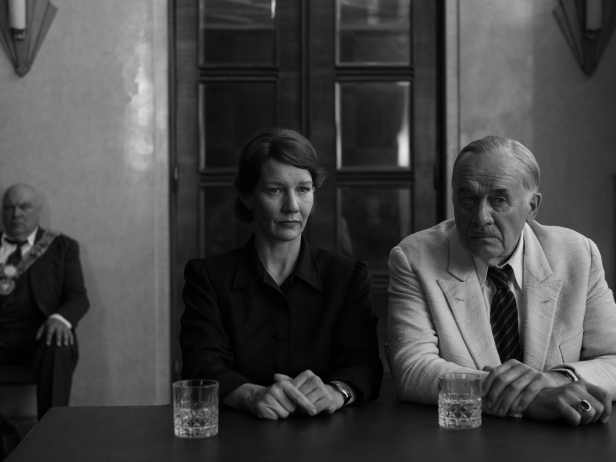
Shooting in a square aspect ratio and in black-and-white, Pawlikowski, who was named best director at Cannes, presents his third take on post-World War II Europe and shows us a kind of otherworldly time capsule. Like “Ida” and “Cold War,” which were also shot in black-and-white and in the 4:3 Academy ration, “Fatherland” suggests the fading rectangles of time we find in our grandparents’ photo albums. How complex is the gender politics between the great father and lesser daughter. He is the author of masterpieces. Erika, who is also a writer and served as a war correspondent for the BBC, is her father’s manager, caretaker, barber, chauffeur as well as Klaus’s loving sister.
Father and daughter arrive first in Frankfurt, which is occupied by the Americans and where she meets a CIA agent aptly named Quint (David Menkin). A military motorcycle traverses the screen. Mann pere is introduced to the Lord Mayor. Reporters from all over the world gather for a press conference. Will the great artist, who has lived in the U.S. since 1942 in Princeton-adjacent New Jersey and then Pacific Palisades, CA, visit Soviet-occupied Germany after HUAC has already given him such a hard time?
Erika translates French and English into German for her father. (Hüller is also fluent in those languages). In their hotel rooms, Erika shaves her father’s enormous face. It is as if he has already transformed into a giant effigy of himself. One is reminded of Sylvia Plath’s monumental 1962 poem “Daddy,” in which another young woman confronts a bigger-than-life father.
Shortly into the tour, Erika and her father learn that Klaus has died in Cannes by his own hand of a drug overdose. Devastated, Erika wants to interrupt the tour and attend the funeral. Her father, who has had a distant relationship with his eldest son, does not. He dismissively describes his son’s death as “the suicide of a drug addict.” We catch glimpses of posters for a stage production of “Faust.” Did Mann make a pact with the devil? In a dream, Mann sees windblown leaves falling into an open grave.
Do the great fame and acclaim of the father further muddy the dark waters of a blood relationship? Yes. Mann shares a bottle of Armenian brandy—“Stalin’s favorite!”—with a Soviet General. Erika, who famously married British poet W.H. Auden after the Nazis took away her right to claim Germany as her fatherland, slaps a man in the face at the hotel bar. What churning emotions does Hüller’s mask-like expressions hide? Hüller’s face could be molded in bronze or carved in marble. In a Bergman-esque interlude, Erika wanders around a sculpture garden. We recall that in Hüller’s breakout film “Toni Erdmann” (2016), she played another adult woman with a complicated, if not failed relationship with an impossible father. Erika pilots her father in “Fatherland” around in a big, black Mercedes-Benz chariot. Someone mentions “Mephistophelean dialectics,” and children in uniform sing of “peace” and “crushing foes.” It ends with a wallop of chiaroscuro and on a note of harmony and reconciliation.
‘Fatherland’
Rating: Not Rated, Profanity, mature content
Cast: Sandra Hüller, Hanns Zischler, August Diehl
Director: Pavel Pawlikowski
Writers: Pawlikowski, Henk Hangloegten
Running Time: 1 hour, 22 minutes
Where to Watch: In theaters
Grade: A-

